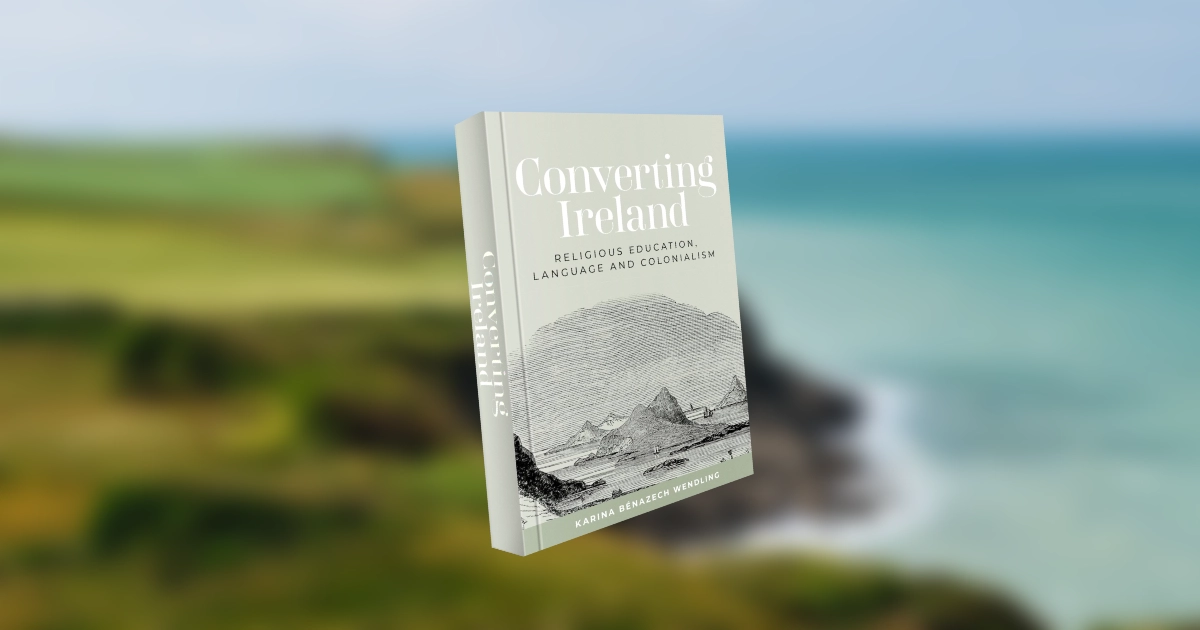
Converting Ireland: Religious education, language and colonialism
Karina Bénazech Wendling
Manchester: Manchester University Press
2026
336 pages
ISBN: 978 1526181206
Converting Ireland: Religious education, language and colonialism examines some of the most contentious issues in religious history in Ireland, namely the evangelising and humanitarian efforts of various Protestant groups in nineteenth-century Ireland, including during the Great Famine. The author is Karina Bénazech Wendling, Senior Lecturer at the Université de Lorraine, who credits her French Huguenot heritage as part of what inspired her interest in Irish history. Her book is divided into three parts. The first section provides an introduction to the broader education issue in Ireland, setting the scene for the establishment in 1818 of the Irish Society for Promoting the Education of the Native Irish through their Own Language, more commonly known as the Irish Society. Part Two delves into the Protestant missionary efforts more deeply, with a particular emphasis on the “Dingle Colony” of Protestant converts, who found themselves ostracised by their Catholic neighbours. Part Three concludes with a look at the vexed question of “souperism”, and the widespread belief that some Protestants offered food assistance to impoverished Catholics during the Famine on the condition that they forswore their religious beliefs.
It is surely interesting subject material, but for a number of reasons, Wendling’s narrative never really catches fire. She goes to some considerable efforts to contextualise the actions of the main protagonists, for instance, by highlighting the patriotic bona fides of the Sligo-born Baptist convert Thaddeus Connellan, who is portrayed here as the driving force within the Irish Society. According to a government report, Ireland contained 500,000 monolingual Irish speakers in 1825, along with another million or so people whose primary language was Gaeilge. As the era of the Penal Laws came to an end and as a state-led education policy took shape, Christians of all churches were concerned about widespread poverty and illiteracy. Translating the Bible into Irish and giving Irish-speakers the ability to read it was part of the solution which was proposed. At least some of those involved in the Irish Society were sincere. Its committee declared that the organisation was “doing a work which is in its nature truly Catholic,” and in public speeches, the Irish Society’s spokespeople advocated the “promotion of Christianity,” rather than any individual creed. Some Catholic schoolteachers were given permission by the Church to work in the Society’s schools. Yet for a variety of reasons, the ecumenical spirit did not survive.
A year after Catholic Emancipation in 1829 (with the timing being acknowledged here to be no accident), the Irish Society changed course by openly backing the use of the native language to proselytise. As one contemporary writer put it: “Protestantism [had] quitted the vantage ground of privilege and power, to descend into the arena of equal contest.” This was surely a tumultuous period for a fast-changing and fast-growing population, and some readers may be surprised at the extent of the Protestant inroads, which even led to several families on the Blasket Islands abandoning Catholicism. Ultimately, the “Second Reformation” launched by the bellicose Protestant Archbishop of Dublin in 1822 did not have a meaningful impact on Irish society. Catholicism continued to grow in strength while Protestantism continued to diminish. The section of this book which deals with “souperism” is the least interesting part of what is at times a rather lifeless work of history. In particular, the Famine-era activities of the viciously anti-Catholic Anglican cleric Alexander Dallas are given insufficient attention.
Wendling does not explore the political aspect of Protestant conversion in depth, but what she does reveal (sometimes as if by accident) demonstrates how this religious process was inextricably linked to the national conflict. The founders of the Irish Society were not all anti-Catholic, but their Anglicising intentions were clear. In her cursory overview of English educational policy in Ireland from the Tudor era onwards, Wendling notes that the establishment of parochial schools from 1537 onwards stemmed in part from “a desire to assimilate and acculturate Catholic populations.” Similarly, Wendling explains that the aim of the Protestant charter schools established in the first half of the eighteenth century was “to anglicise the population and encourage conversion to Protestantism, in some cases through extreme means such as separating children from a ‘corrupting family environment’ and their institutionalisation.” When seeking support from British colonial administrators for the Irish Society, Connellan suggested that its work would serve to counteract the “strongest mental control” exercised by the Catholic clergy. He went even further in promising that the development of this kind of Protestant education would make the Irish “loyal, industrious and happy, like very many of the more-enlightened and better-informed brethren…”
Minor episodes like this highlight the colonial mindset of those involved in the Irish Society and related groups. One of Connellan’s educational works included a map of the world, in which no reference to Ireland was made, but where the words “British Isles” were wrapped carefully around the two islands. The Irish Society clearly saw education as a means of advancing Protestantism. Meanwhile, British government figures saw the creation of a state-controlled system of non-denominational schooling post-Emancipation as a means of advancing Anglicisation. Faced with these threats, the Catholic hierarchy provided stiff resistance, with the “Lion of the West” Archbishop John MacHale deserving particular praise. Then and now, Catholic leaders have recognised the importance of what is taught to young minds in a school setting, as have the Church’s many enemies. Indeed, both Catholic and Protestant appeared to understand what large-scale conversion would mean in the long-run, including when it came to the struggle for independence.
On each side of the Irish Sea, conversion to Protestantism was viewed as a political act. The Dingle converts were reported to have sung “God Save the Queen” with much enthusiasm during Queen Victoria’s visit in 1849, and the British establishment – including Victoria’s mother, the Duchess of Kent – donated large sums to support the new Protestants of West Kerry. In today’s era of inter-religious reconciliation, it is considered uncouth to dwell upon the previous cruelties inflicted by one group upon another. But there is no merit attached to writing a book which examines those sensitive chapters in a way that fails to provide either necessary context or new insights.
From the Tudor Reformation onwards, Britain’s war against Ireland was political (the denial of the right of the Irish to choose their own government), economic (the theft of the land), cultural (the replacement of the Irish language and culture, mainly achieved through the education system) and religious as well. That last component was arguably the most important of all, and it was here where the British suffered their most serious defeat. Ireland could not be converted, and because of that fact, it could never be subsumed into the United Kingdom. This chapter of the national struggle deserves closer study, as do the roots of today’s national school system, but this book offers little to a reader eager to learn more.
James Bradshaw
James Bradshaw writes on topics including history, culture, film and literature.