
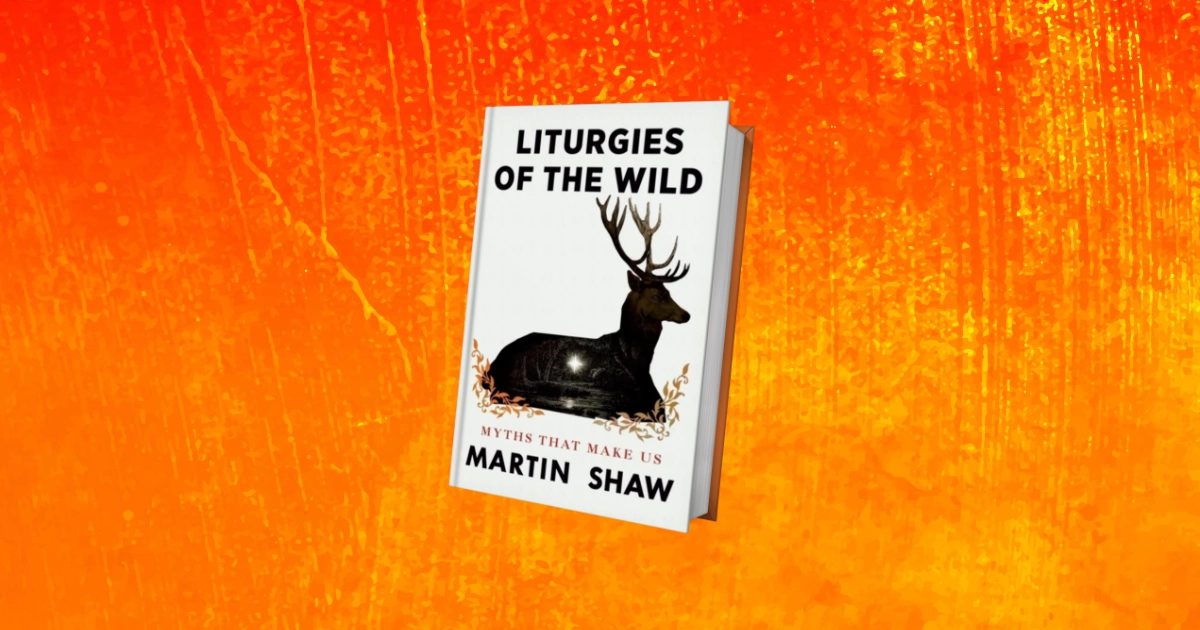
Liturgies of the Wild: Myths That Make Us
Martin Shaw
Ebury Vine
2026
246 pages
ISBN: 9781846048913
Martin Shaw, the English mythographer, writer and scholar, has produced a weird and wonderful book in Liturgies of the Wild. He’s worn many hats over his career – musician, wilderness guide, academic – but it is now five years since he converted to Orthodox Christianity and was baptised into the Eastern Orthodox Church. This, as it usually does, changed everything. Liturgies of the Wild, then, feels like the culmination of a long and colourful journey. It is part memoir, part myth-manual, part life-guide, but really Shaw is spinning a yarn which he feels we urgently need to hear: the story of how a person becomes a proper, grown-up person.
If your discerning literary hackles are now raised, you’re right – this is a kind of literary Trojan Horse disguising yet more rules for life, still further measures of stiff upper lip self-help. Tidy your room and all the rest. But the difference between this and other books in the genre is the fairytales and folktales at the heart of it. The chapters themselves focus on various topics – On Bones, On Prayer, On Death, etc. – but there is always a story to accompany and illuminate them. Whether he is reflecting on nights spent camping in a Dartmoor forest, or on dreams of red-eyed angels, or on teaching a retired assassin how to pray, Shaw is a pleasure to read. He has a wonderfully frank prose style, conversational and charming, rich in metaphor and allusion. The reader might well be seated next to him in an armchair by the fire, brandy in hand, or traversing a misty hillside. His words carry the clear ring of authenticity. This is a man who has lived a whole life.
A whole life is what he wishes for the reader. Shaw claims we live in a “myth-impoverished” world, and that without a healthy dose of stories and fairytales, we have little hope of becoming complete men and women. A given culture’s mythology and folklore are supposed to provide implicit principles by which we might live, furrows in the soil to show us where others have strayed or succeeded. Without these, we are liable to adopt any old story and may find ourselves choosing one which at best does not help us flourish and at worst leads us down dark paths. Stories are “ancient technologies”, claims Shaw, with all the power the term conveys. They are phenomena worthy of our respect and consideration.
As you might expect, Shaw is a most accomplished storyteller. One memorable narrative concerns a young hunter astride a wise and trustworthy horse. Out in the forest, he comes across a firebird’s feather. His horse warns him that should he choose to pick up the feather, he will come to know fear and trouble. Troubled, the hunter decides that a foolproof way around this conundrum – since he really wants to pick up the feather – is to take it but give it straight to his king. Needless to say, this turns out not to be as simple as it seemed, and fear and trouble indeed follow. The hunter will cross many miles and undertake many challenges as a result of this decision. Wise horses ought to be listened to – though the story also suggests fortune favours the bold. The reader will make their own mind up.
The unpicking of these tales to make them comprehensible to the reader is somewhat less interesting and Shaw kind of admits this, prefacing some of the explanations with disclaimers. Stories like these are delicate things, liable to lose their power in the explaining. Flannery O’Connor once remarked that:
[a] story is a way to say something that can’t be said any other way, and it takes every word in the story to say what the meaning is. You tell a story because a statement would be inadequate. When anybody asks what a story is about, the only proper thing is to tell him to read the story. The meaning of fiction is not abstract meaning but experienced meaning, and the purpose of making statements about the meaning of a story is only to help you experience that meaning more fully.
It’s a delicate balance; to be fair to Shaw, it seems unlikely he could have written such a book as this without a bit of critical analysis. He may at least be providing the reader with a methodology for understanding future stories they encounter, and that is something.
More intriguing, however, is the paradigm Shaw identifies across the world’s folk tales, which he describes as “Severance, Threshold, Return.” It will be familiar to English Literature graduates who studied Campbell’s “Hero’s Journey.” Severance is something like a call to adventure, an invitation to turn one’s back on the known and familiar world. Threshold is the most profound and challenging part of the journey – the darkest cave, the deepest waters, the highest mountain. Return means coming home, but coming home different. Return is viewing your original circumstances with the wisdom that Threshold has given you.
This is Shaw’s Return, having spent thirty years in the wilderness. It is striking that he does not now cast away his Native American wisdom and Saami narratives with the zeal of the recent convert, but chooses to see them in a new light. He invites the reader to imbibe the world’s stories with a discerning but receptive heart. It is through them that he found God knocking on – or indeed knocking down – his door. There is something so refreshing, so energising, about Shaw’s earthy, smoky Christian belief. He is a sincere Romantic and his call is to a life of flourishing and beauty. The vision he offers of the Christian life is exciting and generous. It’s reassuring to be told (by a man who has toured the world, lived for extended periods in a tent on the side of a hill and held a one-hundred-day vigil in a forest for his fiftieth birthday which concluded in a mystical vision) that what you are looking for might be right where you are. The call to adventure is not always glamorous but it might still save your life. We don’t necessarily need to go farther, but deeper, always deeper.
Liturgies of the Wild is a handbook for doing just that.
Luke Power
Luke Power is a writer and teacher living on the west coast of Ireland. You can find him on Substack under the title Out on the Western Plain.