
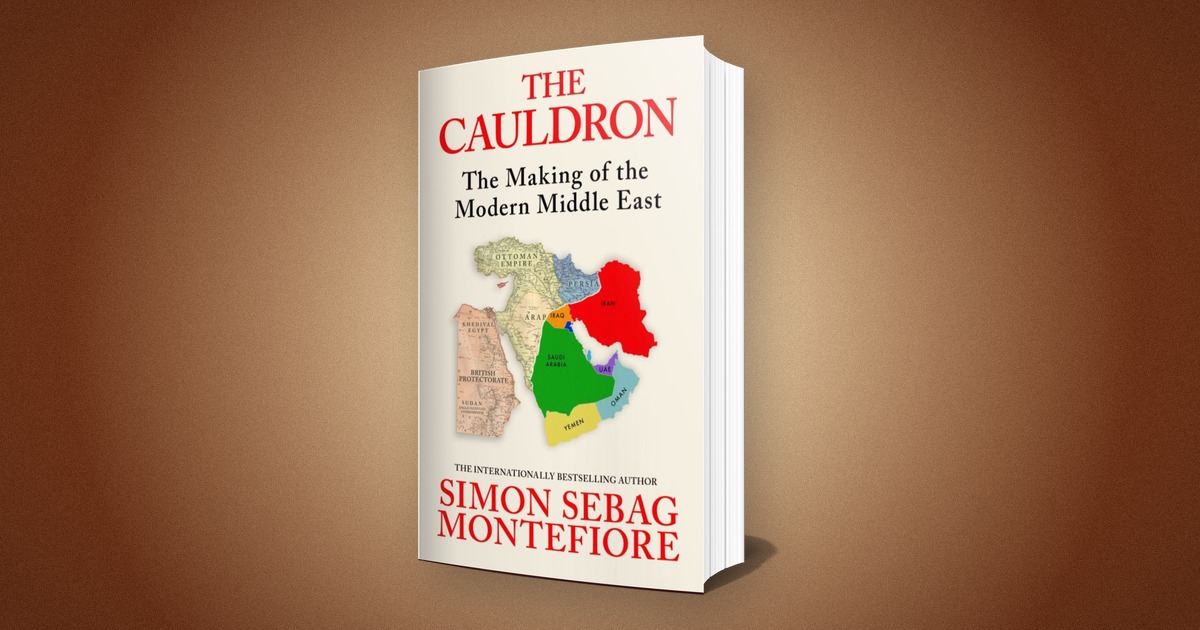
The Cauldron: The Making of the Modern Middle East
Simon Sebag Montefiore · Weidenfeld & Nicolson · 2026 · 528 pages · ISBN: 978 1399634908
As developments in the Middle East reach boiling point, a new book by the writer and historian Simon Sebag Montefiore provides a valuable overview of the region’s history from 1900 onwards. The Cauldron: The Making of the Modern Middle East is born of decades of study. Information is not referenced in the standard academic style: instead, Montefiore provides a lengthy bibliography listing the most important works on the various countries and themes addressed within. As a Jewish Londoner, the story is somewhat personal, but it cannot be labelled as polemical or unreasonably pro-Zionist.
The Middle East has arguably never played a larger role in Western politics than it does now. The intensity of the pro-Palestinian campaigners is remarkable, and is no longer confined to college campuses or far-left professional protestors. Montefiore does not appear to be seeking to change minds, but he is certainly trying to broaden them by examining the interlinking histories of those nations between Morocco and Iran. He points out early on that even the terminology is a minefield. Countries have different names, leaders have different ways of spelling their names and even the term “Middle East” is problematic.
Alas this complexity is not appreciated by the most zealous among us. Montefiore suggests early on that the post-Christian West’s obsession with the region is “the latest instance of Western ‘Orientalism’” and the latest example of the passion which previously sent Crusaders, missionaries and imperial administrators to the region to make it better. The presence of vast quantities of oil explains some part of the region’s prominence in political discussions elsewhere, but as the energy sector evolves, that explanation is losing some of its power. As the author points out, the presence of large and politically influential Muslim communities in many Western societies has helped to make the Israeli-Palestinian dispute a topic in domestic politics, and this is only likely to intensify in the coming years as these communities grow in number.
There is no point in pretending that religion is not part of many regional conflicts, and helps to make some more intractable than they would otherwise be. The region’s history, Montefiore writes, “is fused with theology and ideology to form an unbreakable rampart of absolutist faith that makes pragmatic resolutions extremely difficult. It is hard to negotiate maps and timetables with people who await the Mahdi or Messiah and the eschaton he will herald.”
In this bloody maelstrom, both leaders and followers are quick to see God’s hand in human disputes. Victories are seen as a sign of divine favour, as with Israel’s remarkable victory in the Six-Day War of 1967, which “gave rise to a reckless messianism and nationalist supremacism that led to the building of settlements in the West Bank and Jerusalem and a movement of religious maximalism that ultimately threatened the very existence of Jewish democracy.” Defeat also drives warriors to their knees. After Egypt’s humiliation by Israel in 1967, its new leader Anwar Sadat adopted a more consciously Islamist approach as he prepared for his surprise offensive against the Jewish state in 1973. Changing power balances between religious communities can also be deadly. After centuries in which the mighty Ottoman Empire was somewhat tolerant towards Christians, imperial decline in the late 19th and early 20th centuries encouraged Muslim radicals to carry out genocidal campaigns against the Armenians, the Greeks and the Assyrians.
Aside from religion, there are other reasons why a committed minority in the West is so fixated on this region, and one of them is surely postcolonial guilt. Every Noam Chomsky reader worth their (and not his or her) salt knows that the British and French divided much of the Middle East between them in the Sykes-Picot Agreement of 1916. Those progressives who passionately dislike their own countries are often eager to identify the cause of faraway problems as resting with their own ancestors, no matter how implausible this is. Middle Eastern history did not start with the British or French Mandates though, and neither did territorial demarcations and disputes, including among those who shared the same theology. In the same year that the British and French were carving up their spheres of influence, Ottoman Turks and Arabian tribesmen fought a major battle in Mecca itself, during which the Kaaba – the holiest structure in all of Islam – was struck by artillery fire.
Montefiore offers a qualified defence of the brief Mandate era of European domination, in which living standards improved and the foundations of today’s states were laid. He makes a striking claim that had the Europeans replaced the Ottoman territories with one unified Arab state, “it would probably have broken up fast and furiously.” Dealing in historical counterfactuals is never easy, but as with his claim that the best Arab rulers have been hereditary monarchs, there are strong grounds for believing this to be true. One has to reach back to the early caliphates after the life of Muhammad to find a truly united Arab world, and this (mercifully) did not last long.
There has been no unified Arab world in the period under consideration here. Egypt and Syria became one United Arab Republic in 1958, and then promptly split up in 1961. When the two countries went to war with Israel in 1973, their leaders had radically different war aims, with Egypt choosing to make peace afterwards. Arab powers are not as united regarding the Palestinian cause as many Westerners think they are, and several have experienced the worst consequences of Palestinian radicalism on their own soil too.
The Middle East is simply different, and believing that its governments or its people share the values of Europe or America is foolish. In so much of this region, might is still right. One of the most eye-catching quotes here comes from the founder of modern Turkey, Atatürk, who dismantled Western-imposed borders by force and declared that bayonets were what truly made a nation’s frontiers secure. Many Westerners speak and act as if they are atoning for the age of empire. Yet empire is a constant in the Middle East. The political project of the most successful Middle Eastern leader today, Turkey’s President Erdoğan, is the establishment of something akin to Ottoman Turkey.
In sharp contrast to the situation in the West, religion is of greater relevance to the politics of the Middle East than it was a generation ago, and Montefiore declares that we are living in the “age of revolutionary Islamism” since the all-important Iranian Revolution in 1979. What this has meant for non-Muslim minorities – especially Christians – across the region has been tragic. Montefiore notes that the Christian population in the region has fallen from 20% in 1900 to just 4% today, but devotes too little space to this, apart from his examination of Lebanon’s fracturing. It is hard to blame him. The world’s Christians have paid little attention to this process, so why should Montefiore? It did not need to be like this. Jews have been driven out of dozens of Middle Eastern countries since the Second World War, but they had Israel as a regional refuge. There is no comparable Christian homeland in the region, and there is little evidence that a strong sense of Christian solidarity exists either.
The Cauldron is a skilful synthesis which should assist any reader trying to understand what has been happening in the Middle East in recent times. There is no evidence that the widespread obsession with the region – and the cause of Palestine in particular – is going away, and Ireland is more afflicted than most nations.
Looking beyond this book’s contents, there are two uncomplicated pieces of advice which could be imparted to a Catholic reader pondering how to respond to all of this. Firstly, in order for the beleaguered Christian minority to survive, we need to do more. We should not be embarrassed to adopt a yardstick of judging governments by how they treat Christians and by how the Christian community is faring inside their borders. If the topic of a discussion is Israel, the fact that its Christian population has grown five-fold since that country’s creation should be foremost in our minds. The militant Islam which Hamas embodies should only ever be considered an enemy of the Church.
Secondly, if a moral criterion is being used for judging one country in the region, it needs to be applied to all of them. Israel is a new state, historically speaking. Its creation involved violence and the forced population movement, and intolerance on the part of the majority population has become a more serious problem over time. Yet the same can be said of many other countries in that region, including Turkey, which, like Israel, continues to occupy and settle territory belonging to its neighbour (in their case, Cyprus). Treating one country as the problem in that region is unjust and unwise. We cannot change this region from outside, and it is deeply narcissistic to think otherwise. Refraining from increasing the temperature is the only safe course of action.
James Bradshaw
James Bradshaw writes on topics including history, culture, film and literature.