
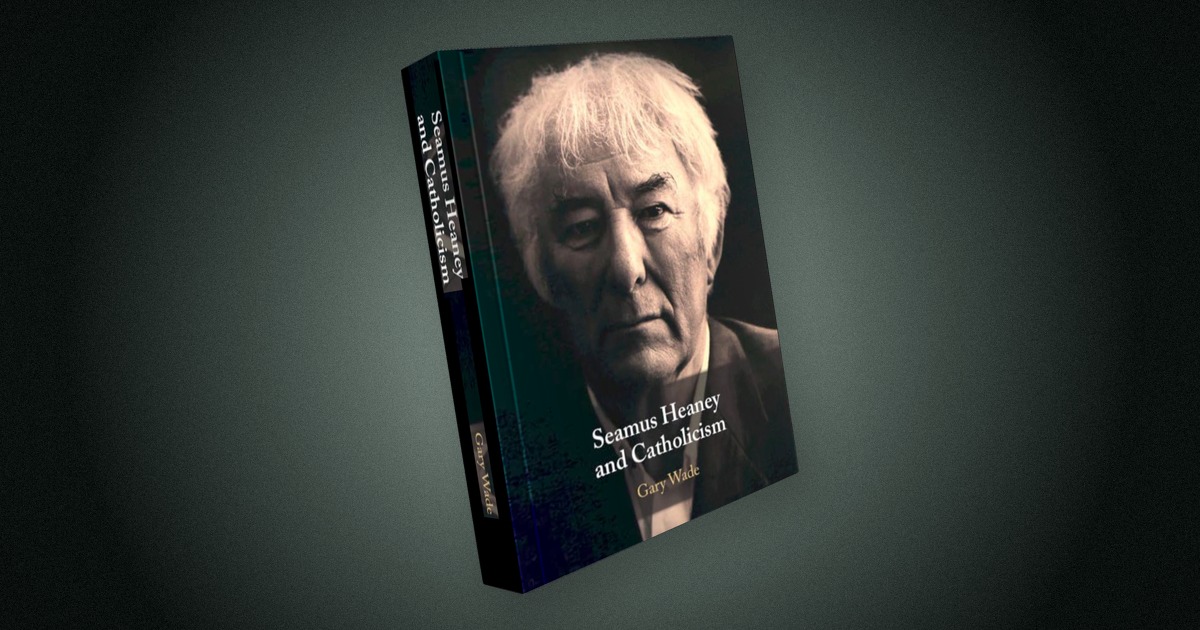
Seamus Heaney and Catholicism
Gary Wade · Cambridge University Press · 2025 · 248 pages · ISBN: 978 1009541343
Seamus Heaney is probably best known to Irish schoolchildren for his touching yet very bleak poem, Mid-Term Break, written in memory of his young brother who died tragically in a road accident. A staple of school textbooks, the poem risks colouring our initial impressions of Heaney as a poet interested mainly in matters morose and mournful, when his writings are far richer and more varied than this. Meanwhile, the critical tradition on Heaney has tended to focus, on the one hand, on his portrayals of the ordinary people, places and things of County Derry, and, on the other, as a Northern Irishman, on his engagement with the tense political situation he and his family lived through in the mid- and late-twentieth century. Awarded the Nobel Prize in Literature in 1995, the committee took a fittingly comprehensive view of his writings, praising them for their “lyrical beauty and ethical depth, which exalt everyday miracles and the living past”. The matter and cadence of Heaney’s poems can seem quite mundane, but a second reading often yields a shimmering transcendence beneath.
In Seamus Heaney and Catholicism, Gary Wade demotes the politics and the pastoral, which tend to prevail in Heaney studies, and takes Heaney’s Catholic upbringing as the lens through which to read his extensive poetic oeuvre. Like Heaney, Wade was educated at St. Columb’s College, Derry. Following studies at University College London and the Angelicum in Rome, he completed his doctoral thesis at Durham University. He is currently an adjunct lecturer at the University of Notre Dame in Sydney, Australia, and a contributor to The Cambridge History of Irish Poetry.
After initial chapters exploring Heaney’s formative childhood in Mossbawn, replete with the pieties and traditions of a twentieth-century rural Irish family, the book considers the Catholic resonances present in each of his collections of poetry. Wade sees Heaney’s 1984 Station Island as a turning point in his relationship with the faith, and he devotes a significant part of his book to this collection. In the poetry that followed in the nineties and noughties, Heaney’s “engagement with Catholicism is less fraught”, less orthodox, but, in Wade’s estimation, no less relevant.
One critic has described Heaney as a “devout lapsed Catholic”. While paradoxical, the idea is not entirely illogical. In an interview published in 2008, when asked “Once a Catholic, always a Catholic?” Heaney reflected: “I suppose so, because Catholicism provided a totally structured reading of the mortal condition which I’ve never quite deconstructed. I might have talked differently, certainly more diffidently, if you’d asked me about these matters thirty years ago, since I eventually did try my best to change from catechized youth into secular adult”. Heaney’s engagement with the faith was not sustained and linear, but it seems never to have definitively ceased either.
Heaney has spoken of how “from the time I was conscious, I was in a highly, not only Christian, but a Catholic environment. The house was full of holy pictures, the rhythm of the week was determined, not by anything secular, but by Mass and devotions”. In a 1995 interview he remarked that “what isn’t sufficiently acknowledged is the radiance of Catholicism. It gave everything in the world a meaning. It brought a tremendous sense of being, of the dimensions of reality, the shimmering edges of things. That never quite vanishes. The older I get, the more I remember the benediction of it all”. Even as Heaney’s relationship with Catholicism evolved, an underlying appreciation seemed to remain. Indeed Wade notes that among his correspondence, now archived at Emory University in Atlanta, “it was not uncommon for Heaney to mark out time by reference to the saints’ calendar”.
Wade writes that the poetry of Gerard Manley Hopkins exercised “the greatest influence on [Heaney’s] apprentice work”. He considers some early examples of Heaney’s verse, which bear the striking hallmarks of Hopkins’s sprung rhythm, compound words, and emphasis on stresses. Heaney himself described Hopkins’s unique idiom as “bumpy alliterating music”, and commented appreciatively on the connection between the “heavily accented consonantal noise of Hopkins’s poetic voice, and the peculiar regional characteristics of a Northern Ireland accent”. More than merely Hopkins’s language, however, as Heaney himself put it, “the height and depth of Hopkins’s understanding matched my own”.
The Jesuit poet, who had spent a number of years living (unhappily) in Ireland, helped to give shape to the voice and subject matter of Heaney’s early verse. Wade observes that “Hopkins’s treatment of rural and agricultural life, and the dignity it assumed in taking on a verse-life, appealed to the young Heaney”. Wade reads Hopkins’s “Felix Randal” in parallel with Heaney’s “The Forge”, one of his earliest sonnets. Both were written about individuals known to the poet, and both were blacksmiths – one a young man from Liverpool, the other a neighbour who lived near Heaney’s childhood home. Wade sees in these poems “the consecration of manual labour as a vocation”.
Published in 1984, Wade argues that Station Island is central to our understanding of Heaney’s complex relationship with the faith. The title itself refers to Station Island or St. Patrick’s Purgatory, the centuries-old place of pilgrimage on Lough Derg in Co. Donegal. Heaney himself had been there a number of times in his youth. The collection’s tripartite structure owes much to Dante’s Commedia. “Dante’s structure is reflected in the three-part journey scaled down […] into the three-day station which makes up the pilgrimage to Lough Derg”, Wade writes.
Wade observes that “from Field Work (1979) on, Dante becomes an increasing presence in Heaney’s work”. Dante’s unassailable status as Europe’s great Catholic poet allowed Heaney, in his own words, “to bring what was and is in Anglophone culture subcultural and ghettoised – that is to say, Northern Irish Catholicism – into touch with a europeanizing, classicizing influence, and thereby give it a much greater hegemony. […] Intellectually, if you like, it was a reminder that your experience which, in one way, is marginalised, in another has huge accreditation”. Dante granted a sense of legitimacy to Heaney’s Catholic-infused idiom, which found itself flourishing amid a historically WASPish Anglophone milieu. Dante, Wade writes, “allowed him to place his Northern Irish Catholicism within a wider European context and thereby credit his early religious experience”.
All well and good, except that Station Island, particularly its central section, also titled “Station Island”, appears to narrate the poet’s gradual loss of faith. It comprises a sequence of twelve poems in which the speaker encounters, in the form of Dantean shades and shadows, dead peers and acquaintances from his earlier life, and literary figures who were influential upon him. These include Patrick Kavanagh and Hopkins, whom Heaney meets early on, and James Joyce, whom he encounters at the end, and who urges him to dismiss his “peasant pilgrimage” and embrace a more wilful detachment from Church and country as he had done himself.
Wade acknowledges the “spirit of uncertainty” and “sincere spiritual quest” at work in the collection, but argues for a more subtle interpretation than outright rejection or subversion of the faith. Following his fellow pilgrims as they complete each “station” on the island, Heaney writes: “I knelt. Hiatus. Habit’s afterlife”. Wade unpacks the complex tensions between practice and disengagement here. Heaney kneels unthinkingly, out of habit, with the other pilgrims. But then he catches himself, pauses (“Hiatus”), and attempts to deconstruct the tight weave of action and intention that has accrued from a lifetime in the faith. The habit, increasingly losing the resonant significance with which intention and will could invest it, becomes merely another ghostly shadow (“afterlife”) among the others on the island.
Over the course of the sequence, Wade writes, Heaney “incrementally divests himself of a religious sensibility”. However, when asked in an interview if the poem helped him to resolve his own unclear relationship with Catholicism, he confessed that “I don’t think the poem resolves it. I was hoping that the book would end up as an act of faith or an act of unfaith and it doesn’t end up in either place. You want certitude but it is hard to find”. For Wade, “Station Island” is not a clear-cut disengagement from the faith, but an attempt to articulate “a more expansive version of Catholicism” for Heaney to inhabit. The collection “clear[s] a blockage so that he could move forward as a poet with a sense of inner and artistic freedom”. Heaney’s poetry in the decades that followed might be ambivalent on aspects of the faith, but was never tinged by Joyce’s attitude of derision.
The shades of Hopkins and Dante that inhabited Heaney’s earlier work found themselves giving way to Virgil in his later verse. Wade finds traces in Heaney’s final collection, Human Chain (2010), especially Aeneid VI, which Heaney was translating around the time he was preparing the collection. Heaney explained in an interview that “there’s one Virgilian journey that has been a constant presence and that is Aeneas’s venture into the underworld. The motifs of Book VI have been in my head for years”. Where once the Church offered definitive answers to death, judgement, heaven and hell, Heaney was now soliciting other voices too. Critics have offered various reasons for the appeal of Virgil’s writings to Heaney – the great Roman poet’s concern for the “lacrimae rerum”, the weight of the world and its sorrows; his status as a farmer-poet and his interest in the pastoral; his visionary writings, and concerns with the soul’s metamorphosis.
Given Heaney’s ongoing interest in, and work on, Aeneid VI, in his later years, Wade observes that “the questions with which Heaney’s Catholic sensibility were concerned […] remain foundational to his reading of Virgil”. These include the fate of body and soul after death, mourning and remembering the dead, and our existence beyond the material world. Even in Heaney’s later work, then, Wade finds “the occasional rising to the surface of the Catholic rituals of Heaney’s childhood even as he turns to a Classical poet to engage with questions which arose out of that early religious sensibility”.
Seamus Heaney and Catholicism is a well researched and carefully written exploration of this contemporary poet’s evolving relationship with the faith. Wade is knowledgeable and his writing is lucid throughout. From the “dolorous murmurings of the rosary” in childhood, as Heaney so evocatively expressed it, to Virgilian frames of reference in later life, Wade finds fascinating “strayed affections of [Heaney’s] childhood faith” shimmering throughout his life and writings to the end. Perhaps we should recall that interviewer’s pithy question once more: “Once a Catholic, always a Catholic?” As Heaney himself put it, whether in resignation or acceptance, “I suppose so”.
Luke Power
Luke Power is a writer and teacher living on the west coast of Ireland. You can find him on Substack under the title Out on the Western Plain.