
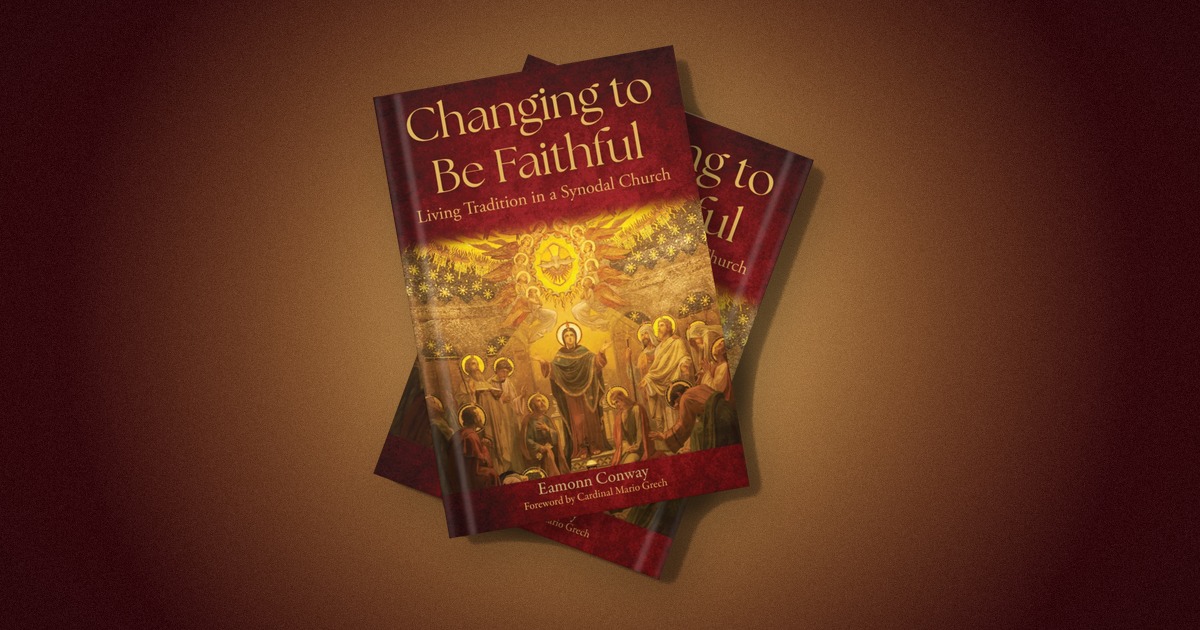
Changing to Be Faithful: Living Tradition in a Synodal Church
Eamonn Conway · Messenger Publications · 2026 · 176 pages · ISBN: 9781788127301
Eamonn Conway’s book offers a comprehensive, insider’s view of the Synod on Synodality’s journey to date, since its inception by Pope Francis through the various stages of engagement at local, national, continental and universal levels. He brings authority to the task as a respected academic and appointee of Pope Francis as expert adviser to the Synod of Bishops on the subject.
The book breaks into two sections, looking in turn at the structural dimension that enables a more participatory Church and the process to apply the truths of faith in a way that speaks to our time. Underlying the synodal concept is an understanding of tradition that is “dynamic, not static,” yet doesn’t compromise the “identity of truth.”
The Holy Spirit guides the Church, understood with new emphasis since Vatican II as “the Holy People of God,” rather than the hierarchical governance tasked with serving it. In every era, the Church reads “the signs of the times” and discerns in a conversation that draws on “theology, the magisterium and lived experience.” The Synod on Synodality sets out to draw the entire body of the faithful into that conversation.
For Eamonn Conway, the Synod continues the work of the Second Vatican Council and its recovery of a more active missionary Church, directed towards engagement with the Gentiles. The inculturation of the Gospel amongst other peoples through changing human history is the Church’s core endeavour, one begun by the Council of Jerusalem. It requires dialogue and engagement with all the baptised who also share in the triple office of Christ as prophet, priest and king. It is the duty of the clergy to support the laity “in the exercise of their baptismal ministry in its diverse forms.”
Eamonn Conway emphasises the infallible “in credendo” character of “the whole people of God.” The “sensus fidei” emerges in “a prayer-filled listening process” and allows us to hear “what the Holy Spirit is asking of us in our time.” The question “what is the Holy Spirit asking of us in our time?” has become something of a synodal mantra.
The process of discernment needs appropriate structures as well as a correctly oriented disposition. The question “Who sits at the table?” is a key one, obviously. It is when we move from theory to practice that the scepticism expressed by many towards the synod process isn’t so easily dismissed. If those invited to the table include those who are “uncomfortable with prayer,” there will clearly be difficulty in enabling “prayerful dialogue leading to consensus,” through which the Holy Spirit’s “unmistakable voice” is heard. For Eamonn Conway, the lack of experience in openly expressing views on faith issues at parish level can leave people hesitant to speak, which gives rise to the danger of taking “silence for consent.” Other difficulties he identifies to the integrity of the process are “ego, agendas and insufficient research.”
According to Eamonn Conway, 5 to 8 per cent of Catholics participated in the initial consultative process. In Ireland, participation is estimated at 1.5 per cent, from statistics published in 2022, following initial meetings across the country’s dioceses. However, low uptake does not mean engagement was unrepresentative of the body of the faithful, he says. This claim is questionable, not because of the high numbers of those who stayed away but because of why they chose to. A random selection of 5 to 8 per cent can be considered a reliable sample in an opinion poll. In this case, however, many who opted not to participate feared the Synod had an unacknowledged programme to “harmonise Church teaching with new social mores.” Issues highlighted in Ireland and the Western Church in the run-up to the Synod indicated a desire and a will to change the Church’s stance on homosexual relationships and marriage. Interestingly, the issue of contraception never surfaced at all, whether as something to be challenged or defended.
Despite such observations, it can be conceded that the priorities identified by those who participated probably did speak for the majority of a typical Sunday congregation. Reflecting perhaps the sensus of the prevailing culture rather than the “sensus fidei,” Synod participants raised issues like the difficulties facing women “in following pathways of holiness that God has laid out for them,” the Church’s “draconian” teaching on divorce and an atmosphere “where abuse of gay people is tolerated.”
While the concerns listed may speak for the majority of Irish Catholics who make up the Sunday congregation on most weeks, they diverge radically from the concerns expressed by the Zimbabwean synod, an example offered in the book. Not only are the issues raised different, but they come with a very different kind of understanding of what God is calling the Church to do in our time. The Zimbabwean list includes “prisoners, the homeless, the housebound, the blind, the disabled, those in polygamous relationships, single parents and street kids.”
The differences between countries like Ireland and Zimbabwe are indicative of more than their respective socio-economic and political circumstances. The Zimbabwean priorities, unlike some of the Irish ones, for instance, are pastoral and don’t challenge Church teaching and tradition. Clearly, when different parts of the universal Church come with such different concerns and mindsets, there can be no easy path to consensus-building.
Because co-responsibility is now qualified as “differential co-responsibility,” final “decision-taking” remains entrusted to the Synod of Bishops under the Pope. It is for them to discern what the synthesised report from the deliberations of regional assemblies is asking of the Church and to discern within it the voice of the Holy Spirit.
The “decision-taking”/”decision-making” distinction is a somewhat opaque rendering of the “consultative”/”deliberative” distinction people are familiar with from parish pastoral councils. The Synod offers a new emphasis, however, in saying that “thinking synodally” requires final “decision-taking” to respect the discernment offered by the global faithful “as the authentic voice of the Holy Spirit.”
There is, of course, the important proviso that the discernment process through the various stages of synodal assemblies was undertaken properly and its integrity not compromised. According to Eamonn Conway, the rejection of certain proposals from the Amazon Synod by Pope Francis reflected his concerns about the integrity of the process itself.
Eamonn Conway acknowledges there will be difficulties in adjusting to “a more distributive model of leadership,” one that requires “a compelling reason” for setting aside the well-considered contributions of regional assemblies. There is an imperative to preserve unity over uniformity. Eamonn Conway quotes Pope Francis, who said, “The pastoral task cannot be to offer a refuge from ambiguity.” The challenge of aligning the pastoral and teaching tasks of the Church coherently is not new. However, tension between “fidelity to Church teaching and pastoral outreach” is now part of a broader conversation and involves the whole body of the faithful.
The Final Document of the Synod forms part of the Church’s magisterium, as decreed by Pope Francis. Nonetheless, it is not “strictly normative,” but “choices made must be consistent with what is stated in it.” There is also an emphasis on accountability in implementing the synodal process, and dioceses will be required to provide a theological and pastoral report on their implementation of the final document.
The Synod on Synodality is a journey, and like all journeys, we may expect the unexpected. There may be course resets over time. There may be pauses as we wait for others to join. What is clear to Eamonn Conway is that this is a journey planned since Vatican II, and its undertaking is a response to the unmistakable voice of the Holy Spirit in our time.
Margaret Hickey
Margaret Hickey is a regular contributor to Position Papers. She is a mother of three and lives with her husband in Blarney.