
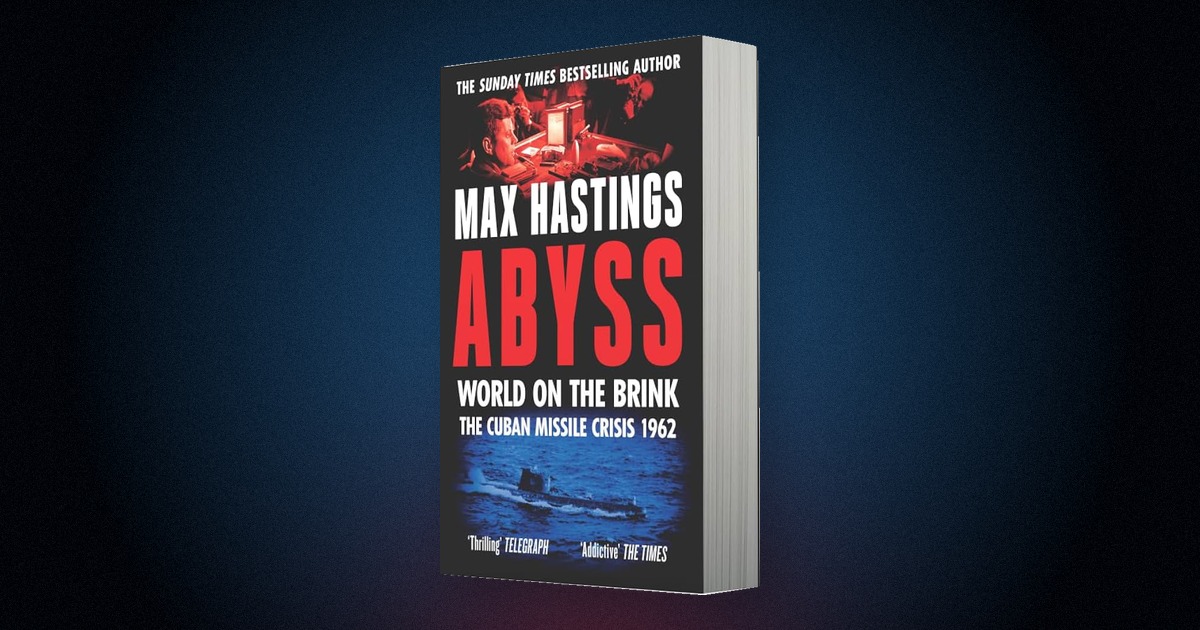
Abyss: World on the Brink – The Cuban Missile Crisis of 1962
Max Hastings · William Collins Books · 2022 · 483 pages · ISBN: 978-0-00-836503-5
I was in my first year at boarding school in October 1962 when, one morning, one of the few dayboys told us that there was going to be a war — just like that, without much drama. I remember the chilling feeling, but, oddly enough, the way the college authorities handled the news over the following fortnight has faded from my memory. Few boys owned transistor radios in those days, and the quality of communications within the college mirrored the global situation, with the superpowers seemingly stumbling towards a nuclear war despite possessing arsenals capable of destruction on an almost unimaginable scale.
Max Hastings has written a detailed account of how events unfolded from the perspectives of the White House, the Kremlin and Fidel Castro’s Cuba. He has enriched the narrative with background material that will be particularly helpful to readers who were not even born when those momentous events took place more than sixty years ago. The book was published in 2022, before Russia’s invasion of Ukraine and the subsequent conflicts in the Middle East further heightened international tensions and made the world a more dangerous place.
Before 1959, Cuba had been a playground for wealthy Americans, while much of the profit from its exports, including sugar, fruit and cigars, went into the hands of American-controlled companies. A repressive government presided over widespread poverty, leaving the country ripe for revolution. After several unsuccessful attempts, Los Barbudos — the bearded ones — led by Fidel Castro swept into Havana on New Year’s Day 1959 and took control. Following an initial honeymoon period, the Cuban government began nationalising industries such as sugar, prompting the Americans to do what they had repeatedly done in Latin America when a regime they disliked came to power: attempt to overthrow it.
In the 1960 US presidential election, following eight years under the former war hero Dwight D. Eisenhower, the young and charismatic John F. Kennedy narrowly defeated Eisenhower’s vice-president, Richard Nixon, and took office in January 1961. In the dying days of the outgoing administration, the Central Intelligence Agency (CIA) had devised a plan to invade Cuba using Cuban exiles. The proposal was presented, perhaps disingenuously, to the new president, who must surely have wondered in retrospect whether he should have ignored the advice he received. The ill-fated Bay of Pigs invasion became an unmitigated disaster and a profound embarrassment for Kennedy and his administration. It also drove Cuba closer to the Soviet Union, strengthening the ties between Havana and Moscow.
Meanwhile, in Europe, the legacy of the Second World War meant that Berlin remained divided into American, British, French and Soviet sectors, surrounded by communist East Germany. Unable to prevent millions of East Germans from escaping to the considerably more prosperous West, the East German authorities erected the Berlin Wall in August 1961, beginning a twenty eight year long effort to prevent further defections. Tensions between East and West over Berlin remained a constant feature of the Cold War. It may be difficult for today’s holidaymakers visiting the German capital to imagine the misery inflicted by the Wall, which separated neighbours and families and placed anyone attempting to escape at considerable risk of death. Many nevertheless made the attempt.
Although Cuba and Berlin were the principal flashpoints, tensions simmered elsewhere in the world. Both superpowers, the United States and the Soviet Union, sought supremacy in armaments, particularly nuclear weapons, and competed in the Space Race, in which the Russians initially established a lead. They also vied to extend their influence in newly independent countries, particularly across Africa. The Cold War was therefore not simply a contest between two military superpowers; it was a worldwide struggle for strategic advantage, political influence and ideological supremacy.
Following the Bay of Pigs fiasco, Moscow’s support for Cuba intensified, culminating in October 1962 with the construction of Soviet missile bases on the island and the dispatch of a fleet of ships carrying military equipment, including nuclear weapons. Even allowing for the limitations of communications technology at the time, it seems astonishing that the Americans did not discover what was happening much earlier. Soviet leader Nikita Khrushchev evidently believed he could outmanoeuvre a young and inexperienced American president. As history records, he was mistaken. Kennedy called his bluff, but for thirteen terrifying days in October the world watched as the prospect of all-out nuclear war loomed. Hastings describes how events unfolded from several perspectives: in Washington, Kennedy’s senior military commanders urged him to launch a full-scale invasion of Cuba; there were genuine fears that nuclear war might begin accidentally; and in Moscow, Khrushchev soon recognised that the Soviet Union’s much smaller nuclear arsenal placed him at a considerable disadvantage. He therefore needed to find a way to withdraw the ships and dismantle the missile bases without appearing to surrender.
Khrushchev nevertheless possessed a bargaining chip. If the United States could maintain missile bases in Turkey directed towards Moscow, he argued, why should the Soviet Union not be permitted to station missiles in Cuba? In an ironic twist, this argument proved crucial to resolving the crisis. Saturday, 27 October, became known as Black Saturday and is widely regarded as the day on which the world came closest to nuclear war. As both leaders faced unbearable pressure from their military advisers, Robert Kennedy, the President’s brother and closest confidant, secretly met the Soviet ambassador, Anatoly Dobrynin. The ambassador had himself been kept in the dark by Moscow about the full extent of the missile deployment. During their meeting, Robert Kennedy conveyed a three-part message intended for transmission to the Soviet leadership: the United States threatened imminent military action if the missile bases were not dismantled immediately; in return for Soviet compliance, America would end its naval quarantine of Cuba and formally guarantee not to invade the island; and, in a secret understanding that was not to be made public, the United States would remove its missiles from Turkey within four to five months.
Khrushchev accepted the terms. The missile bases were dismantled, the Soviet ships turned back and the world breathed a little more easily. Yet the danger had been far more immediate than many people realised. On that same Saturday, an American U-2 reconnaissance aircraft was shot down over Cuba. Meanwhile, the crew of a Soviet submarine, believing that war might already have begun, came close to launching a nuclear torpedo against American forces. One of the three officers whose agreement was required refused to authorise the launch. That decision may have prevented a catastrophe. It is a sobering reminder that the survival of humanity can sometimes depend on the judgement of a single individual in circumstances of almost unbearable pressure.
In August of the following year, the United States, the Soviet Union and the United Kingdom signed the Partial Test Ban Treaty, offering hope that cooler heads would prevail and that the use of nuclear weapons might be avoided. Unfortunately, the world today remains afflicted by numerous conflicts, while the arms industry continues to profit from the insecurity and suffering of others. The promise of 1963 has proved far from secure, and the danger of escalation between nuclear-armed powers remains a cause for profound concern.
Hastings combines formidable research with a highly readable style. Even when the eventual outcome is known, it is frightening to follow the chapters describing events unfolding simultaneously in Washington, Moscow and Havana, and to appreciate just how close the world came to the Third World War. The attitudes of some of the principal actors are particularly disturbing, not least the confidence with which military commanders contemplated actions that could have triggered a nuclear exchange. Kennedy’s reputation suffered considerably when details of his private life and infidelities emerged in the years after his death, but his handling of the Cuban Missile Crisis remains one of the defining achievements of his presidency. He resisted pressure from his generals, recognised the need for restraint and pursued a settlement that allowed both sides to retreat from the brink.
In an age when international tensions are again running dangerously high, Hastings’ account is more than a history of a crisis that occurred over six decades ago. It is a warning about the consequences of miscalculation, ideological arrogance and the willingness of powerful men to gamble with the fate of humanity. The world survived the Cuban Missile Crisis partly because its leaders ultimately recognised the need to compromise, and partly because individuals in positions of responsibility refused to take irreversible decisions at moments of extreme danger. Such lessons are as relevant today as they were in October 1962. Would that we had leaders of Kennedy’s calibre in the world today.
Pat Hanratty
Pat Hanratty taught Science/Chemistry in Tallaght Community School from its inception in 1972 until he retired in 2010. He was the school’s first Transition Year Co-ordinator and for four years he had the role of Home School Community Liaison Officer.