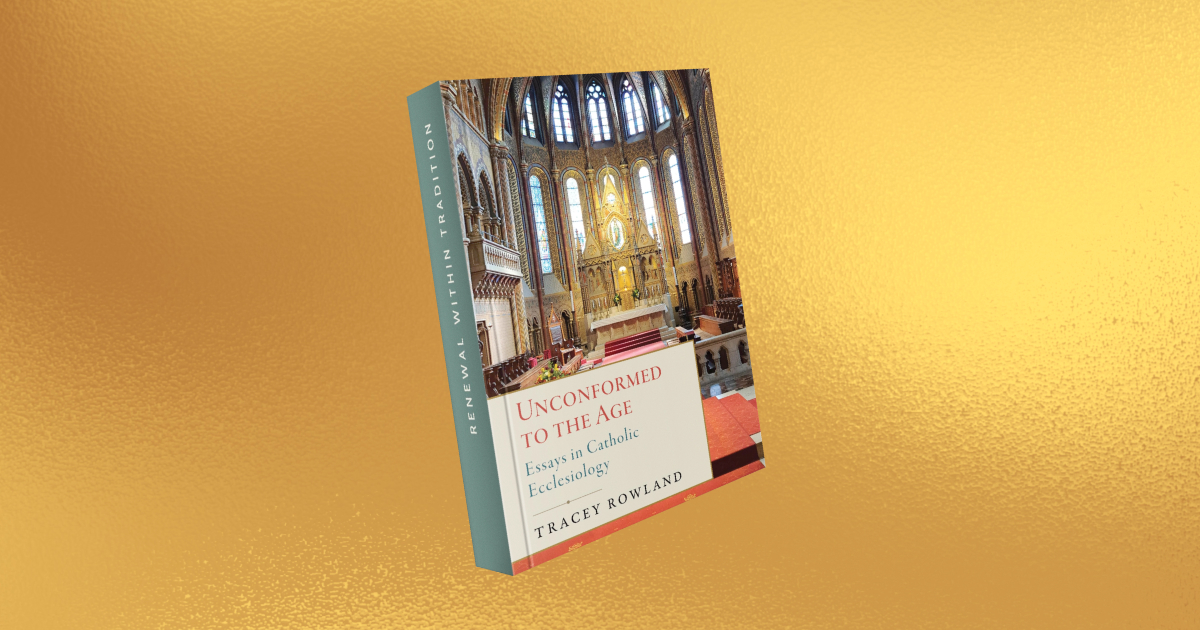
Unconformed to the Age: Essays in Catholic Ecclesiology
Tracey Rowland
Emmaus Academic: Steubenville
2024.
180 pages
ISBN 978-1645853985
Tracey Rowland is a distinguished Catholic theologian, Professor of Theology at Notre Dame (Australia), former member of the International Theological Commission (ITC), winner of the Ratzinger Prize for Theology in 2020. She specialises in the theology of Joseph Ratzinger, having written introductions to his theology (Ratzinger’s Faith and a Guide for the Perplexed volume on Benedict XVI) as well as to the area of these essays: ecclesiology, the nature of the Church. She is a representative of the Communio approach to theology as opposed to the Concilium one. These are two rival theological journals representing two different versions of the Church’s self-understanding: on the one hand, a “Communion,” configured by sacraments whose mission is the New Evangelisation, and, on the other, an extension of the “debates of the Second Vatican Council in the new era of intercultural theory and practice,” respectively.
The Church’s identity
What is the Church after all? A field hospital, an NGO, “Catholic Inc,” with a penchant for philanthropy, or the Body and Bride of Christ? Are these models compatible with one another? From Mystici Corporis (Pius XII’s 1943 encyclical on the Church as Mystical Body) up to Vatican II’s Lumen Gentium and beyond, Rowland shows us how the theological debate has been going and is now likely to go. Her essays, written from 2014 to 2023, range widely, dealing with subjects like the timelessness of truth, whether the Church is a democracy, what the Church is and is not, Ratzinger on ecclesiology, the way the Holy Spirit guides the Church into the whole truth, the Church as communion, People of God, etc. There is, however, one chapter which encapsulates her approach as well as the central issues on her mind and the Church’s mind right now: “Between the Theory and Practice of the Synodal Process.”
Synods and Synodality
Synods, she explains, are not new: they go back to the second century at least. Bishops always needed to come together to discuss the issues of the day. Their latest incarnation has (a) also invited lay Catholics and (b) tends to discuss and explore matters of long-settled magisterial teaching. Lay people are involved, for after all, the argument goes, the People of God are gifted with the sensus fidelium, or “a Catholic nose.” Newman, of course, had controversially included lay people among those through whom the tradition of the Apostles could manifest itself, though he added that the gift of discerning that tradition lies with the ecclesia docens (teaching Church).
There were periods when the teaching Church was confused (4th-century Arianism comes to mind), and Rowland suggests that we are in a similar situation now, with fault lines to be found across theologians and bishops, along the lines of critical theory: while some say that the truth has already been given to us, others claim that theology is the critical self-consciousness of Christian praxis, something to be worked out in time. But what are “the signs of the times”? Not all the ideas which circulate among the People of God are; she quotes St John Paul II in 1987: “the only key with which the Church and humankind should open ‘the signs of the times’ is the crucified and risen Christ.”
Pope Francis got involved with the issue: he asked the ITC in 2013 to develop criteria for the sensus fidelium, since, he said, it cannot be confused with a simple majority opinion. They duly did and came up with six: (1) participation in the life of the Church; (2) listening to the Word of God; (3) openness to reason; (4) adherence to the Magisterium; (5) holiness; and (6) seeking the edification of the Church. She suggests that these criteria have not always been met at synods, as, for instance, those chosen (or even available) to people them tend to be full-time Church employees, from richer countries, obviously, who may have a tone more managerial than magisterial. Synods, however, are there precisely for the bishops to proclaim the apostolic tradition of the Church.
She quotes Ratzinger’s amusing comment on the “disappointing” interest of lay people in synods: “There are complaints that the majority of believers generally show little interest in dealing with the Synod (European Synod of Bishops, 1999). I have to admit that this reluctance seems to me to be more a sign of health.” As a meme from the period put it, “God so loved the world that he did not send a committee.” Rowland quotes von Balthasar that the Church needs to be mystical rather than a Church of conversations; she cannot remain in a synodal debating chamber, for bishops need to get back to their dioceses and preach the Gospel; lay people need to be witnesses to a world hungry for the Word.
The whole truth?
Her chapter on the Holy Spirit pits those who expect the Spirit to come up with a new and anarchic “pneumatic” Church against those who look to Christ’s promise to the Apostles that the Spirit would actually bring the Church into the whole truth by reminding them of all that Christ had said.
Rowland leads us through the post-conciliar debates on truth. Is truth constantly being constructed in history, as Schillebeeckx claimed, or is it received within a community which maintains its own hermeneutical framework? For Balthasar and Cardinal Newman, for instance, the apostolic generation received the faith in its purity directly from Christ and under the guidance of the Holy Spirit. Christianity, for them, is, of course, historical, rooted in a historical event; but this is not in opposition to its truth. We Catholics find our centre of gravity in the revelation we have received from Christ, and the Church is well able to offer us the nuances needed to appreciate the aspects of this truth and to negotiate the different senses of the revelation (e.g., the various senses of Scripture, sometimes literally historic, sometimes poetic, sometimes contemplative, always revelatory).
Conclusion and appendices
Rowland concludes with a meditation on Christian humanism and the Cross, an event which “transvalues human suffering.” Pain and death have received meaning, and while other great religions (and secular Enlightenment) found ingenious ways of escaping suffering, Christianity was able to revalue it completely: “If we live, we live in the Lord, if we die we die in the Lord.” The theology of the Cross sheds light on the sacraments and on the true mission of the Church.
Finally, she offers useful short appendices: a list of the ITC’s “dispositions required for possession of sensus fidei”; from the Catechism of the Catholic Church on the nature and role of the hierarchy of the Church, and from St John Paul II’s Pastores Dabo Vobis (1991) on the identity and mission of priests.
This is a rich review of Catholic ecclesiology from an orthodox perspective, imbued with Balthasarian and Ratzingerian thinking, well able to compare it with the alternatives on offer.
Rev. Patrick Gorevan
Rev. Patrick Gorevan is a priest of the Opus Dei Prelature. He lectures in philosophy in St Patrick’s College Maynooth and is academic tutor at Maryvale Institute. He has written on the early phenomenological movement, virtue ethics and the role of emotion in moral action.