
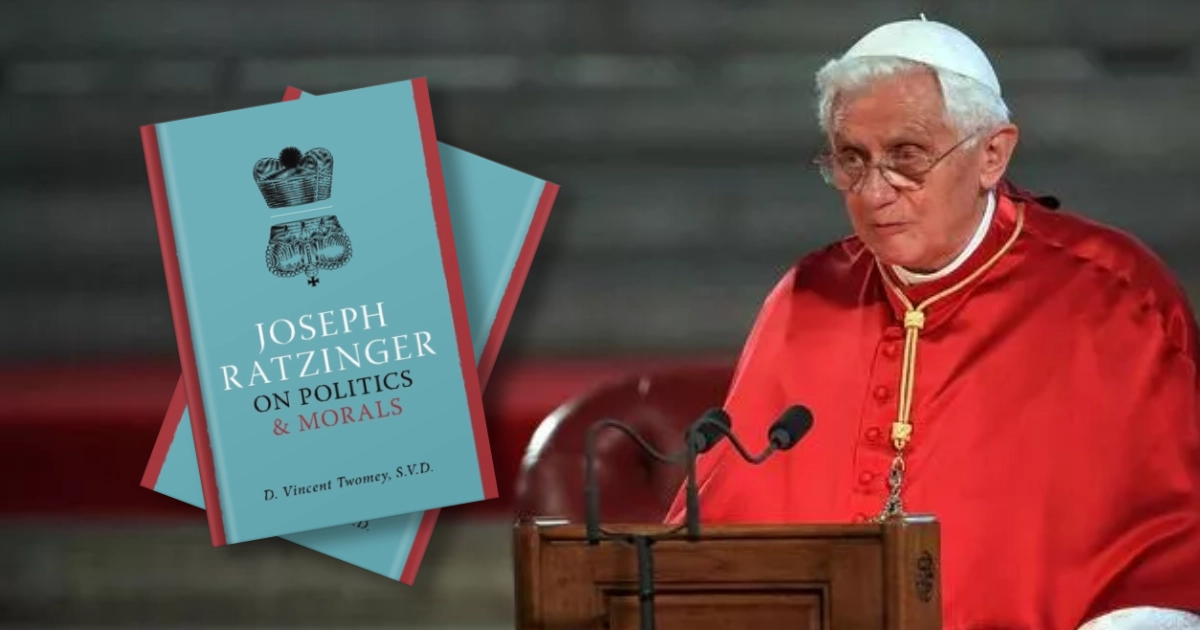
Joseph Ratzinger on Politics and Morals
D. Vincent Twomey
Emmaus Academic
2026
224 pages
ISBN 9781645855194
Fr Vincent Twomey’s latest volume dealing with Joseph Ratzinger’s theology of politics is timely. Many of the chapters were written on the occasion of a conference, as happened to Ratzinger himself: his commitment to understanding and communicating with modernity was often expressed in a lecture or a speech which went viral and commanded immediate interest: think of the Regensburg or the Westminster Hall addresses, or his debates with Jürgen Habermas or Marcello Pera. One of the chapters in the book, “Conscience and the Church’s Mission,” is an address given by Twomey to the Ratzinger Schülerkreis in 2014.
While Ratzinger never articulated a theology of political life, he was intent on showing how God is at the heart of the Church’s rapport with contemporary life. Christianity has a missionary impetus, affecting every aspect of human life, including the social: “if it isn’t somehow everything, it is nothing” (Louis Dupré). In particular, Joseph Ratzinger remembered his devout father’s reaction to the German Bishops’ Conference’s bland statement about Nazi ideology in 1933. This taught him that you needed to keep an eye on politics to be a faithful Christian and you also needed to be aware of what it might cost you.
Moral theology
Ratzinger’s theology is objective, historical, and subjective. Like Nicodemus and Joseph of Arimathea, you can be as sophisticated as you like but you also need a simple heart, capable of seeing the truth behind the passing parade. An example of this approach was his attitude to the Humanae vitae controversy: he admired St Paul VI’s courage, and was also happy with St John Paul II’s personalist vision which complemented the timeless validity of Paul’s encyclical.
But Ratzinger concentrates on fundamental moral theology, the principles whose disappearance had left moral theology without resources to deal with the individualist revolution of the sixties. The basic crisis is one of faith in the existence of the transcendent God. The Church’s role is to wake people up, in season or out of season, because it amounts to a sleeping sickness.
Twomey points to four topics which define Ratzinger’s treatments in his historic addresses:
The primacy of God in the public square
Justice as goal of politics
The priority of ethics over politics
The danger to political life and to humanity of closing the Western mind to God.
What about natural law? For Ratzinger, it is the language of creation. The Ten Commandments reflect the moral order and meaning of our created human nature, body and soul; and this can rightly be reflected in the modern appeal to human rights against unjust laws. He is convinced by C. S. Lewis’s fear of the Abolition of Man, which he often quotes about the danger of man becoming raw material, a natural object, and this by our own free choice.
Conscience
For Twomey, Ratzinger’s greatest contribution to moral theology is his work on conscience. He admired Newman, whose whole life was a commentary on conscience. The Enlightenment tried to see conscience as an infallible personal authority, when it is actually a lamp that enables us to touch and be touched by the truth of our being. Ratzinger is particularly severe on the notion of conscience as “pseudo-rational certainty that is woven out of self-righteousness, the habit of conforming, and laziness.” Ouch!
This autonomous but limited “certainty” has created the deserts, both outward and inward, in which contemporary culture languishes. Not so much denying God as “suspecting” him, as per Genesis 3, it also takes love as “dependence” and no longer the only gift that can truly bring me alive. Ratzinger, however, wants to save what is best in the Enlightenment, and in particular its liberal democracy, from its own life-threatening errors.
Basic principles in action
Ratzinger’s political science involves separation of God and Caesar; justice in temporal affairs and highlights the danger to political life and humanity of the closing of the Western mind, with its truncated notion of reason. Without God, or as Václav Havel put it, a pre-speculative assumption that the world functions and is generally possible at all because there is something beyond its horizon, we tend to an instrumental sense of reason, which brings us to use and be used by one another. In this view, the human body is simply a tool for one’s own or even others’ well-being. But the truth is that each of us is willed, each of us is loved, each of us is necessary, as Pope Benedict put it in the inaugural homily of his pontificate (2005). The human body is bearer of meaning and truth: “morality cannot be replaced by chemistry … the body cannot be relegated to the field of what is merely manipulable, merely biological.”
Conclusion
Joseph Ratzinger on Politics and Morals offers a sweeping view of Ratzinger/Benedict’s profound engagement with contemporary life. Twomey refers to particular moral issues but above all through Ratzinger’s writings illustrates how Christian faith, hope and love can transform and enrich a moral attitude to these and many other questions. His concluding extended commentary on the Encyclical Deus caritas est can stand on its own as a companion to this important encyclical, which Twomey interprets as a sustained symphonic poem, or we might say, an ode to joy.
Rev. Patrick Gorevan
Rev. Patrick Gorevan is a priest of the Opus Dei Prelature. He lectures in philosophy in St Patrick’s College Maynooth and is academic tutor at Maryvale Institute. He has written on the early phenomenological movement, virtue ethics and the role of emotion in moral action.