
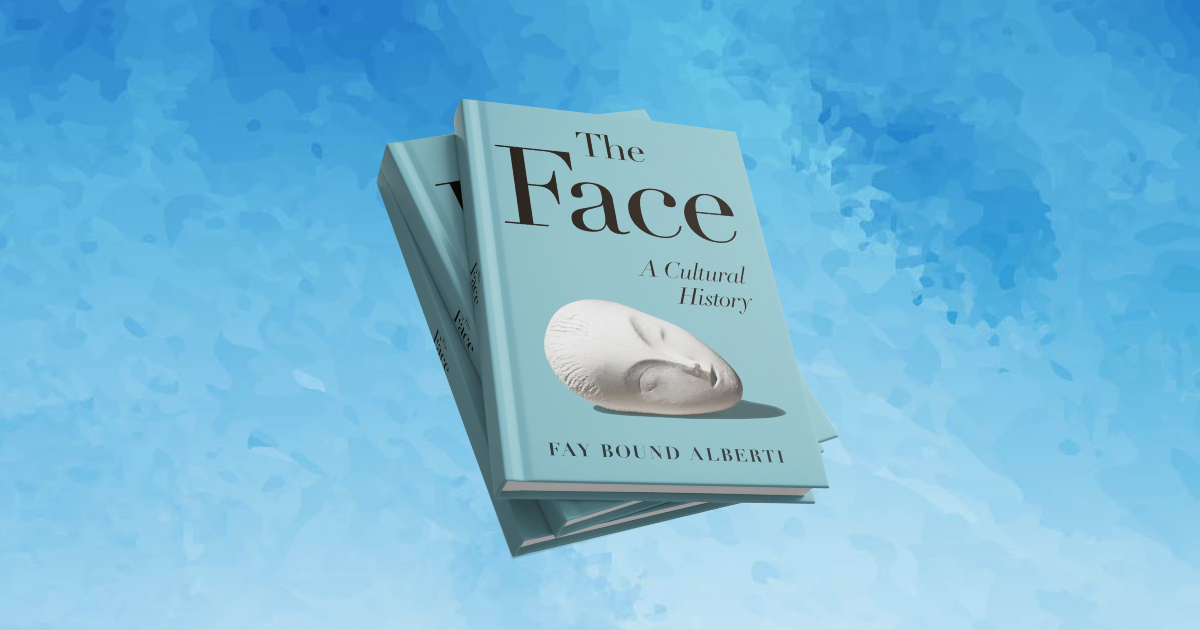
The Face: A Cultural History Fay Bound-Alberti
Allen Lane
May 2026
288 pages
ISBN: 978-0241670712
Fay Bound-Alberti’s The Face: A Cultural History is an exploration of the historical, cultural, and technological characteristics that intersect in this complex part of the body. Bound-Alberti is professor of modern history at King’s College, London. Her research has focused on medicine and emotion, with previous monographs including a history of loneliness and a history of the heart. The present book, published earlier this year, explores how the face has been understood across time. Early chapters focus on biological and artistic approaches to the face and its representation, while later chapters consider the influence of contemporary technology and medicine on physiognomy.
Bound-Alberti lives with a condition known as “prosopagnosia,” or “face-blindness.” In her own words, this is “a condition where you can’t hold in mind the association between a face and an individual person.” This can be developmental, from birth, or acquired, for example, through brain injury. Bound-Alberti recounts her struggles to recognise her parents’ faces as a child, and even her own children’s faces today. She describes how she has had to resort to other features of her loved ones in order to recognise them, such as their clothing and smell. Her circumstances bring a certain depth to the perspectives in the book.
The earliest portrayals of human faces were quite generic. The famous cave paintings at Lascaux in France depict numerous equines and bulls. “One humanoid has a bird-face, but there is nothing that characterizes a particular individual.” Similarly, in the Chauvet-Pont-d’Arc Cave in France, dating to some 30,000 years ago, archaeologists found stylized depictions of humans and various animals, such as horses, lions, and bears. However, “it is notable that human beings are less realistic than the animals depicted.” Bound-Alberti argues that, at this point, as the unity of a group was critical to its survival, “perhaps there would be no point in marking out any one individual, or face, as unique.”
By around 450 BC, however, “something dramatic was changing in how faces were portrayed. […] Attention to the details of the body and the face was more pronounced, with greater interest in characterization, emotion, and movement.” A number of moments bear this out. The formation of an anatomy school in Alexandria by Erasistratus and Herophilus points to a new focus on the body and its workings. Euclid’s systematisation of geometry and development of ratios in his pursuit of order and proportion point to new thinking about humanity’s place in nature. The pseudo-Aristotelian Physiognomics, which argued that “a well-proportioned face reflected someone ‘just and courageous,’” points to a new and deeper interest in humans as relational beings.
Bound-Alberti observes that some religious traditions, such as Judaism and Islam, “had a prohibition on idolatry and ‘graven images’ that included the face.” Christianity diverged significantly from this. We see this in the development of portraiture from the late Middle Ages onward. As an art form, it is largely unique to the West. The type of detail and focus on the distinctive features of a person’s face is not typical of other cultures. Portraiture reached its high point in Renaissance Europe, where “for the first time, we see artists taking an interest in capturing not just status but personality” in their subject’s face. From da Vinci’s enigmatic Mona Lisa to Holbein’s Portrait of Sir Thomas More, the face grew in detail and expressiveness in Renaissance painting across northern and southern Europe.
For Bound-Alberti, the mass production of the mirror marks a turning point in our sense of self. Portraits were slow, laborious, the preserve of the wealthy, and often done for the sake of others. Mirrors are instantaneous, and their reflection tends to be for our consumption alone. Until the last few centuries, she writes, “it is entirely reasonable to believe that a person might go from birth to death without seeing themselves at all, let alone with the regularity, frequency and detail we do in the modern West.”
An indistinct and infrequent reflection of our face in water or in a piece of glass was as close as we got to seeing ourselves for much of our history. Going our whole lives seeing the faces of those around us, and only rarely and hazily seeing our own, surely altered the way we perceived and related both to ourselves and to others. Our awareness of our appearance and identity would have develop[ed] in relation to others, rather than to our own reflection. It must have made us “less self-conscious and self-critical.”
By the eighteenth century, with the increasing prominence of mirrors, “the face had to be managed in new ways.” This period saw a growing interest in behaviour manuals and conduct books aimed at teaching the upwardly mobile how to deport themselves properly. By the late twentieth century, not only was there a mirror in every home, but its technological descendant, the camera, was in virtually every pocket. Yet the heightened self-awareness these devices have granted us is intertwined with an increasingly raw and vulnerable self-consciousness. Body dysmorphia disorder was recognised “as a rare psychological pathology in the 1980s,” but its “prevalence has risen” since then. A recent University of London study found that “90 per cent of girls aged 11–21 use filters when taking photos to alter skin tone, teeth, or facial structure, with negative effects on self-image.”
Rather than offering us a sense of freedom by granting us new perspectives on ourselves, the mirror (and its digital successors) has become “a device for perpetual self-surveillance.” The mirror and camera have lulled us into feeling in control of our own image and presentation. But instead we have surrendered control to others, or corporations, or social pressures. They have made the face “a thing external to us,” “a commodity” to be traded in our daily interactions. Reflecting on life as an average man or woman a few centuries ago (despite the real and life-threatening uncertainties of disease and crop failure), Bound-Alberti muses that there must have been “a kind of psychological freedom” to a world with few or no mirrors, where we rarely ever saw our own face. The most visible and most expressive part of our body remained almost forever invisible to us.
The Face is an engaging read. At times, Bound-Alberti’s prose lapses into uncritical contemporary narratives of gender and race. Some later sections lose their analytical astuteness in favour of a looser, more reflective approach. Overall, however, the book’s exploration of the historical, cultural, and anthropological significance of the face is valuable and insightful.
Reading Bound-Alberti’s book and contemplating its unusual subject matter, one could not help but be reminded of that other contemporary thinker who focused on the intensity and intimacy of the face. In the introduction to his momentous three-part Jesus of Nazareth series, Pope Benedict XVI contemplated what it means to see God “face-to-face.” Benedict recalls Moses’ request of God, “I pray thee, show me thy glory.” But God refused: “You cannot see my face. […] You shall see my back, but my face shall not be seen.” This elemental desire, as early as Moses, and earlier, to see and know our creator, was motivating Benedict too.
This mysterious interaction “served as the basis for attempts to discern how far contact with God can extend in this life.” Moses was permitted into God’s presence, but he could not behold God’s face. For Benedict, the Old Testament’s promise of a new Moses hinted at the eventual achievement of this significantly deeper intimacy, “a real, immediate vision of the face of God, and thus the ability to speak entirely from seeing, not just from looking at God’s back.”
Benedict considers St. John’s assertion in the prologue of his gospel that “No one has ever seen God; it is the only Son, who is nearest to the Father’s heart, who has made him known.” What Moses could only grasp in fragmentary form has been fully realised in Jesus, who, Benedict writes, “lives before the face of God, not just as a friend, but as a Son.” His teachings are thus “not the product of human learning,” but come “from immediate contact with the Father, from ‘face-to-face’ dialogue.”
Benedict’s book represents, in his words, “my personal search ‘for the face of the Lord.’” Though entirely secular in its exposition, Fay Bound-Alberti’s book prompts us to consider how the face’s inscrutable yet inseparable nexus of the material and the immaterial resonates with the face of the one who became man, taking on a face of his own, so that we could know him better.
David Gibney
David Gibney is a school teacher in Dublin. He holds a Ph.D. in English literature.