
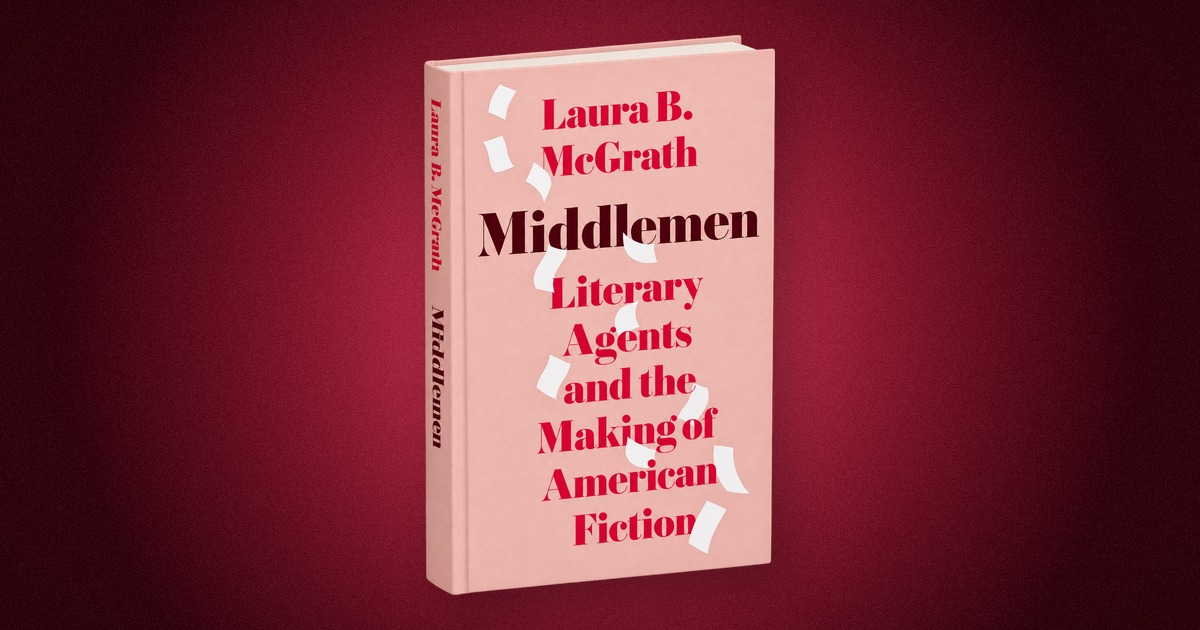
Middlemen: Literary Agents and the Making of American Fiction
Laura B. McGrath · Princeton University Press · April 2026 · 296 pages · ISBN: 978 0691256160
Authors, and sometimes their editors, are the ones remembered for dazzling choices and artistic vision. Hardly anyone mentions the people who represented them: the literary agents. From the outside, publishing looks like a matter of printing and selling books. In truth, it is a trade in intellectual property: in ideas, and in the people whose words are worth reading. Any published author knows that a publisher is buying the exclusive right to publish their work, on certain terms, and is paid against projected sales. I spent more than a decade in publishing, mostly selling international rights, and it seems only fair that the people who make books happen, usually invisibly, should be looked at more closely. If you are settling into a novel tonight, there is almost certainly an agent behind it who went looking for it and found it for you.
It didn’t start out that way. McGrath has done excellent investigative work on the American literary scene; London, a little disappointingly, is hardly mentioned. Early agents plied a suspect trade. Publishers complained openly that these interlopers wielded undue influence. Many of the interlopers were women, as many agents still are. Meanwhile, the market itself was changing. Short stories in magazines had once commanded extraordinary fees: at his peak, McGrath points out, F. Scott Fitzgerald could earn the equivalent of $400,000 in today’s money for a single story. As magazines waned, the novel came into its own in the middle of the century. Agents, too, went from begrudged interferers to power brokers. The bidding war and the “debut novel” as a selling category are both, in large part, their inventions, as they came to be advocates for the writers.
McGrath’s central argument is that the agent’s real power is taste. Editors trust their submissions, and the agent’s pitch can end up, word for word, on the back cover. Sterling Lord sold Jack Kerouac’s On the Road as a debut, even though he knew it was Kerouac’s second book; a genre was born that publishers still lean on today. The agent works within a system and makes the most of it. But the agent must also spot talent. The brilliant Candida Donadio signed Thomas Pynchon on the spot. Over long lunches at the Italian Pavilion in Manhattan, she built an influence so great that she may be the only reason we have Joseph Heller’s Catch-22 or Mario Puzo’s The Godfather. She found Philip Roth too.
There are touching interviews throughout, many given anonymously. Agents speak of their authors in terms of loyalty and friendship. They describe weeping when a client’s next novel goes unsold, fighting for the best deal, and championing marginalised voices. There are funny moments in the archival correspondence too. Lynn Nesbit once wrote to Donald Barthelme that it was wonderful to get a letter from a writer asking for anything other than money. She added that she would take him up on the love affair, if someone hadn’t “already forewarned her how beautiful, intelligent and charming his wife is.” (p. 69). One of McGrath’s interviewees credits Nesbit with having “invented postmodernism.” Whatever the truth of that, the letter shows how personal the bond between author and agent can be.
As a read, Middlemen is part storytelling, part oral history, part research paper. I was puzzled by a bullet-pointed analysis of how meetings run at the Frankfurt Book Fair. It felt like an effort to reduce the craft of selling to academic terms, and it misses what the fair is actually like: anyone who has endured seventeen half-hour meetings in a single day there knows it is closer to an endurance sport. I dare you to try it. Still, the stories, and the abiding question of what makes a great book, are well worth the time.
McGrath admits she has never held a formal role in publishing, and that shows. There is plenty of talk about money and advances. What is missing is any real account of publishing as a business of profit and loss, and of where authors and agents sit within it beyond their taste and ideas. We are told that adult fiction has, on average, accounted for 37.8 per cent of sales and non-fiction for 62.8 per cent, a market that apparently adds up to 100.6 per cent. More seriously, the book never quite explains what an advance is, though so much depends on it.
Here you are, then. An advance is a payment made to the author up front, set against future royalties and calculated from the sales the publisher expects (net receipts, usually, are the calculation, and a percentage goes to the author from them – which is negotiated). The author sees no further royalties until the book sells well enough to pay more than their advance. An agent knows this well, but would rather talk about how a big advance commits the publisher to spending on the book. It’s interesting to read here, but unsurprising, that few authors receive advances over $250,000. For most, this is not a millionaire’s business.
Did agents, then, invent American fiction? Not quite. They decided which writers reached an editor’s desk, how those books were described, and which categories publishers came to rely on. Where and when that influence is exercised, only agents really know. Ask them and most will say “it depends,” which is perfectly true. As you pick up your next read, you will only see their name on the Acknowledgements page. But, without them, it is abundantly clear, you probably wouldn’t be reading that book; they found it for you.
Dominic Perrem
Dominic Perrem is National Director of Alpha Ireland, where his work focuses on evangelisation and reaching people outside of the Church. Before this he worked in the book publishing industry, and as a presenter for Spirit Radio. He lives in Meath with his wife, Annie and seven children.