
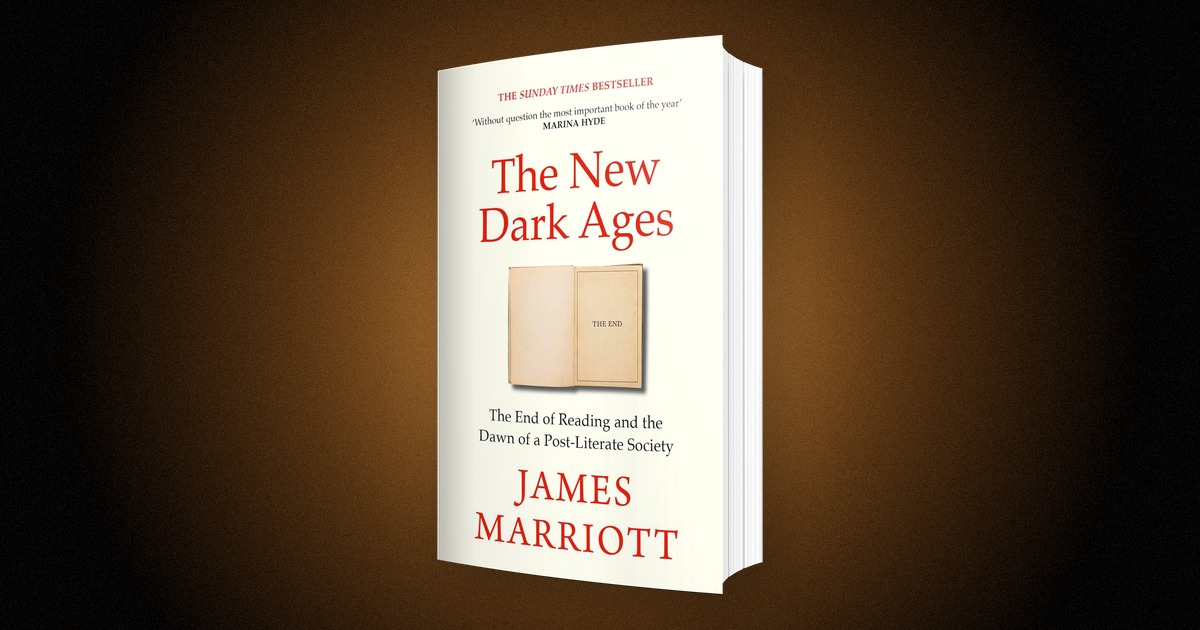
The New Dark Ages: The End of Reading and the Dawn of a Post-Literate Society
James Marriott · The Bodley Head · Sept. 2026 · 208 pages · ISBN: 978-1847929518
The New Dark Ages: The End of Reading and the Dawn of a Post-Literate Society is one of the most important books of this year, or even this decade. James Marriott, who writes about culture for The Times, sounds the alarm over the decline of reading, setting out in lucid terms how literacy has transformed the world for the better and why this extraordinary historical achievement is now in jeopardy. Over the course of recent centuries, literacy has spread across the world, and vast swathes of humanity have become regular readers. Yet the current status quo is not the historical norm: writing was invented independently in only a handful of civilisations over the course of several millennia, and widespread literacy is a relatively recent development. Although the rise of artificial intelligence is an important element of this story, the decline of reading far predates the advent of programmes such as ChatGPT.
Reading for pleasure declined by 40 per cent in the United States between 2000 and 2020, while in Britain more than a third of adults admit to having abandoned the habit. The problem is not simply that people are choosing to read less, but that they are gradually losing the ability to read in the same way that they, or their parents, once could. Marriott cites evidence from American and British academia demonstrating a clear decline in university students’ capacity to interpret complex material. Corners are being cut in colleges and elsewhere: one academic in an English department is quoted as saying that she assigns far less written material because her undergraduates are increasingly unable to concentrate on lengthy texts.
One of the most important international measures of educational performance is the Programme for International Student Assessment (PISA), whose tests assess the reading, mathematical and scientific abilities of 15-year-olds. Its results show that proficiency in these subjects began declining in 2012. By a remarkable coincidence, The New Dark Ages was published in the same week as the latest PISA findings, which showed further declines in reading, mathematics and science across EU and OECD countries.
Across the world, popular culture is gradually being dumbed down to accommodate the diminishing information-processing abilities of the public. Marriott writes that Netflix has reportedly been demanding simpler scripts, while studies show that sentence lengths in best-selling books have been contracting. Statistical analyses of pop songs recorded over the past 50 years likewise indicate that “lyrics are becoming simpler, more repetitive and less rich in their vocabulary”. Even the ubiquity of cinematic sequels may, he argues, be attributable to the reduced attention spans of the viewing public. The introduction of the iPhone in 2007 was clearly a seminal moment in recent history, and Marriott deals with it extensively, but television appears to have done more damage overall. Average leisure time increased significantly during the twentieth century, only for much of that additional time to be swallowed up by television viewing. Drawing on the available evidence, Marriott shows that increased television consumption is correlated with the gradual decline in average IQ scores recorded since the end of the twentieth century. In Norway, comprehensive IQ testing of military conscripts, combined with the gradual rollout of cable television across a geographically inaccessible country, allowed one researcher to conclude that a decade’s exposure to cable reduced IQ scores by an average of 1.8 points. We have now had several generations for whom watching many hours of television each week is perfectly normal. On top of this, the smartphone – which the average person reportedly checks 144 times a day – offers an ever-expanding range of distractions that have had a deleterious effect on human attention spans.
Marriott writes as an Enlightenment liberal, the son of an English teacher. “Literature was our religion, the way we explained and interpreted our lives,” he reflects. It is a telling sign of the cultural moment in which we find ourselves that he writes of his teenage infatuation with the ‘New Atheists’ with what feels like a certain embarrassment and nostalgia. Rather than believing that we are living through “a mopping-up exercise at the end of the Enlightenment”, he is now disturbed by a descent into irrationality that is visible on both the Left and the Right. For Marriott, the decline of reading threatens nothing less than a reversal of the Enlightenment itself. “No medium other than writing can contain the same density of argument, the same level of abstraction or the same intellectual rigour. To lose reading would be to risk losing the complex and sophisticated kinds of thinking that underwrite our entire civilisation,” he writes, later speculating as to whether mass democracy can even survive without mass literacy.
One of the most remarkable features of reading’s heyday was how democratic it was. Although a class divide existed in access to books during the previous century, it was not especially pronounced. In 1944, almost two-thirds of skilled workers and nearly half of unskilled workers in Britain had grown up in homes containing substantial libraries. In 1937, 90 per cent of Americans said they were regular newspaper readers, and newspapers of every kind – highbrow and lowbrow, weekly and evening editions, local and national publications – flourished. Any reader who has taken the time to examine the speeches of elected politicians from the twentieth century or earlier will be struck by the higher intellectual and literary standards that once prevailed. Marriott dwells on this point, highlighting examples of exceptionally well-read political figures, including men such as Winston Churchill and Harry Truman, neither of whom had attended university. Of all the abuses of the English language, the use of the term ‘educated’ to describe those who have spent time in modern universities is surely among the most egregious. Possessing a degree is not the same as being educated, and the growth in the proportion of the population holding degrees has not necessarily been accompanied by an increase in literacy or intelligence.
Marriott draws on the media theorist Neil Postman’s concept of ‘printed orality’: “the tendency of men and women in highly literate cultures to speak like books”. Such people can construct logical, structured arguments informed by a broad body of knowledge. Analysing the speech of President Donald Trump, the liberal-minded Marriott points to its repetitiveness and dearth of supporting evidence, but argues that “almost as dismaying are the vacuous truisms and platitudes mouthed by many centrist politicians”. He identifies the British Foreign Secretary Ed Miliband as a good example; Simon Harris springs to mind in an Irish context. Why, then, is reading different from other activities? Watching television or listening to podcasts can undoubtedly be educational and stimulating, but Marriott makes clear what ought to be obvious: reading demands more of us and activates the mind at a deeper level. People can find easier sources of amusement elsewhere, and increasingly they do, particularly in a world where smartphones provide an endless stream of videos tailored to our lower appetites by cunningly designed algorithms. “Books make considerable demands on our imaginative, intellectual and critical faculties,” he writes. “I believe that if books are to have a future we must make the case for precisely that difficulty.”
He is correct, and could perhaps go further when assailing the podcast stars inhabiting the fringes of the internet, whose authority “is founded not on their superior skills of argument or their unusual analytical abilities but on charisma, fluency and confidence”. I was once in the company of a wise man who posited that there were three forms of intelligence: first, reading about things; second, writing about things, building on that foundation; and third, speaking about things, using the knowledge acquired through the first two. One of the great problems in contemporary media and politics is the number of prominent people who have skipped the first two steps and gone straight to the third, becoming famous for talking despite having nothing intelligent to say. We should not be shy about proclaiming that reading is objectively superior to other comparable forms of entertainment. A culture of podcasts is no replacement for a culture of books. Even the best podcasts often degenerate into self-absorbed conversations that can do little more than skim the surface of a subject.
Marriott’s book is extraordinarily valuable, but the future he fears – one in which reading is practised only by a learned few – also reflects some of his own culturally Protestant biases as a liberal Englishman, particularly in his treatment of the West before the printing press. Regrettably, he seems to lack a deep appreciation of the medieval monks who kept the flame of learning alive by transcribing and illustrating books. He is right that a new Dark Age may be looming, one in which education and intellectual culture once again become the preserve of a minority. But, as with the previous period that has been described in that misleading fashion, the light that remains will emanate from the Catholic Church: man’s last refuge in this desolate landscape. And even one small candle is enough to illuminate the page of writing before us.
James Bradshaw
James Bradshaw writes on topics including history, culture, film and literature.