
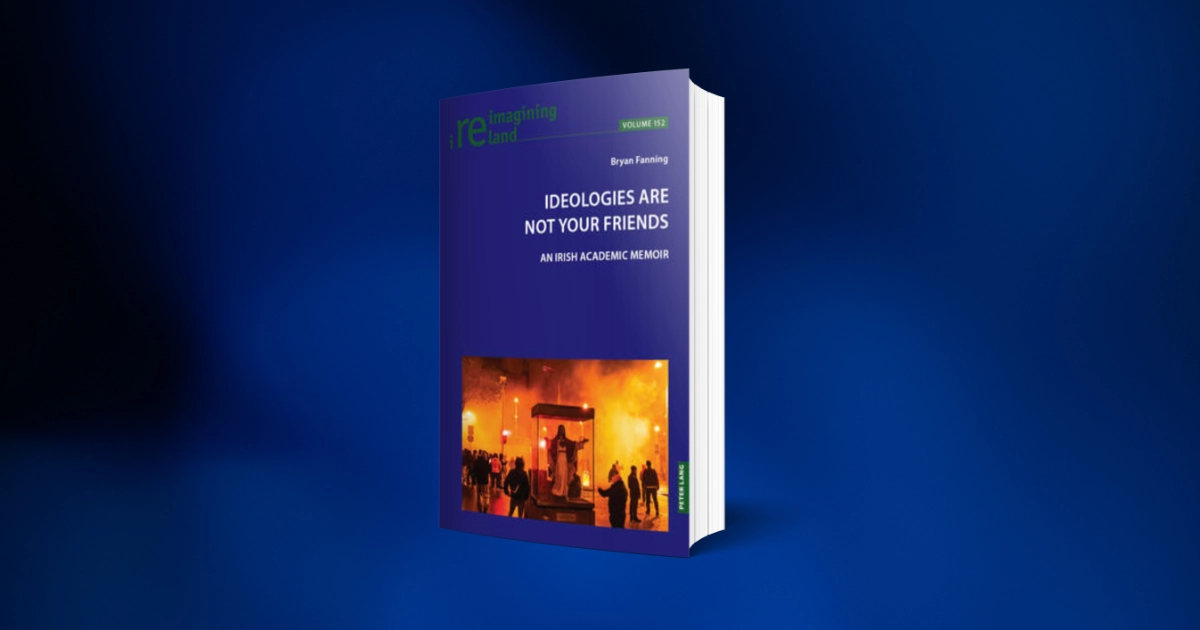
Ideologies Are Not Your Friends: An Irish Academic Memoir
Bryan Fanning
Reimagining Ireland, vol. 152
Peter Lang
2026
206 pages
ISBN: 978 1805842576
Professor Bryan Fanning works in the School of Social Policy, Social Work and Social Justice in University College Dublin.
After entering Irish academia via a rather circuitous route, he has spent almost thirty years in the sector. His books on immigration in Ireland mark him out as the leading authority in that area, but his research output is far broader than this, as seen in his intellectually stimulating new book, Ideologies Are Not Your Friends: An Irish Academic Memoir. A native of Clare, Fanning emigrated to London in the bleak days of the 1980s, spending the next decade there amongst newcomers from across the world. After completing a PhD while working full-time in local government, he and his wife returned to a newly prosperous Ireland which had finally begun to attract immigrants of its own. His experiences of working with asylum seekers on a local level complemented his academic research nicely, and this expertise has led to Fanning publishing essential works like Diverse Republic and Migration and the Making of Ireland.
A memoir describing this work alone would be worth reading, yet it forms only a small part of this memoir, along with subjects like Fanning’s deep interest in “lost intellectual worlds” such as the influence of Catholicism on the development of Ireland’s social sciences. For a professed atheist working in what many would see as a naturally left-leaning part of academia, it is remarkable how much of an influence the Church has had on his work, and how deeply Fanning has delved into this topic. His first academic work (which focused on this country’s treatment of asylum seekers and Travellers) appeared in the Dominican publication Doctrine and Life. Around the same time, he came across old copies of the well-known Jesuit scholarly journal Studies, which was at the forefront of Irish Catholic thought for much of the twentieth century. The young academic began to seriously examine the work which had been published within its pages, even joining its editorial board and editing An Irish Century: Studies 1912–2012, an anthology of the most significant essays which appeared in Studies.
Fanning noticed that many academics did not consider the Church’s influence seriously, writing that in some quarters, “Catholicism was viewed as the basis of ethno-nationalist identity rather than as the bearer in its own right of ideological and political positions.” Such perceptions were hardly confined to scholarly circles in post-independence Ireland, where the absence of common characteristics of European nationhood made cultural Catholicism all the more important, but which likely counteracted efforts to help people to understand the Faith more deeply. It is interesting that the author’s religious practice had long ceased before he began to take an intellectual interest in Christianity, and it is all the more interesting that he was not at all exposed to the Church’s intellectual tradition when growing up in a culture where Mass-going was the norm. “Catholicism as I experienced [it] was a bundle of rituals and social norms without any intellectual aspect. Catholic morality reflected Church doctrine but the theological and philosophical ideas upon which such dogma was built were not explained,” he reflects. A deep process of religious study, particularly the work of St. Augustine, paved the way for future works such as his 2023 book, Public Morality and the Culture Wars.
A fascination with ideas appears to be the driving force within Fanning’s career, both ideas which he is in sympathy with and those with which he disagrees. In his examination of the liberal, socialist and Christian Democratic influences on the development of the modern welfare state, he rightly rejects the idea that “these broad schools of thought were hermetically sealed off from the others.” Instead, it is vital that a student of history look at how the roots of one intellectual idea are interwoven with those of rival traditions. This is why Fanning’s perspective of Ireland is so important. Unlike others in his field, he has the maturity and broadness of mind to appreciate the inheritance that today’s secular Ireland owes to the Catholicism of yesteryear, including when it comes to how the most vulnerable people are treated.
“Catholicism had developed a distinct ideological approach to social policy that variously influenced Christian Democrat political parties in a number of European countries, the institutional design of the European Union and Ireland’s 1937 Constitution,” Fanning writes. This is a blindingly obvious statement, and one which a leader of, say, Germany’s Christian Democrat Union could make with some pride, and without any fear of creating controversy. In Ireland, on the other hand, everything that comes from the past – the Constitution, de Valera and his vision, the role of Archbishop McQuaid – is today instinctively dismissed, if not reviled. Catholic Ireland’s history has been subject to a decades-long campaign of excoriation which can only result in a belief that our country’s past is something to be thoroughly ashamed of. In this environment, history becomes a caricature. Social policy becomes something which is engaged in by noble secularists as a means of correcting the problems caused by clerics in the past.
Describing his previous work with social services workers engaged in child safeguarding in London, Fanning notes the complexities involved and the institutional failures which invariably occurred there and elsewhere. “This is not often appreciated in the Irish case where blame tends to be placed on religious congregations but not on the governments and civil servants who were meant to oversee social services. Irish media and political debates tend to wallow in revelations about historical scandals,” he writes.
Fanning is not a conservative. As a young man, he campaigned against the Eighth Amendment in 1983, and chafed under the Church’s role in Irish society. His own process of intellectual development, combined with interesting life lessons along the way, has seen him move rightwards. As a firm opponent of racial abuse, he saw how the new focus universities placed on gender identity distracted from racial prejudice. When serving on exam boards for social work programmes, he could detect the subtle bias against male candidates. Witnessing the attempted silencing of female academics with gender-critical views, Fanning became part of an academic network which seeks to facilitate viewpoint diversity.
The fact that such a network was necessary speaks volumes about the state of academia today, but it is certainly not the final word. Many with a more conservative or right-leaning viewpoint have developed an antagonism towards the sector in recent times, with the humanities being regarded with particular disdain. Part of this is understandable. The “Woke” monster was incubated on the college campus before being set loose to run amok through our societies. Many academics do not appear dedicated to understanding the world, even though they are paid to do so. Others in the social sciences clearly shy away from investigating topics where research findings may prove uncomfortable: for instance, when it comes to the role that family structure plays in determining social outcomes.
At one point, Fanning reflects that he has been struck by the “lack of intellectual curiosity of many social scientists who stuck doggedly to some party line, or whose curiosity has been stymied by timidity, ideological certainty or by narrow specialisation,” while worrying that AI will make this problem worse. He is right to worry, but conservatives and religious people are profoundly wrong to dismiss the great work which is still being done in places like UCD’s School of Social Policy, Social Work and Social Justice. By ignoring the academy and retreating to an unschooled echo chamber of their own making, some are robbing themselves of the insights which help to understand this world in all its glorious complexity. They are also repeating the errors of previous generations of Irish Catholics whose anti-intellectualism helped pave the way towards modern secularism.
Writing here about the scholarly work of the prominent sociologist and later Bishop of Limerick Jeremiah Newman, Fanning points out that Newman’s journal Christus Rex shied away from using conceptual tools from secular sociology or engaging with that tradition more generally – even though Newman surely had the intellectual resources to do so. “He didn’t want to open the Pandora’s box of secular social theory but by the late 1960s, when a flood of international popular sociology had become available to Irish readers, this kind of intellectual isolationism was no longer feasible,” he writes.
In its own small way, and in a very different Ireland, Position Papers engages with the world outside: considering what books are being published and what ideas are being discussed, and providing an intelligent Catholic perspective, rather than dismissing anything out of hand. As long as there are professors of the calibre of Professor Fanning in our universities, there is no excuse for failing to adopt a similar approach when it comes to academia.
James Bradshaw
James Bradshaw writes on topics including history, culture, film and literature.