
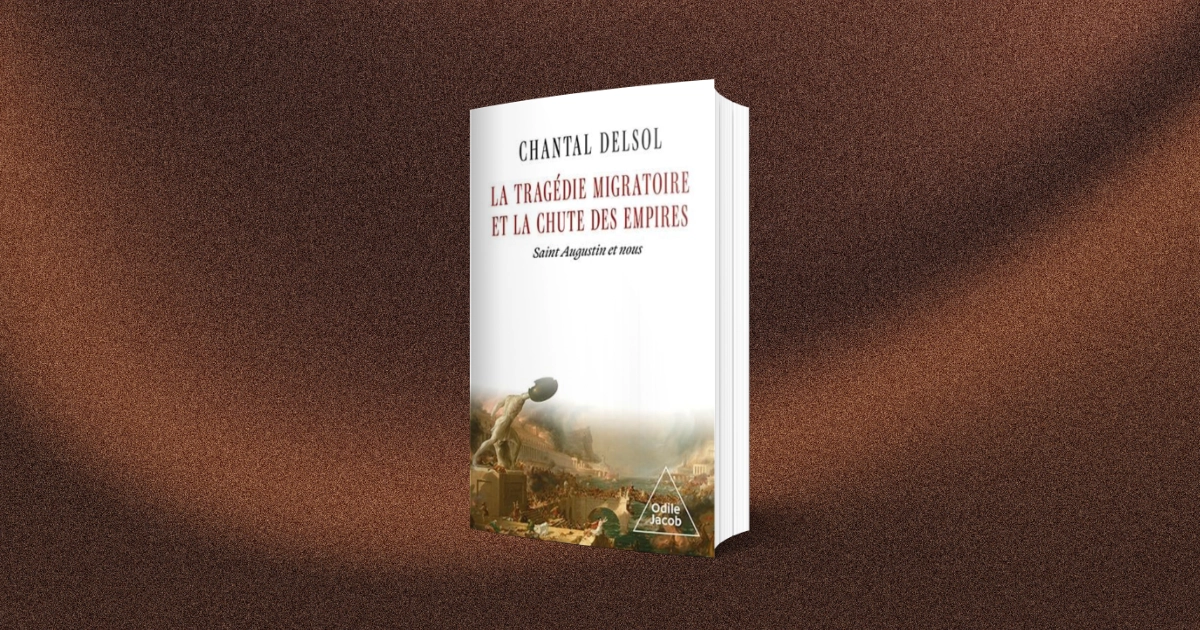
La tragédie migratoire et la chute des empires. Saint Augustin et nous
Chantal Delsol
Odile Jacob,
January 2, 2026
208 pages
ISBN: 978-2415013981
Chantal Delsol is a respected French political philosopher and academic and the founder, in 1993, of the Institut Hannah-Arendt. A student of antiquity as well as of modern times, she is a member of the French Academy of Moral and Political Sciences and the author of many publications, including a remarkable historical study of the subsidiarity principle. In this book, she reflects on parallels between the collapse of the Roman Empire during the life of St Augustine and the convulsions facing the West or the Western ‘Empire’ in our own time. Both Empires, she maintains, were ‘Conquest-Empires’, which expanded greatly over time but then became ‘Refuge-Empires’ that experienced large-scale immigration from the peoples that had been colonised in earlier times.
St Augustine’s life (354-430 AD) coincided with the time of collapse of the Roman Empire. He died in a city (Hippo) that was under siege and was shortly afterwards taken by Vandal invaders. Delsol uses Augustine’s writings, especially the ‘City of God’ as a framework for her reflections and notes that he began writing that book around the time of the Sack of Rome by Alaric in 410. Delsol documents the turbulent and complex interactions of the Roman Empire and the ‘barbarian’ tribes it encountered. In some cases, for example, barbarian tribes were invited in to help Imperial forces, while in others, they invaded the Empire. The fears of Augustine’s contemporaries, Delsol maintains, are similar to some Western fears today — for example, of being overwhelmed by people of different cultures. As today, these fears were much stronger among ordinary people than among elites.
For Augustine, Delsol maintains, the Resurrection is the central event in history, and the fundamental rupture in historical time. The Sack of Rome was a traumatism for Augustine but he didn’t confuse the Roman Empire, even in its Christian manifestation, with the City of God. Delsol praises this wisdom and detachment, rooted in a belief in the Resurrection. While she doesn’t analyse geopolitical developments in depth, Delsol’s argument is that we today are also living in a time of ‘rupture’, when the western ‘Cultural Empire’, which conquered the world, both militarily and by its powers of attraction, is under threat. In both Roman times and ours, the Empire saw itself as eternal — one recent writer even spoke, very prematurely, of the ‘end of History’.
In recent centuries, the ‘Western Empire’ — though we often don’t think of it as such — expanded all over the world in a massive movement of colonisation, advocating universalist values, which were shaped first by Christianity and then by the Enlightenment. This Empire, with its prosperous and ordered lifestyle, became deeply attractive to the peoples who were colonised. It is now experiencing a huge intake of immigrants and its international influence is diminishing and there is, she argues, a widespread sense of disintegration. She acknowledges, however that Western, apocalyptic visions of the end of the world are culturally conditioned and are not shared by people in the Global South.
In the final section of the book, which focuses on immigration, or what she calls the ‘migratory tragedy’, Delsol offers a stimulating philosophical reflection but no detailed policy prescriptions or ‘magical’ solutions. At one level, Delsol argues, we Westerners can’t complain about mass immigration today since we colonised, over a long period, the countries from which the immigrants come and now have to accept the consequences of our actions. Moreover, in the more recent, post-war period, Western countries also actively sought to attract relatively cheap labour from poorer countries.
One might nuance this argument somewhat in respect of Ireland as our country was itself colonised rather than being a colonial power. Moreover, we are rightly proud of the contribution of our ancestors to modern Britain, the former colonial power — an example of the positive impact of large-scale immigration. Nevertheless, we obviously exist today in the same prosperous Western European geographical space as several former colonial powers and possess the same ‘soft power’ held by other Western democracies but not by Russia or China. Immigrants have clearly voted with their feet by heading to Western Europe, America and elsewhere but not to authoritarian countries like Russia or China or to poor countries.
The immigration question, Delsol maintains, is a ‘tragedy’ in the sense that it manifests a radical and apparently insoluble contradiction between two sets of values which are both essential and ‘ravenous’ and which are based respectively on politics and morality. Politics suggests that Governments should protect the societies for which they are responsible. Morality suggests that one should accept all those immigrants wishing to enter one’s jurisdiction, even if it undermines the cultural identity of the receiving nation. Although Delsol presents the conflict as ‘insoluble’, she does offer some thoughts on constructive possibilities for the future and advocates approaches of ‘lucidity’ and ‘solidarity’.
‘Lucidity’ means having a clear contract of integration with arriving immigrants, including an emphasis, for example, on the attainment of language competence and the expulsion of illegal or criminal immigrants as well as having a ‘language of truth’ in relation to Islam, including in relation to its attitude to women in the public space, while maintaining respectful interaction with Muslims. ‘Solidarity’ means working in a serious and persevering way on the welcome and integration of new arrivals and respecting the work of associations working with immigrants on the ground. Both approaches, she maintains, require courage.
What she calls ‘angelism’, or an unrealistically optimistic perspective on imperfect human societies, includes, in this context, the notion that large-scale immigration doesn’t offer significant challenges or that there is nothing meaningful to discuss, and tends to provoke extreme positions on both sides of the debate. Extreme positions include, on the one hand, the argument that human beings are totally interchangeable while denying the importance of individual cultures or maintaining that only a universal culture matters. Extreme opinions at the other end of the spectrum include the arguments that immigrants are not motivated by need or generally wish to destroy the receiving culture.
Switzerland and Denmark, she says, are good examples of countries which have a successful immigration policy, marrying lucidity and solidarity or firmness and generosity. This is a dense and subtle essay, which draws on a lifetime of scholarship and is not easily reduced to neat soundbites. It illuminates current debates and usefully points to the path set out by St Augustine, of accepting the world as it is with humility, and of seeking to build ahead, not from ground zero, but from the concrete circumstances of the society in which we live, even at a time of dramatic change. She suggests that his equanimity and serenity at a time of great convulsion should be a model for us as we too live through enormous change. Her brilliant and thought-provoking essay may contribute to a revival of interest in St Augustine, and in his City of God, particularly now that a son of Augustine sits on the chair of St. Peter!
Tim O’Sullivan
Tim O’Sullivan taught healthcare policy at third level and holds a BA in History and French, as well as a PhD in social policy from UCD.