
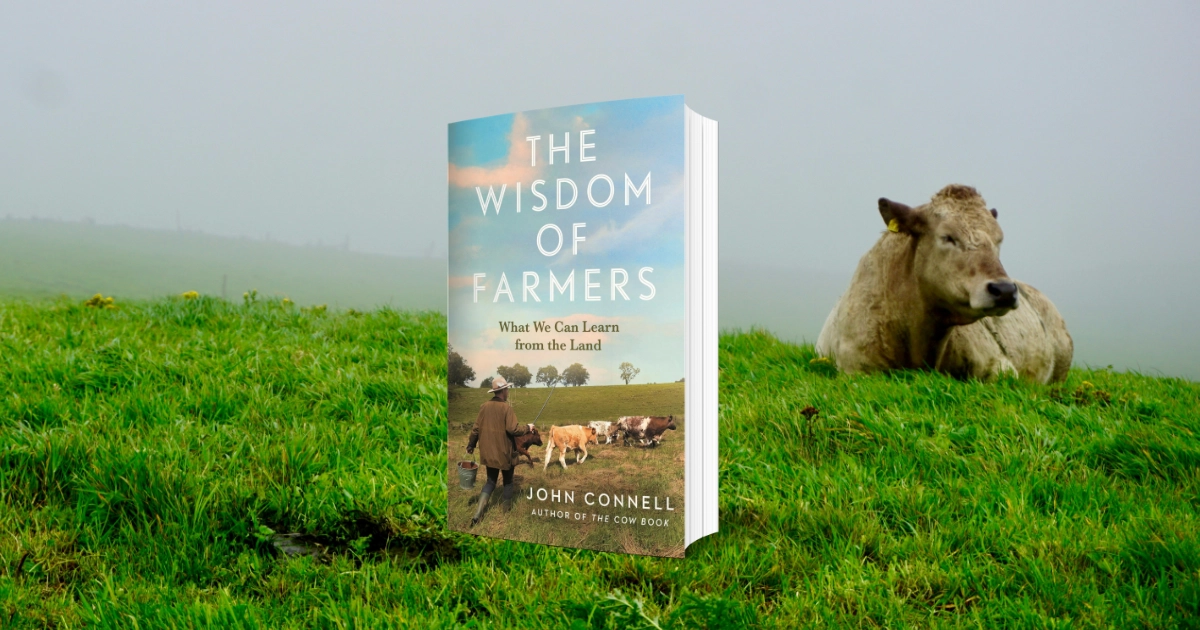
The Wisdom of Farmers:
What We Can Learn from the Land. John Connell. Allen & Unwin.
2026. 241 pp. ISBN 9781805464235
The Wisdom of Farmers comes at an interesting time in Ireland. Less than two months ago, widescale protests were staged in response to the global fuel crisis, involving thousands of workers who blockaded fuel depots, road infrastructure and Ireland’s only oil refinery at Whitegate. Many of them were farmers. The protestors maintain that their hand was forced by years of increasing overheads and hostile environmental policy, a pressure finally reaching breaking point in the Strait of Hormuz crisis. The government maintains that the protest was illegitimate, illegal and undemocratic. After an increasingly surreal week involving army scuffles and demands for renewed oil exploration off the country’s western coastline, the protesters folded and the government produced an eye-wateringly large support scheme in the hopes of shutting everyone up. What we are supposed to have learned from this is unclear.
John Connell is an author, investigative journalist, film producer and farmer. Based in Longford, he returned to his family farm almost a decade ago and has written several successful books since, the latest being The Wisdom of Farmers: What We Can Learn from the Land. It’s a self-help book with the genre’s obligatory Jordan Petersonian twelve rules, drawing on history, archaeology, philosophy, personal anecdotes, cowboys, and a good dash of rural common sense.
Connell’s central thesis is something he calls the “land philosophy,” an approach to life modelled on the hard-earned wisdom of farmers throughout history. It involves ideas such as “slowing down our lives,” “get[ting] up early,” and “the past is closer than we think.” Connell had to learn these principles himself in adult life, realising that he “had given [his] labours not to the earth, as all [his] forebears had done, but rather to technology, in the form of [his] life as a journalist in the early twenty-first century.” The sense of personal journey is vividly felt, as well as the joy Connell evidently feels at having at last come home.
Leaving aside for a moment the land philosophy and its lessons, there is much to the author’s credit here on the subject of farming and rural life. Connell is well-read and well-travelled, and his placing of the farmer at the very centre of history is illuminating. Farming gave rise to surplus, which gave rise to civilisation. Every one of us today is a descendant of the much-discussed first farmers, and each one of us shares the same brain as them, biologically speaking. This is an important premise for the book, with Connell keen to emphasise that for this reason and others, there is nothing to say city-dwellers can’t also profit from the land philosophy we’ve all been bequeathed.
Interesting also is the book’s emphasis on the societal value of the contemporary farmer. Why should farmers not expect to make a living from the country they feed? Why should those of us who do not produce food expect to be fed cheaply at the expense of those who do? Connell invokes Wendell Berry with his talk of the “plunder of rural America,” making a persuasive case that our food choices are intrinsically political in a global economy, and that as consumers we have a responsibility to make sure those choices are sustainable in the broadest sense: economically, environmentally and culturally. One only needs to open one’s laptop to observe the contempt that certain quarters of the Irish internet have for farmers and farming communities. This derision for the food-producing classes is dangerous and suggests an ignorance Connell is keen to address.
But as well as being a meditation on the farming profession, the book seeks to offer guidance to its reader. Some of this guidance is practical — get up early, be brave, work hard — but other sections lean heavily into a kind of ambiguous mysticism, with much talk of Pachamamas and other spiritually vague but attractive ideas. Equally vague are some of the definitions, including that of farming itself, which seems to include bullfighting (Chapter 7) and the wilderness (Chapter 11). It is hard to see how the goading and torturing of an otherwise healthy animal to death in front of a hollering crowd bears much resemblance to farming. “We all need wilderness” is the title of Chapter 11, and that is very likely true — but I remain unconvinced that farmers, who spend their careers imposing order on that same wilderness, cherish it in any special way.
This is perhaps my main frustration: the context is farming, the images are farming, the anecdotes are farming, the author evidently loves and knows farming very well, but ultimately the advice owes far more to the author’s personal philosophy than to our ancient goat-herding forebears. “If we can take the time to savour joy, we can discover our inner smile,” says Connell. “That smile resides within us, but at times we must work hard to stoke its flames.” There is, to be fair, nothing wrong with any of that. But it seems that Connell will frequently present a conviction he has and argue that it is based in the history or culture or psychology of farming, when in reality the conviction is general enough that some farmer somewhere at some time is bound to have adhered to it. For example, “Take Time to Savour Joy.” This is the wisdom of Mr Connell, as found in some farmers.
But I don’t wish to diminish the genuine insights on offer, originating though some of them might in the author himself. He is certainly shrewd in diagnosing society’s ills. He recalls the farmer’s motto, “Where you will have livestock you will have deadstock,” observing that in agricultural life, you are constantly aware of the presence of death. This is not so in the modern, urban world, he claims, where acquaintances of his hardly acknowledge the deaths of their colleagues, having no ritual framework in which to do so, and furthermore where the reality of food — that an animal lived and died so that we may eat — is sanitised through brightly lit supermarkets and plastic packaging. Death is put at a distance in a culture bent on excising all things which are not of comfort and convenience. But Connell warns us that all things have a price, even life, describing lakes poisoned by nitrates, soils degraded beyond use — though we may not see that price as we walk the frozen food aisle with Airpods in.
Connell emphasises the centrality of ritual in food, and of food in ritual, things which ground us in place, in community, in faith. Farming is a life of cycles, a ritual existence; to a farmer, the seasons still mean something. The first farmers knew “that there are times of feast and of modesty.” I would only suggest that my grandparents’ generation still held that same knowledge. It has taken no time at all for this hard-earned, received wisdom to be swept away by prevailing cultural winds, something against which this book very evidently wishes to push back. For that alone it is of value, making the case that our ancestors, farmers who survived generation after generation, might just have something to tell us. To be deracinated means to be without roots; farmers would have no difficulty telling you what happens to a plant in such a state.
I think there is a reasonable debate to be had about April’s fuel protests. They were shambolic and destructive, and a revolution rarely does what it sets out to do. We are probably lucky they ended when and how they did. We might use our good fortune, however, to reflect on the value of the work these people do, and on the unprecedented quality of life the rest of us enjoy as a result. John Connell in his short book makes a case for the centrality of the farmer in this precarious civilisation. It’s a world built on stone walls and cattle grids — it’s time we remembered that.
Luke Power
Luke Power is a writer and teacher living on the west coast of Ireland. You can find him on Substack under the title Out on the Western Plain.