
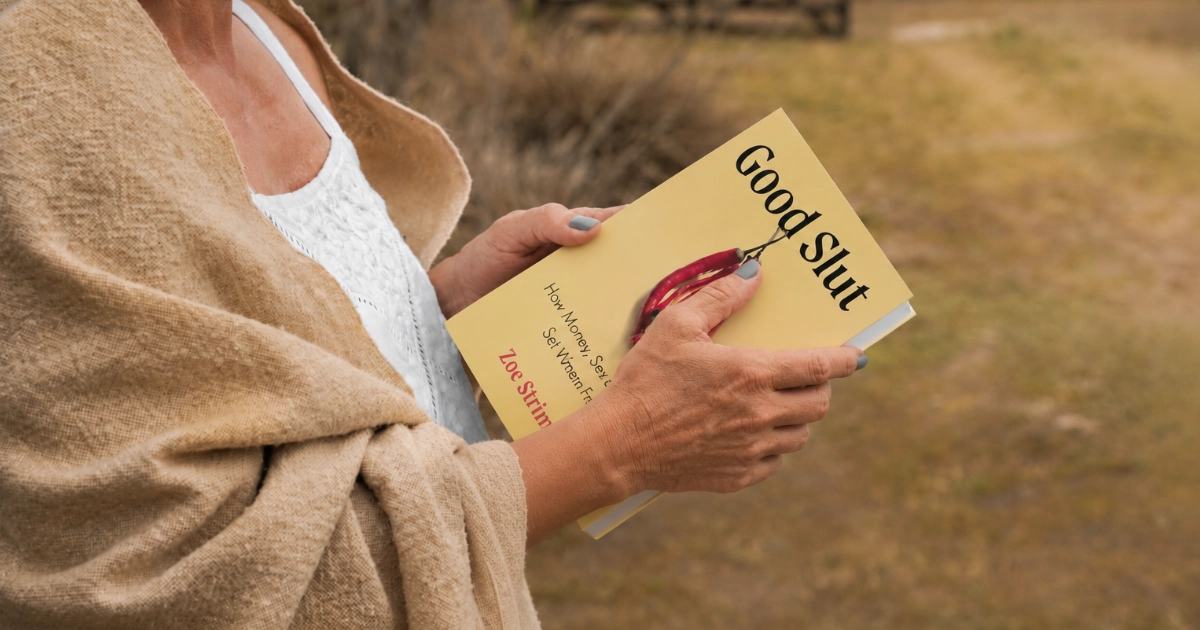
Good Slut: How Money, Sex and Power Set Women Free.
By Zoe Strimpel. London: Constable, 2026.
256 pp. ISBN 9781408720974.
Zoe Strimpel is a columnist who writes in various leading British conservative publications. She holds a PhD in modern history, and her main area of interest and expertise is gender and feminism. She is an atheist of Jewish parentage, which is an important part of her personal identity and heritage.
The title of her book is so provocative as to appear ironic, but in fact there isn’t a single thing about the sexual revolution which she sees in a negative or even mildly critical light. It’s all good, all win-win for women in every single respect. Her book is a direct response to the emerging new revisionist movement in feminism led by writers like Louise Perry and Mary Harrington, who have come to see that the sexual revolution failed women and damaged society. Her response to them concedes nothing.
She sets her tone from the first pages. “Women have never had it so good,” citing advances across a wide spectrum that run from progress in the medical, scientific, and biotechnological sectors to recognition of equality in all areas of civil and social life. She points out that the movement for full equality and inclusion for women has led in turn to movements advocating for other vulnerable groups and minorities.
Progress is underpinned by a “morally robust but not authoritarian” new ethic, “encouraging of most appetites but not without curbs.” She sees the undermining of family life and traditional norms as a positive thing because, in her view, they tended to be “abusive and oppressive.” Strimpel notes the result of polling that indicates young mothers are dissatisfied with many aspects of their emancipated lives but dismisses it summarily as nostalgia for a life that never existed outside patriarchal propagandising. She points to the cult of the “trad wife” in American culture that’s all about happy dependency in comfortable, tasteful homes, filled with the sound of children and simple joys.
The pattern of her polemic is clear from the start. She points to bad and atypical examples and exaggerates failures in systems and structures that overwhelmingly deliver good outcomes both for individuals and communities before resting her case and then going on to make equally sweeping claims for the success of the sexual revolution. Its failures don’t count because they are the result of freely made choices, not coercion, as she sees it.
Strimpel can’t comprehend how any woman would freely choose to raise her own children in her own home and forfeit, at least temporarily, “the conversation, routine and financial independence” of a career. She understands the tug towards motherhood that most women feel but is convinced it’s possible “to have it all,” with good organisation and adequate social supports. She cites revisionist feminists like Harrington and Perry as examples of how career and motherhood can satisfactorily combine.
Unlike the latter two, Strimpel is a “go it alone” mother. Her plans to have a baby through in vitro fertilisation were overtaken by what seems like an opportunistic decision to become pregnant with a casual sexual partner. She claims rather absurdly that “women often find bringing up children with men extremely difficult.”
She is strongly in favour of free, unfettered, self-tailored choice within a very lightly regulated social order where “norms and values, no longer imposed from on high, become a domain regarded as more appropriately governed personally.” She also believes light-touch governance in the financial and economic, as well as moral, spheres delivers best for most people. She has no time for the grievance politics to which feminism, in both its liberal and revisionist versions, has succumbed.
In her multiple-choice ethic, all answers can be either right or wrong depending on how they work out for a specific individual in specific circumstances. It all comes down to a philosophy of unabashed, unapologetic hedonism. Oddly, however, it’s the counterintuitive and outlier choices that she most enthuses about. Thus motherhood is optimal around forty because mature women handle the challenges of motherhood better. She tells us that “single women do better, live longer.” Porn and prostitution are just dimensions of the “sex-positive” culture she celebrates. It can be exploited by women as much as men, citing the OnlyFans website. She disputes evidence that porn promotes sexual violence, observing that “violent men are attracted to porn.” She claims casual sex with strangers is safe for most women and not usually emotionally damaging.
It all sounds a bit like saying anyone can walk an unprotected, narrow, slippery bridge without falling off because a few people manage to do it, or have managed to do it up to a certain point in life. At forty-three years of age, Zoe Strimpel has a lot of living ahead of her, and one wonders if she will still think the same way from a broader life perspective as choices narrow inevitably as the years roll on.
What makes this book a fascinating read is what it reveals about the emergence of new forks in the road of the feminist movement. Mainstream feminism, as Strimpel points out, has become consumed with a grievance and disempowerment complex. It has diverted its energy into a broader, left-leaning political activism, characterised as DEI (Diversity, Equity, and Inclusion), that is focused on power structures, in which many women participate, rather than patriarchy per se. Early feminism, according to this view, has empowered some women and some members of ethnic minorities, but “the tide didn’t lift all ships.” These women, typified by Sheryl Sandberg, former CEO of Facebook, are regarded as collaborators with patriarchal capitalism rather than the trailblazers they imagine themselves to be.
Reactionary or revisionist feminism, led by writers like Mary Harrington and Louise Perry, has come to see that the sexual revolution, based on the view that what’s good for men is good for women, and the biotechnology—transhumanism, to use the word minted by Harrington—that enabled it, is the problem. Zoe Strimpel takes issue with both current streams of feminism by keeping faith with the original equality of opportunity objectives the movement started out with and celebrating what are for her its successes. Her message is, it’s there for you, take it. She’s essentially telling women you can survive, even thrive, in the moral jungle because not everyone gets devoured.
Strimpel lives in the cultural bunker, so well described by Pope Benedict XVI. The women she refers to, whether of her own brand of feminist positivity or women who espouse reactionary feminism, are all clever, educated, and highly resilient. They have careers. They work in what Mary Harrington calls “the knowledge economy.” They generally don’t have to do the household chores that Strimpel says women “detest.” Yet, those chores remain to be done by someone and are generally carried out by a class of women who are completely invisible to feminists like Strimpel. In fact, the “chores” of caring for one’s own home and family are far more satisfying and rewarding than the repetitive grind of many of the jobs open to women who are not privileged educationally and socially like Strimpel, Harrington, or Perry.
The blinkered moral vision from a writer and columnist who can certainly see the wood from the trees when it comes to other subjects is staggering and sobering. She represents a large swathe of public opinion which sees morality as entirely subjective and relativist unless perhaps one tries to push back against such a creed publicly.
For Strimpel, the baby in the womb is “a clump of cells.” Even if it should become more than that at some point before birth, it remains “a choice,” for her. Unsurprisingly, she doesn’t take that line of discussion any further. She wouldn’t see the point. Each person must be free to decide their own right and wrong, however others may think.
Her book offers a useful indicator of how deep the divide is in public moral and ethical discourse. It’s about more than the effect of people talking to one another in online ideological bubbles. The bubbles are the result, not the cause, of the emergence of irreconcilable ways of thinking. One is faith-based, whether explicitly or tacitly. The other comes from a restless nihilism tormented by a desire for meaning or at least validation.
Bringing people together to dialogue, where that is possible, isn’t enough because the filters through which people like Strimpel see the world have become internalised, part of the very process of their seeing.
It comes down to the fundamental point of divergence, which is whether one believes in God or not. If that premise isn’t challenged or defended first, it’s hard to reach minds and hearts that have been so radically re-wired by the toxic creeds of our time. For me, this book makes the case for an unapologetic promotion of the Gospel, which is the only real argument against a well-established and well-buttressed tyranny of relativism. Chipping away at its arguments separately isn’t enough. Its grounding assumptions need to be confronted. Without challenging its fundamental premises and presenting what it means to be human within a metanarrative, we might as well be trying to persuade a tone-deaf person of Wolfgang Amadeus Mozart’s genius.
Margaret Hickey
Margaret Hickey is a regular contributor to Position Papers. She is a mother of three and lives with her husband in Blarney.