
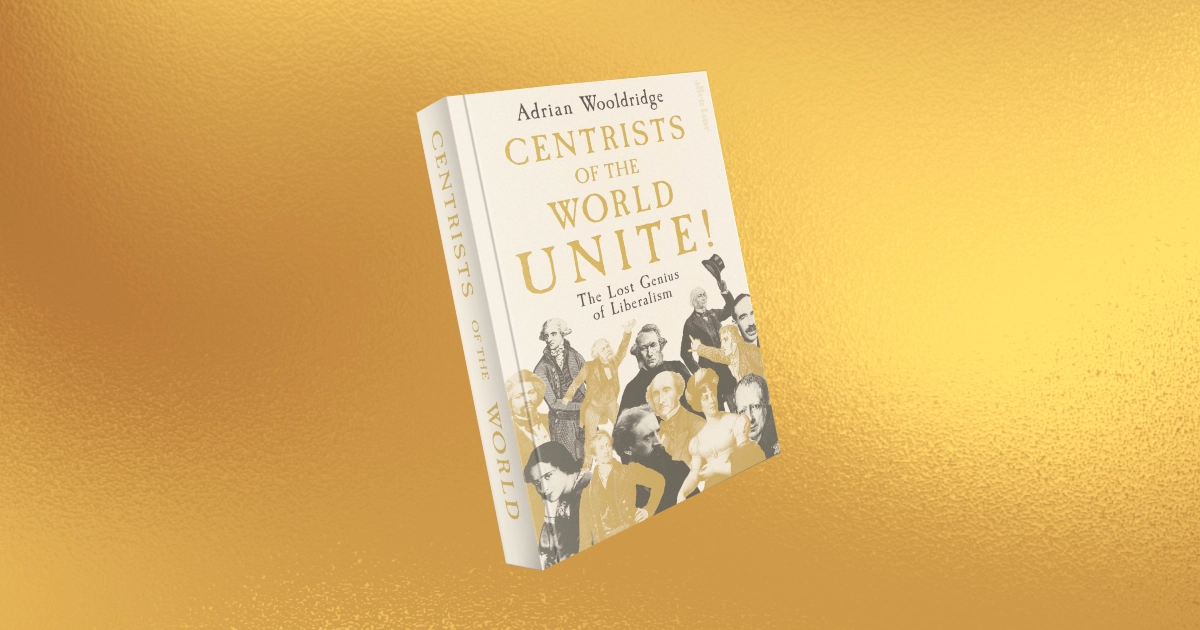
Centrists of the World Unite!: The Lost Genius of Liberalism
Adrian Wooldridge
Penguin Books Ltd
March 12, 2026
416 pages
ISBN: 978-0241758700
It is difficult to speak authoritatively about liberalism in the political realm, not least due to how nebulous that term surely is. By many metrics, the liberal establishment in the West — especially the large centre-left parties — has been in decline of late. In America, the problems facing the Trump administration have obscured the failure of the Democratic Party to come to terms with its 2024 catastrophe. In Britain, Labour is well on its way to destruction at the next election. Once powerful social democratic parties in France and elsewhere have come asunder.
In many countries, it is not their traditional rivals in the centre-right parties (Germany’s CDU/CSU, France’s Gaullists, Britain’s Tories, etc.) which have profited, for these parties are also facing huge challenges from populist alternatives, or from populist or nationalist elements within their own organisations. These parties or party factions (Alternative für Deutschland, Rassemblement National, Reform UK, and the rabid MAGA faction within the GOP) often see their central goal as being the destruction of the political establishment. Clearly, the liberals are embattled, centre-right and centre-left alike.
Centrists of the World Unite!: The Lost Genius of Liberalism is aimed at that audience, and is written by one of the most eloquent voices which liberalism can offer. Adrian Wooldridge spent more than 20 years writing for The Economist, which has long been a great bastion of liberal thought, both economic and social. Together with his longtime literary collaborator John Micklethwait, Wooldridge has co-authored insightful and entertaining books like The Right Nation: Conservative Power in America (2004) and God Is Back: How the Global Revival of Faith Is Changing the World (2009). Working alone, he has also crossed swords with Harvard’s Professor Michael Sandel by penning a very persuasive defence of the concept of meritocracy, The Aristocracy of Talent (2021).
Wooldridge is a committed liberal, but one who sees the damage which excessive liberalisation has wrought, and throughout the book he skilfully manages to trace the evolution of liberalism in such a way that he can mount a qualified defence while also suggesting certain correctives. Liberalism’s undeniable value is seen in the conditions which existed in the pre-liberal era, where economic stagnation was a fact of life and where people had little say over the direction of their lives. “Pre-liberal societies were defined by group membership and collective traditions,” Wooldridge writes. “Societies were regarded as fixed hierarchies stretching from the ruler at the top to the peasant at the bottom, and individuals occupied their positions on the basis of parentage rather than talent.” India’s caste system offers a frightening example of what this must have been like. The gradual development of the concept of individual rights (a process which owed much to the rise of Christianity, as Wooldridge himself notes) ushered in a new and brighter era.
Wooldridge describes individualism as being built around four basic freedoms: the freedom of thought; the free market; support for “experiments in living;” and self-development. After flourishing in the Anglosphere and spreading elsewhere, European liberalism declined significantly in the interwar period, where a democratic rollback occurred. A careful and studiously balanced writer, Wooldridge makes clear that the rise of Fascism was only one part of the broader decline of liberalism, as it was in this period that the Communist regime in the Soviet Union attracted growing support from a wide range of left-wing Western intellectuals.
The US-led victory over the Axis powers and the successful construction of liberal democracies in those countries are a vital part of the author’s argument about the need for liberalism, as he sees no hope for success being offered by the three alternative visions: the populist project; the anti-liberal thinking offered by religious thinkers, or the left-wing celebration of identity politics. Instead, Wooldridge wants to see a rejuvenated and reformed liberalism emerge. He cites the development of a federal West Germany under the leadership of Konrad Adenauer as an example of how a better balancing of rights and wealth can be achieved, although it is unfortunate that he does not focus on the Catholic social teaching which informed Adenauer’s decisions as Chancellor.
Anti-liberal thinkers like Patrick Deneen would likely contend that this balancing of rights rarely endures for long, and to his credit, Wooldridge engages with this and other critiques, demonstrating an outstanding command of the subject matter. He also recognises the darker side of the liberal idea, highlighting as he does the manner in which Thomas Hobbes dissolved all societal bonds in his vision of a Leviathan state. From that seventeenth-century foundation, modern liberals have too often invoked the need for social freedom as an excuse to attack the mediating institutions (particularly the churches) which bind people together and establish what we understand as human society. For many a liberal or progressive, it seems that there is no expansion in the power of the central state which is unjustified.
This does not have to be a liberal dogma. Wooldridge writes that respect for local government was at the heart of the American Revolution, but that the French Revolutionaries — brought up in the tradition of the ancien régime — had a very different approach. He bemoans the influence which French centralisers have had on the development of the EEC/EU project, while suggesting that a more German or British influence would have guarded against this. On this topic, he would have been better off focusing on the dramatic increase in the power of America’s federal government vis-à-vis that of the states which formed it. Nevertheless, the point is well made. An acid test for liberals in the coming years (in Washington DC or Brussels) will be to what extent they tolerate decisions being made at state level which they disagree with, for instance, when it comes to transgenderism.
When discussing where liberals have gone wrong, immigration occupies much of the author’s attention, and rightly so. Wooldridge draws attention to the rise of “parallel societies” and the difficulty European countries have faced in assimilating large Muslim populations. He praises those countries like Denmark which have focused more on “selectivity, assimilation and fit,” while also pointing out that Spain and Portugal are wisely prioritising immigration from Latin America. He is also scathing in his critique of drug legalisation, which he calls the “most misguided liberal policy of recent decades,” while arguing that a reversal of this move “is a precondition for taking back the streets and reweaving the social fabric.”
None of this is revolutionary, but consider the source of the criticism. Wooldridge’s opinion matters. His treatment of the societal role of religion is particularly interesting. As the author makes clear, religious minorities have often embraced liberal reforms as a means of protecting themselves from the tyranny of the majority. Jewish liberalism and even radicalism in Tsarist/Orthodox Russia are an example of this, but there are many others. To this day, liberals are often antagonistic towards any religious influence in public life. Wooldridge urges like-minded readers to consider the role of tradition in counteracting the worst aspects of individualism, and writes that “liberals need to recognise that conservatives have awoken earlier than they have to the potential dangers of pornography, drug addiction and the breakdown of social order.”
He urges liberals to become more open to differences of opinion, and less detached from their countrymen socially, politically and economically. “The elite needs to sink its roots much deeper into the soil of society by recruiting bright working-class children, not least by reviving standardised tests, selective schools and gifted programmes. Just as importantly, it needs to recruit people with a wider range of views on social and religious issues. The ideological narrowing of the elite has not only reduced its talent for debate as elite enclaves become echo chambers, it has driven all too many talented mavericks into the welcoming arms of the populists,” he writes.
Centrists of the World Unite! is a brave book, and its publication should cement Adrian Wooldridge’s standing as one of the finest journalists and commentators of this era. Will other liberals listen? Social democrats in Denmark and Britain have changed their tune on immigration, but there are few signs of a broader recalibration, particularly in America where the Democrats hope that unforced errors by Donald Trump will save them. Here in Ireland, the liberal political project still has some distance to go, not least due to the desperate condition of Irish conservatism as a political force. International evidence suggests that the social and political establishment only considers its own failures and biases in response to a serious political defeat. That has not happened yet.
Conservatives should welcome Wooldridge’s book, though, and should consider their own preconceptions about the liberal world order which previous generations have handed down to us. For all its flaws, liberalism has made us free and wealthy beyond the imagination of our ancestors, and the political framework it offers is still infinitely superior to the authoritarian political models offered by Communist China, imperialist Russia, and the various other savage dictatorships now threatening the West. Centrists should unite, and if an olive branch is sincerely offered to Christians, they should remember the example of Konrad Adenauer (and others) and take it.
James Bradshaw
James Bradshaw writes on topics including history, culture, film and literature.