
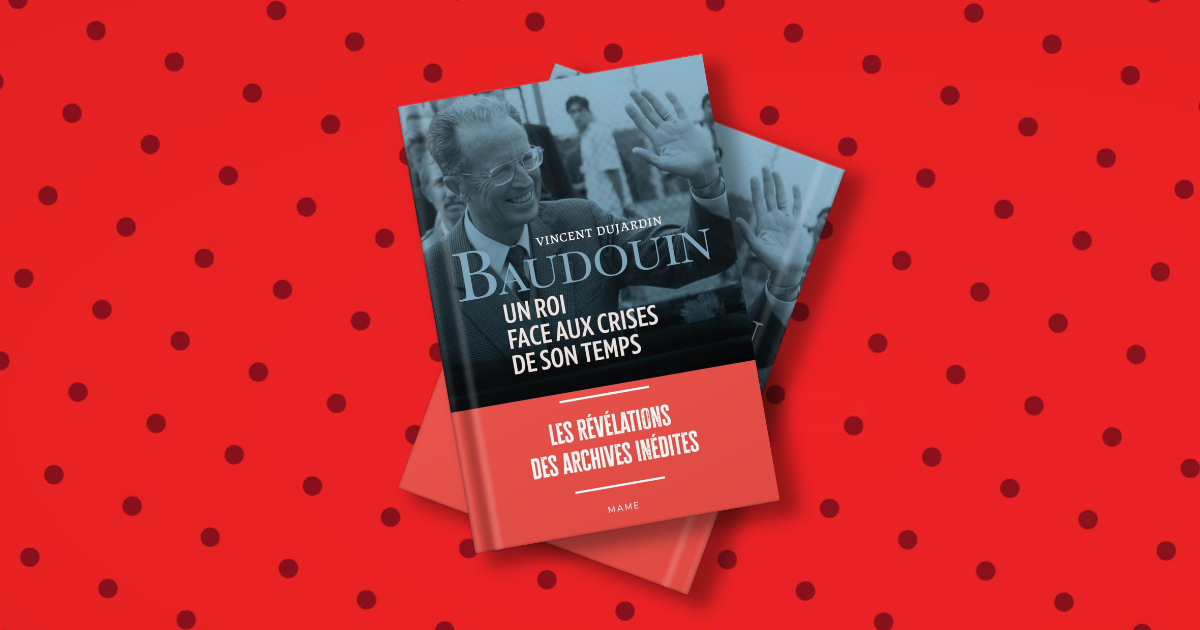
Baudouin. Un roi face aux crises de son temps. Les Révélations des Archives Inédites (Baudouin, A King Facing the Crises of His Time: The Revelations of Unpublished Archives)
Vincent Dujardin
Mame
2026
877 pages
ISBN: 978-2728939053
In his historic address to the Spanish Parliament in June, Pope Leo stated that “every human life must be recognized and safeguarded, from conception to its natural end.” Can a society, the Pope asked, that casts into the shadows the unborn child, the elderly, the sick, those who suffer in silence, or those who depend entirely on the care of others be called fully just?
King Baudouin of Belgium (1930–93) is an inspiring recent example of a Christian head of state who witnessed at a critical moment to the sanctity of human life. This meticulously researched French-language biography of Baudouin by Vincent Dujardin, a Belgian historian, draws on twenty years of research and on the author’s access to the King’s previously unpublished personal archives, such as his diaries. Queen Fabiola (1928–2014), Baudouin’s widow, provided Professor Dujardin with this material.
Baudouin had a difficult childhood and youth. Born in 1930, his mother died in an accident when he was five. During World War II, he experienced periods in exile and much uncertainty. Because of his role during the war, Baudouin’s much-loved father, Leopold III, became a deeply controversial figure in Belgium and was finally obliged to abdicate in favour of his son in 1951, when Baudouin was just twenty years of age.
Prof. Dujardin calls the 1950s the “difficult years” for Baudouin. He had a strong sense of injustice about how his father had been treated but was also living with his father and step-mother and was arguably too much under their influence while also serving as King. All that was to change with his marriage in 1960, a marriage in which there was an important Irish connection. In March 1960, through the future Cardinal Suenens of Brussels, Baudouin met Veronica O’Brien, from Midleton, Co. Cork, a remarkable Irish envoy of the Legion of Mary in Continental Europe, and she undertook to help him find a suitable spouse. Baudouin’s devotion to St. Teresa of Avila predisposed him to marrying a Spaniard.
In May 1960, in Madrid, O’Brien met an aristocratic Spanish lady, Fabiola de Mora y Aragón, and quickly became convinced that Fabiola would be a most suitable wife for the Belgian king. After some initial hesitation on the part of Fabiola, who was being asked to embrace a very different, royal future overseas, the relationship between the couple developed quickly, for example, during a brief pilgrimage to Lourdes, and they were married in Brussels in December 1960. The biographer and many contemporary observers have described 1960 as a major milestone for Baudouin, and indeed for the Belgian monarchy, and highlight his more joyful and creative persona after his marriage.
He and his wife were a deeply devoted and united couple but had to accept the suffering of childlessness, as Fabiola experienced several miscarriages; they eventually came to understand that they had a wider parental role for the whole nation.
Some of the material in the book will be of interest mainly to students of Belgian politics. However, the long chapter on Baudouin and Africa is likely to be of wider interest. Belgium’s colonial record in the Congo from the late nineteenth century has been a matter of great controversy. When Baudouin came to the throne, the time for decolonisation had come. This biography covers the achievement of independence in the early 1960s by the Congo, Burundi, and Rwanda and the post-independence relationships between Belgium and those countries.
Although Irish peacekeepers in the Congo in the 1960s do not get a specific mention here, Irish readers might be interested in how the Belgian authorities viewed their difficult relationships with colonies and ex-colonies during a very turbulent period. Drawing on unpublished material in the King’s personal archives, Professor Dujardin rejects certain accusations, which he sees as inaccurate and unjust, about the role of Baudouin, particularly in the early 1960s in the Congo, and offers an evidence-based rebuttal of claims, for example, that Baudouin was in any way implicated, or at fault, in the killing of the Congolese leader Patrice Lumumba in 1961.
Dujardin devotes a chapter to the abortion controversy of 1990. In that year, King Baudouin refused to sign a law permitting abortion and was obliged to stand aside temporarily. This was a time of anguish for Baudouin. He had a deep conviction that a Christian monarch could not sign the abortion bill but was also concerned about the long-term implications for the monarchy of his refusal to sign. He was prepared to abdicate and go into exile, had that been required, but, in the end, a more temporary solution was found.
Baudouin was also concerned about the impact of his stance on public opinion, but he need not have worried, as there was widespread respect for his courage and conviction, and his first public appearances after the controversy were marked by standing ovations. While Baudouin’s action did not prevent the legalisation of abortion in Belgium, his courageous witness undoubtedly prompted significant reflection nationally and internationally on the need to respect human life and to follow one’s conscience in public life.
Finally, Baudouin’s strong faith is very evident throughout this biography. His diaries feature his ardent prayer before important or challenging meetings and even his openness to personal prayer with other heads of state. The life of faith of Baudouin and Fabiola also overflowed naturally into a spirit of committed service to the Belgian people. Biographies of impressive Catholic figures do not necessarily get great attention in our media, but the life of this Christian head of state deserves to be better-known.
Tim O’Sullivan
Tim O’Sullivan taught healthcare policy at third level and has a BA in History and French and a PhD in social policy from UCD.