
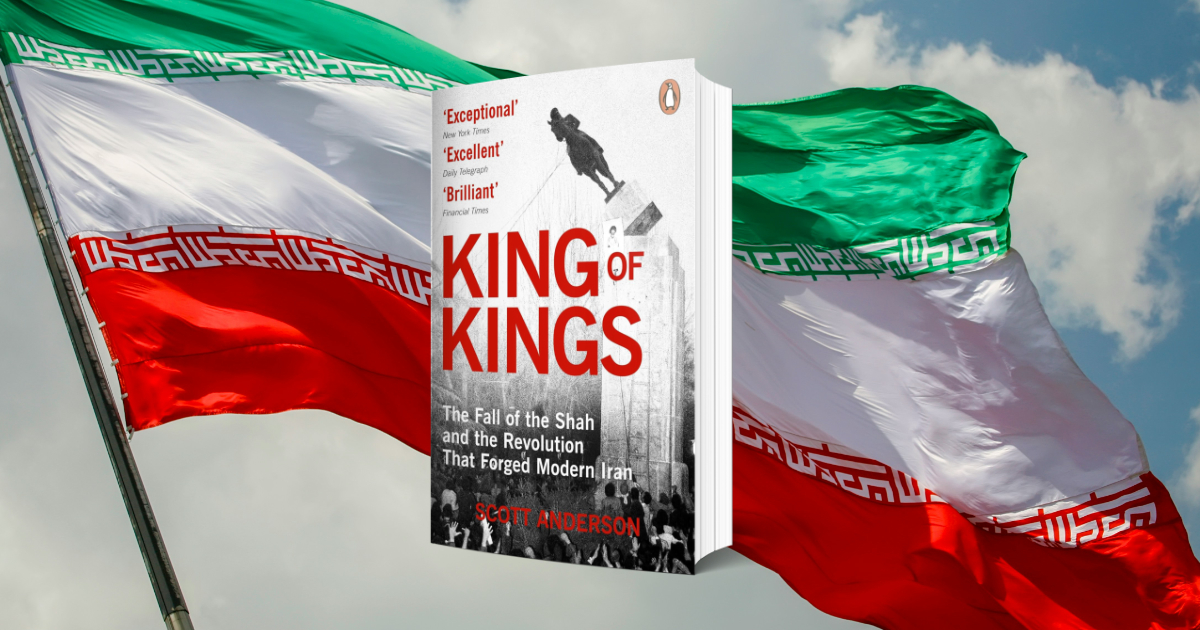
King of Kings: The Fall of the Shah and the Revolution That Forged Modern Iran
Scott Anderson
Doubleday
2025
688 pages
ISBN 9780385548607
Sometimes a great book can suffer the misfortune of being released at the wrong time. Other times, a mediocre book can become a bestseller due to its publication coming at a fortuitous moment. And then there are those rare occasions when a truly brilliant book is released at precisely the right time. This happened in 2025, with King of Kings: The Fall of the Shah and the Revolution That Forged Modern Iran.
The author Scott Anderson is an experienced war correspondent who has written several books about the Middle East. King of Kings hit the shelves shortly after the Twelve-Day War in June 2025, which led to President Trump’s momentous decision to strike Iran’s heavily fortified nuclear facilities. Trump’s decision to launch a wider U.S.-Israeli offensive against the Islamic Republic in February 2026 has made last year’s war look insignificant by comparison, and in the wake of the short-lived peace deal, it appears as if intense conflict between America and Iran will continue.
The answer to the question of how Iran became America’s bête noire can be found in Anderson’s stunningly incisive and skillfully written book. Anderson asserts that the Iranian Revolution of 1978–1979 ranks alongside the American, French, and Russian equivalents as one of “that small handful of revolutions that spurred change on a truly global scale.” Three principal characters were involved: the Shah Mohammad Reza Pahlavi, Ayatollah Ruhollah Khomeini, and the President of the United States, Jimmy Carter, each of them guided by a very small number of key advisors.
The Shah – the King of Kings, Shahanshah – is surely the most intriguing of the three men, having reigned from 1941–1979, during which time he oversaw Iran’s extraordinary economic and social transformation. Given the monstrous nature of the regime which replaced the last Shah, it is understandable that many regret his fall. Today, the last Shah’s son, Reza Pahlavi, is the effective leader of Iran’s opposition. Yet, the portrait of his father which is presented here is deeply unflattering. In spite of his power and prestige, the last Shah was an exceptionally inadequate man, who felt the need to have a second coronation ceremony a quarter of a century into his reign because the first one was not impressive enough.
He demanded a level of obsequiousness which went far beyond that practiced by the average dictator. His loyal minister Asadollah Alam – whose death on the eve of the revolution robbed the Shah of his best advisor – was required to kiss Pahlavi’s hands at the start of every morning meeting. The Shah sacrificed his blameless longtime Prime Minister by sending him to prison in a bid to deflect from his own failings, and that friend would ultimately die a barbaric death when Ayatollah Khomeini’s thugs seized the prisons.
The crisis of 1978–1979 was not the first time Pahlavi was almost toppled. In the famous (but mostly misunderstood) coup d’état of 1953, the Shah had actually fled the country before the Iranian plotters and their CIA/MI6 assistants got to work. When Ayatollah Khomeini denounced the Shah’s rule in 1963, it was Prime Minister Alam – not the spineless Shah – who ordered Khomeini’s arrest. When enraged Islamists took to the streets in response and the whole regime was imperilled, Alam’s view was clear: the security forces needed to use lethal force. The Shah’s response to that advice summed him up as a human being: “Mr. Prime Minister, if that is your judgement, and you are prepared to take the consequences of your judgement, you may proceed.” Alam repeatedly urged his ruler to introduce some kind of democratisation in order to secure the country’s future, but the Shah prevaricated. When the crisis escalated in late 1978, there was no Alam to advise on how to navigate it, or to demand that the Shah take strong measures.
Khomeini appears to have been a different beast, a true fanatic who lacked any trace of humanity. When he first arrived as an unknown visitor in the French village of Neauphle-le-Château, the locals thought little of the strangely dressed holy man, but they did notice one thing: he never smiled. As the prospect of Khomeini coming to power increased, foreign journalists flocked to France to hear his thoughts as transmitted (and sometimes not translated) by a Westernized interpreter, Dr. Ebrahim Yazdi, who knew how to present his master in a sympathetic manner. Yet one female Canadian journalist saw that Khomeini’s “facial expression betrayed no emotion, and his eyes seemed like black holes.” She was, she later reflected, overcome by the “feeling that I was looking into the face of evil.”
King of Kings is to a large extent the story of American incompetence, particularly that of officials who were tasked with intelligence, and displayed none whatsoever. During his long exile, Khomeini’s warlike sermons were smuggled into Iran on widely available tape cassettes, but until the dying days of the Shah’s regime, the CIA and State Department had made no effort to translate those tapes into English. Instead, many security figures allowed themselves to think that the Ayatollah was someone America could do business with. Upon making his triumphant return to Iran in January 1979, Khomeini went straight to the graveyard where Islamists killed by the security forces had been buried and excoriated America while threatening Iran’s military leadership with slaughter. America’s Embassy – soon to be overrun – did not even think to send a Farsi speaker to the speech to listen in.
Jimmy Carter was one of the foremost casualties of the ensuing hostage crisis, going down in flames against Ronald Reagan in the 1980 presidential election. Yet he bore significant responsibility for the Iranian Revolution, probably more than Anderson concedes. Having helped make the U.S.–Iranian relationship into one of America’s most important international partnerships, Carter was painfully indecisive as the revolution unfolded. When the American Embassy was stormed and its diplomats taken hostage, Khomeini quickly sensed that America’s leader lacked the strength to use military force, and so the Americans remained in bondage.
The tragic legacy of all this is seen today in the suffering of the more than 90 million people who call Iran their home. Whatever his flaws, the last Shah could point to real accomplishments. Per capita income increased twentyfold during his reign, the literacy rate quadrupled, average life expectancy more than doubled, and a large middle class emerged. Had a Pahlavi remained in power, the country would likely be the main economic, military, and political power in the Muslim world, without being the socially repressive regime it is now. Was the Shah brutal? Surely, but to nowhere near the same extent as those who replaced him.
Anderson quotes estimates by human rights groups that the Shah’s secret police killed fewer than 100 people in the last decade of his reign. Contrast this with the 8,000 Iranians executed in the first four years of Islamic rule, not to mention all those killings which followed. More to the point, consider the Islamic Republic’s crimes in the months since this book was published. After ordinary Iranians took to the streets in December 2025, trigger-happy government forces embarked on a campaign of slaughter which took thousands, or perhaps tens of thousands, of lives. The morality of Trump’s military offensive – including the assassination of Khomeini’s successor, Ali Khamenei – cannot be considered without this being factored into the equation.
King of Kings provides an important lesson about the perils of rapid social change. Iran under the Shah was becoming wealthy, but the wealth was unevenly distributed, and that inequality helped to fuel the discontent among poorer and more traditionalist Iranian Muslims. Fixated upon the ideological battle with Soviet Communism, America’s leaders failed to even try to understand the religious dimension. The Shah, being only nominally Shia, also failed to properly engage with the moderate religious authorities in his country.
Anderson draws a comparison (made previously by others like the late, great John L. Allen) here between Shia Islam and Catholicism, with its saints and rituals and pilgrimages. Like James II in Anglican England, the Shah thought he could rule without the hierarchy, but he could not. Those tasked with overseeing American foreign policy thought that religion did not matter, but it did.
This is an outstanding book about a tragic revolution, which could have been averted at multiple points. It has endured for almost half a century, and the most recent blows inflicted by America and Israel have not shattered its foundations. Perhaps the best Western commentator on Iran is the Catholic convert Sohrab Ahmari, who left his homeland as a child. Writing in 2022, Ahmari identified many of the factors which led to the Iranian Revolution, while also explaining why the presence of millions of committed supporters of the Islamic Republic makes regime change unlikely.
Ahmari’s argument continues to ring true, and this reinforces the thesis of Scott Anderson about the lasting significance of the fall of the Shah. We still live with its consequences, and probably will for many years to come.
James Bradshaw
James Bradshaw writes on topics including history, culture, film and literature.