
Despite its uniqueness among Hollywood blockbusters in being named for a Catholic prayer and using a marketing tagline emphasising faith, there is little in the plot that is formally Catholic about Project Hail Mary. Nor does the script ever mention football, much less that fateful pass in 1975 from Roger Staubach that was preceded by a whispered prayer to our mother (and through which the Hail Mary pass became an indelible feature of Americana). Yet the film, based on the Andy Weir novel of the same name, does imagine a doomsday scenario for which invocation of Our Lady’s aid is fitting.
The sun’s brightness is diminishing—almost imperceptibly at first, but exponentially over time. Something is depleting its energy—a sort of space algae that can travel near the speed of light is eating the sun. At the rate of diminishment, catastrophic global cooling will lead to mass extinction events, ecosystem collapse, and crop failure, such that half the world’s human population will die within thirty years—and all the rest not long after.
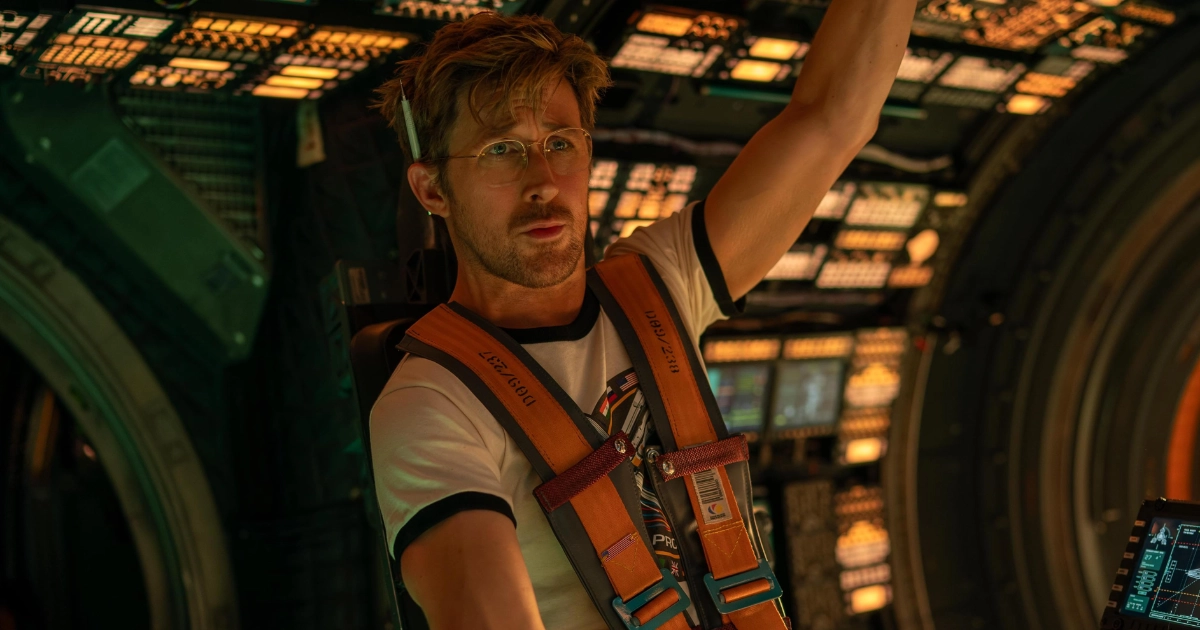
Ryland Grace (played by Ryan Gosling) is our improbable hero. He awakes from a coma on an interstellar ship, the Hail Mary, with amnesia. The pilot and engineer, his crewmates, are mysteriously dead—Grace alone fills the Hail Mary. Only slowly does he remember that he, the science officer of the crew, was a middle school science teacher and failed academic who had been run out of academia for his heterodox views of astrobiology. Those very views, he recalls, were the reason he was sought out by Eva Stratt, the leader of a global task force, to find a solution. Reminiscent of the Roman dictators of old, Stratt was empowered by the governments of the world with despotic powers and immunity from domestic civil and criminal laws to requisition persons and goods and to do whatever is necessary to find a solution.
It turns out that Astrophage has infected all the nearby stars save one: Tau Ceti, 11.9 light years away. The only solution is to go there and find out why. This would be impossible with current human technology, which could send humans in spaceflight up to about 60,000 miles per hour (a 133,000-year-long trip). But with some ingenious engineering, Astrophage becomes a rocket fuel that can propel the ship, the Hail Mary, to arrive in just four years, investigate, and find a solution. But there is only enough fuel for a one-way trip—it is a last-ditch attempt to save Earth on a suicide mission.
Like the previous Andy Weir novel-turned-film, The Martian, the story is plot-driven by various puzzles that Grace must use his scientific acumen to solve. But this story is more character-driven, as Grace slowly remembers who he is and must face his inner brokenness. The twist is that Grace is not alone in the Tau Ceti system. Another ship is there, apparently on a similar mission to save its species from sun death from Astrophage. It is piloted by the eyeless, crustacean-like Rocky, who “sees” through echolocation, communicates entirely by sound, is a master engineer who can build virtually anything out of his indestructible metal xenonite, and has come on behalf of his home planet, Erid. As expected, the plucky, hilarious, and loyal Eridian steals the show.
The dragon Grace must face is his own cowardice, which turns out to be a function of his liberated and unencumbered lifestyle.
Weir’s peculiar ability to combine imaginative, scientifically plausible-enough fictional elements (Astrophage, Eridians, etc.) with the rigours of hard science (physics, chemistry, mathematics) made the original book work. I confess, I had my doubts that directors Christopher Miller and Phil Lord (of The Lego Movie and Spider-Verse fame) would pull off this live-action adaptation. But I was wrong. From the groovy score that keeps you on the edge of your seat to the ingenious set engineering and design, the beautiful visuals with a modest and disciplined use of CGI (including the animatronic puppeteering of Rocky), and a script that induces laughter and tears in turns, it is a film deserving of Rocky’s laudatory catchphrase: “Amaze Amaze Amaze.”
As far as the science fiction genre is concerned, it is in the same tier as the greats (e.g., 2001: A Space Odyssey, Gattaca, Interstellar, and Dune: Parts One and Two, etc.). The distinctive question it asks is this: What is late-modern man willing to die for? The dragon Grace must face is his own cowardice, which turns out to be a function of his liberated and unencumbered lifestyle. In one flashback, Grace marvels at the volunteer captain of the Hail Mary crew for the courage in his DNA. The captain replies that fortitude is not something genetic—the need is to find someone to be brave for. Cultivation of the virtue of fortitude presupposes the bonds forged by commitment and gift-love.
Grace remembers that the prospect of saving Earth, absent any meaningful bonds of family or friendship in his own life, failed to move him to volunteer. The message is strikingly true to moral reality and is a nice rebuke to Rousseauian ethical sentimentalism, the idea that morality is rooted in pity, and its general expression as “love of humanity.” Abstract love of humanity—a sentiment that surely filled the breast of the single, childless, and middle-aged middle school teacher from San Francisco—was insufficient to move Grace. Not even the weight of all of humanity can move the heart, for on the scale of moral affections, weighty it is not.
As Screwtape counselled Wormwood, the wider the circumference of one’s love of “humanity” is thrust outward, to people one does not know, the more imaginary it becomes. Loving one’s neighbour, it turns out, is much harder than loving “humanity” in general but is nonetheless necessary, for as Chesterton put it, he is “the sample of humanity which is actually given us.” Grace’s interstellar journey gives him a second chance at loving his neighbour, but in the most unexpected way: a nonhuman sample of an image-bearer.
Project Hail Mary is everything that audiences want in a film: not another superhero movie or reboot but an imaginative, original plot with likeable characters that is meaningful without being preachy or advancing an idiotic political agenda. Will this film be the miraculous fourth-quarter touchdown that Hollywood needs to arrest its decline and spark a renaissance? Our Lady has apparently been successfully invoked for lesser ends.
Kody W. Cooper
Kody W. Cooper is UC Foundation Associate Professor of Political Science at the University of Tennessee at Chattanooga. He is the author of The Classical and Christian Origins of American Politics: Political Theology, Natural Law, and the American Founding (Cambridge University Press, 2022) and Thomas Hobbes and the Natural Law (University of Notre Dame Press, 2018). This article is reprinted from wordonfire.org.