
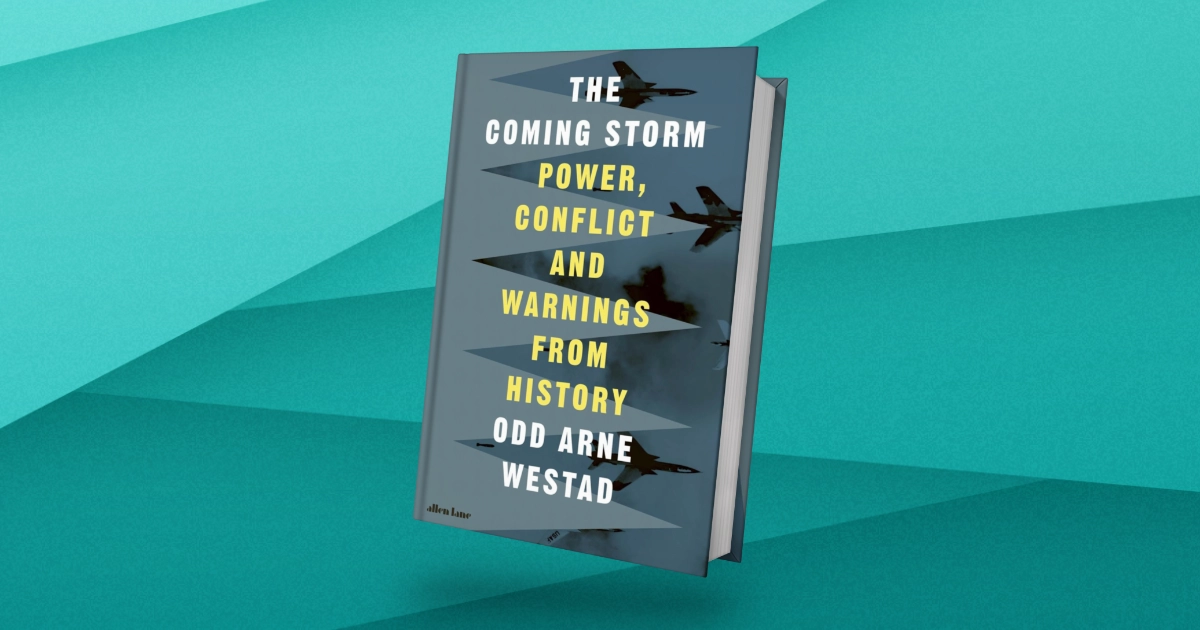
The Coming Storm: Power, Conflict, and Warnings from History
Odd Arne Westad
Henry Holt and Co.
March 3, 2026
256 pages
ISBN: 978-1250410283
Global politics has changed beyond recognition. A massive conventional war is being waged on European soil, the Middle East is aflame, rhetorical battles over trade are being waged daily, and after a hundred years of choosing to be defenceless, even Ireland is developing a serious military. A much more destructive conflict could be brewing. The Coming Storm: Power, Conflict, and Warnings from History offers readers an illuminating and terrifying insight into where we are heading.
Its author, Odd Arne Westad, is a Professor of History and Global Affairs at Yale University. A native of Norway, Westad is best known for his work on the Cold War. Today’s rivalry between the United States and China is frequently thought of in Cold War terms, with the “Cold War 2.0” label—coined by Professor Niall Ferguson—gaining increasing currency. If anyone is qualified to draw a comparison, it is Westad, yet he takes a different view. “We are entering a phase where multiple great powers jostle for supremacy within regions, and within human endeavours such as nuclear technology, artificial intelligence, or space exploration. Trade, which was becoming freer for two generations, almost back to where it was before World War One started, is increasingly more restricted and fragile, and trade wars are breaking out among major powers.” This world, he continues, “is unlike anything any of us have experienced in our lifetimes. But it does look quite a bit like the world of more than a hundred years ago, from the late 19th century to 1914.”
Westad’s central claim is that the present moment bears a striking resemblance to the geopolitical landscape of the early twentieth century. In his telling, modern-day China is akin to the Kaiser’s Germany: a rapidly rising economic and military power, eager for greater prestige and influence, and unsettling to more established rivals uncertain how to manage its ascent. The United States, by contrast, occupies a position similar to that of Britain before the First World War. Though still formidable, it has declined in relative terms, and a growing sense that its best days are behind it has prompted a retreat from free trade and a turn towards a more assertive external posture. Meanwhile, China’s alignment with Russia echoes Germany’s association with a faltering Austro-Hungarian Empire. Russia, like that earlier empire, is no longer a first-rate power, yet it seeks to compensate through coercive control of its neighbours, as seen in its war against Ukraine. Westad extends the analogy further, suggesting that India today resembles pre-war France: vulnerable to a stronger rival and already subject to coercive pressure along contested borders.
Turning from analogy to causation, Westad revisits the outbreak of the First World War, probing the failures that allowed a regional crisis to escalate into global catastrophe. He challenges the conventional view that rigid alliance systems made war inevitable. “The problem with pre-1914 alliances was that they failed to keep the peace, not that they provoked war,” he argues. Alliances, in practice, were marked by poor communication and limited trust. Austria-Hungary delayed its ultimatum to Serbia and failed to coordinate effectively with Germany, while France and Russia, though formally allied, hesitated to share intelligence or operational plans. Even Britain’s intentions remained uncertain to many observers. The issue, then, was not excessive cohesion but insufficient cooperation—an absence of the sustained diplomatic engagement that might have slowed or halted the march to war.
It is here that Westad’s analysis takes on its contemporary urgency. The lesson he draws is not simply that great-power rivalry is dangerous, but that unmanaged rivalry is catastrophic. In 1914, there existed few mechanisms for sustained dialogue among the major powers; today, he warns, a similar deficit is emerging. Contacts between Washington and Beijing remain limited, even as tensions mount across multiple flashpoints. Taiwan is the most perilous, but not the only one: border disputes between China and India, ongoing regional conflicts, and the accelerating pace of technological change all heighten the risk of rapid escalation. In a future great-power war, the progression from conventional to more destructive forms of warfare could be swift, just as the First World War saw the introduction of poison gas and other horrors.
Westad avoids reducing these dangers to the personalities of individual leaders, yet his emphasis on the importance of sustained contact between them carries clear implications. There is some cause for cautious optimism in the willingness—however inconsistent—of figures such as Donald Trump to pursue negotiations aimed at ending conflicts. At the same time, Westad’s insistence on the value of strong alliances and effective multilateral institutions sits uneasily with more unilateral approaches to foreign policy. The deeper problem, as he suggests, is not confined to any one leader. “Less than half of one percent of the world’s population has experienced great power war,” he observes—a reminder of how little lived memory exists to discipline decision-making at the highest levels.
Westad’s warning is stark. The relatively peaceful and optimistic phase that followed the Cold War may be drawing to a close, and the conditions that once gave rise to global conflict are re-emerging in altered form. History has not ended, nor can it. War remains a persistent feature of human affairs, and while distinctions between just and unjust wars endure, the scale of destruction now possible makes the prevention of great-power conflict an overriding imperative. If that task fails, the consequences will not be abstract. The experience of great-power war, now distant for most of humanity, will once again become immediate and universal.
James Bradshaw
James Bradshaw writes on topics including history, culture, film and literature.