
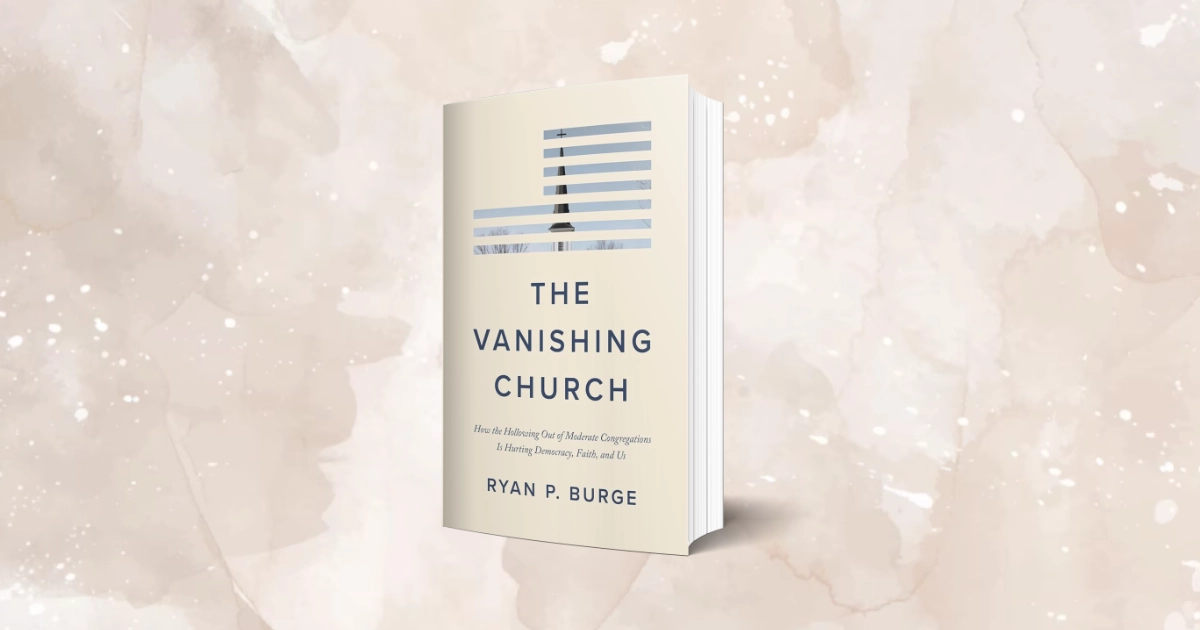
The Vanishing Church: How the Hollowing Out of Moderate Congregations Is Hurting Democracy, Faith, and Us
Ryan P. Burge
Brazos Press,
January 13, 2026
232 pages
ISBN: 978-1587436697
The Vanishing Church: How the Hollowing Out of Moderate Congregations Is Hurting Democracy, Faith and Us is the new book by Ryan Burge, one of America’s most astute commentators on religion. Burge has a unique vantage point within the religious landscape. In addition to being a social scientist, he was until recently also a Baptist clergyman, ministering in a relatively liberal denomination, quite distinct from the Southern Baptist Convention. Having been part of the team that put together The Great Dechurching three years ago, Burge uses this new book to warn of the consequences of the decline of America’s previously dominant religious entities, especially the mainline Protestant groups.
For generations, the Episcopal Church, the United Methodist Church, and the rest of the “Seven Sisters of American Protestantism” attracted vast numbers of Americans. In spite of their decision to “move with the times” in adopting ever more progressive views on issues like sexuality and female ministry, their membership and influence has waned, and many unhappy congregants have departed for Evangelical alternatives, while many others have lapsed into religious indifference. “At one point, about half of all Americans were part of this moderate, mainline tradition. In 20 or 30 years, if current trends continue as predicted, the mainline tradition will largely be extinct across many parts of the United States. This tectonic shift in American religion has happened so slowly and methodically that most Americans don’t even know about it,” Burge explains.
Many irreligious Americans have come to see Evangelicalism as being the embodiment of American Protestantism, and in many ways it is. Though he is a mildly critical observer of Evangelicalism, the temperamentally moderate Burge sees the movement as being in a relatively good position, in spite of secularisation. The political shift which has resulted in the overwhelming majority of American Evangelicals embracing the Republican Party (this situation is a far cry from the era of Jimmy Carter, and even the period afterwards) has not limited these churches’ reach. Instead, more politically conservative people have gravitated even more strongly in this direction. Opposition to abortion among Evangelicals has hardened considerably at the same time as support for the pro-life position has declined nationally. Remarkably, the percentage of self-professed Evangelicals who say they attend church weekly has risen in recent decades, which again coincides with a movement by the general population in the opposite direction. Evangelicals, Burge notes, “are more theologically unified than ever before,” with growing support for biblical literalism being another indicator of this process.
For the mainline Protestants, things could not be more different, and Burge links the decline in political moderation in America—demonstrated by the widening chasm between uniformly leftist Democrats and uniformly rightist Republicans—with the decay of moderate Christianity. As recently as the late 1950s, more than half of Americans were associated in some way with mainline churches, but a dramatic decline in membership was recorded from the 1980s onwards, to the point that only 9 per cent of Americans were aligned with a mainline denomination in 2022. The United Methodist Church, for example, lost 40 per cent of its members between 2006 and 2023, in part due to defections of entire church congregations over issues such as same-sex marriage.
At a time when American Protestantism is becoming ever more associated with conservative politics, another change is taking place in another part of this troubled society. In his analysis of the “Nones”, Burge draws upon the available evidence to conclude that atheists have become one of the most politically active religious groups in the United States, thus adding another element to the never-ending battle between America’s two large political parties.
Unsurprisingly, Burge’s main area of expertise relates to Protestantism, but an important chapter dealing with American Catholics is included. While being clearly impressed by the organisational and theological unity of the Church, Burge sees a risk that it could also follow the Evangelical route. American Catholics have grown more conservative politically: after all, Donald Trump won a decisive victory over Kamala Harris among this demographic, and Burge’s analysis shows that the areas where Trump gained the most ground between 2016 and 2024 were disproportionately Catholic. Burge observes that though most Catholic priests ordained in the 1960s self-identified as progressive, younger priests today are much more likely to be conservative. He sees the seeds of a similar rupture in controversies over the Latin Mass, and is probably at least partially right.
In considering why all of this is a problem, the author draws upon the rich resources provided by Harvard’s Professor Robert Putnam and others who have documented the vital social role which religion can play: how it unites people of different backgrounds; how it fosters a spirit of compromise based on mutual respect; how it provides both “bridging” and “bonding” capital, both of which are necessary for a diverse society to work in the long run. And it is clear that in many ways America is no longer working. Its political debate is ever more hateful, its great institutions have been corrupted by partisanship, and its Christian churches have not been able to stem this tragic tide.
Even trying to address the problem is difficult, as any Catholic bishop who attempts to play a meaningful role in public discourse quickly finds out. With political identity superseding religious identity in the hearts of many, a challenging sermon is often enough to make people vote with their feet: a different church for Protestants; a different parish for Catholics; no church at all for the “Nones”, but instead a toxic dose of progressive views about race, gender, and sexuality to fill the God-shaped hole in their lives. Ryan Burge is keenly aware of his own failures as a pastor presiding over declining Baptist congregations, but he can gain some solace from the fact that he has become such an invaluable analyst of these trends.
His book is of great importance, even though it suffers from a common failing. America is the greatest country in the world for social science, but its social scientists too often forget that similar developments are taking place elsewhere (think of the decline of the Church of England) and are worth addressing, if only briefly. Though The Vanishing Church is primarily focused on the changing face of American Protestantism, there are two key ways in which Burge’s argument should give us pause for consideration. Contrasting the mighty state of America’s Catholic Church with the experience of its minor Protestant counterparts, Burge describes the vastness of Catholicism’s physical and social presence. Whereas schism is a constant in the main Protestant traditions, American Catholicism has held together in spite of social changes, including the ethnic transformation of the Catholic population in recent times due to large-scale immigration. “The fact that one can visit a Catholic church in Seattle, Washington, and rural Pennsylvania, finding both to be part of the same organisation and following roughly the same order of service, is staggering considering the cultural and political differences between those two parts of the country,” Burge reflects. This is no small thing. It should be borne in mind at all times, and the ongoing challenge presented to the unity of the Church by the actions of splinter groups requires a response proportionate to the threat.
Secondly, Burge’s warning about the declining socio-economic diversity of American churches should give us pause also. Protestantism is by its nature tainted by an individualism which is poisonous to the soul. Not only does America’s Catholic Church excel in its social and educational outreach, Catholics can draw upon an immense intellectual gift in the form of Catholic Social Teaching. This is something that American Evangelicalism lacks, and its absence reinforces the indifference of many American conservatives to those who are less fortunate than themselves. It is hardly an accident that the first Pope from the United States chose to follow in the same line as Pope Leo XIII, the founder of that noble tradition, which in America is needed now more than ever before.
James Bradshaw
James Bradshaw writes on topics including history, culture, film and literature.