
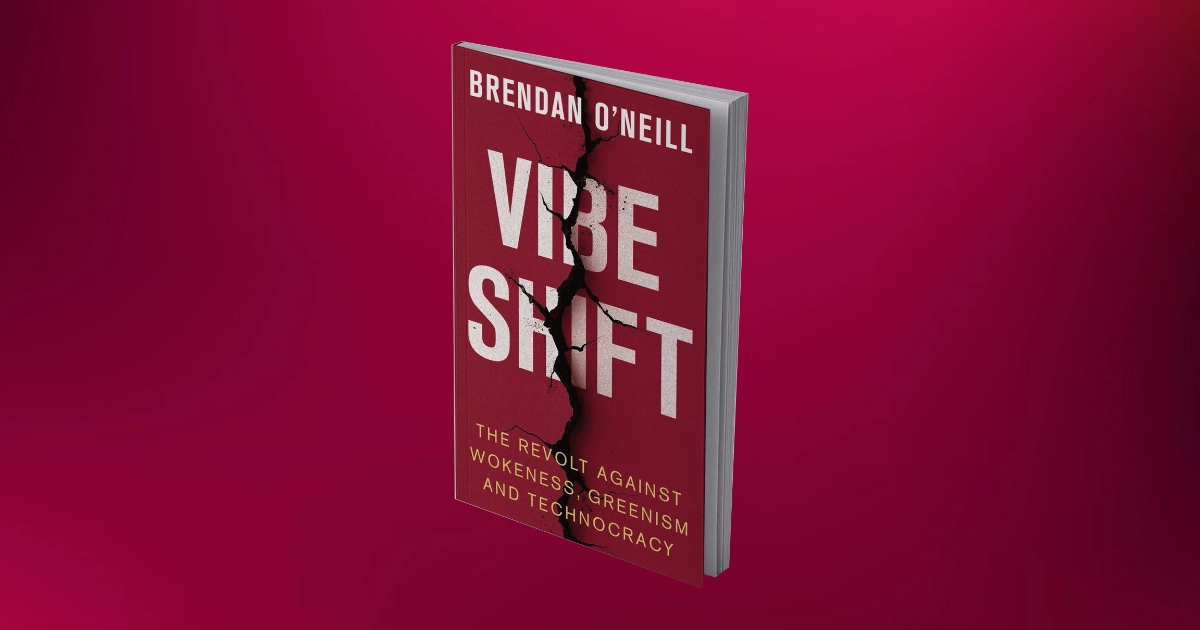
Vibe Shift: The Revolt Against Wokeness, Greenism And Technocracy
Brendan O’Neill
Spiked Ltd,
February 16, 2026
68 pages
ISBN: 978-1068719325
Brendan O’Neill has spent years on the front lines of the culture wars. He is chief politics writer and former editor of spiked, a regular contributor to The Spectator and the Daily Mail, and a former contributor to The Guardian. His reputation is for political uncorrectness, and his latest offering, Vibe Shift, is no exception.
O’Neill gives us three essays across a slim seventy pages on the shifting cultural waters where the trans issue, climate change action, and open-borders policies have recently run aground. It is a work of solid research with plentiful citations (admittedly, quite a number of them to the author’s own articles). A useful analogue might be Douglas Murray’s The Madness of Crowds, with its division of culture-war battles into distinct sections. But at the time of Murray’s book, “woke” was at its apogee. Now, argues O’Neill, things are starting to change.
On the trans issue, in a chapter titled “Women in Revolt”, O’Neill is scathing. It is hard to disagree with him, despite the generally crass tone he adopts (there are plentiful references to the genitalia which trans men may or may not possess). The reader is given a laundry list of the unusual positions taken by otherwise intelligent public figures on the topic: Keir Starmer suggesting in 2021 that it is “not right” that only women have a cervix; Kamala Harris congratulating trans woman and activist Dylan Mulvaney on his first year “as a girl”; or Liberal Democrats leader Ed Davey stating that women can “quite clearly” have a penis. Strange indeed.
O’Neill notes the tendency to “mock wokeness as the daft hobby of meat-dodging Gen Zers with blue hair” but urges the reader to recognise the profound and tangible impact it has had on people’s lives, noting how this “identitarian pox … [has] conquered virtually every institution of the Anglo-American world”. Women have paid the highest cost through the erosion of their hard-fought-for single-sex spaces, including changing rooms, sports fields, and prisons. This intrinsic conflict of rights may be why trans ideology has always been doomed to fail: it cannot succeed except at the expense of much of the rest of the populace. It remains, as O’Neill puts it, a “regressive policy swaddled in progressive parlance”.
The section on the environment is a slightly harder sell. O’Neill seeks to outline the inherent and perhaps irreconcilable conflict between the green policies of the last twenty-odd years and the well-being and livelihood of modern farmers, with the two sides typified by Extinction Rebellion in Britain and the gilets jaunes movement in France. The eco-activists of Extinction Rebellion are the “public-school elite” of the “wokerati world”. The gilets jaunes, by contrast, are the sensible working classes—farmers, labourers, and shopkeepers—compared (perhaps unfortunately) to the sans-culottes of the French Revolution. It is the “luxury activism” of the elites against the real cries for help of the suffering proletariat.
This is fine as far as it goes, but some of O’Neill’s views on matters green are puzzling. He speaks with admiration of the Trump team, who come off like the “swaggering industrialists of the nineteenth century” in their mission to “excavate nature’s gifts” to “restore American prosperity”. Although he is correct that some of the discourse around climate change has been, at least to some extent, unscientific and alarmist, there are still many legitimate reasons to be wary of the “drill, baby, drill” policy of the current American administration. Yes, industry and growth have increased prosperity in the West, but at what cost to the developing world, and for how long can it continue? For sure, the mass excavation of finite natural resources will provide relief to ordinary working people in the short term, but is it not the case that these resources really are finite? Are we missing something on that? And without a doubt, the mass culling of cattle to appease methane targets is yet another blow to the autonomy and independent earning power of Irish farmers, but is our current system of agriculture—where a tiny number of producers bear responsibility for feeding a vast urban populace—really sustainable across decades and centuries? Nuance here would have been welcome in a debate which is sorely lacking it.
The final essay examines the anti-nationalist and “borderless” policies of the 2010s and early 2020s. O’Neill has lots to say, framing the debate (again) as one between the privileged few and the deracinated many. Take the 2025 “flag wars”, where across Britain the Union Jack was flown as part of an organised campaign called “Operation Raise the Colours” (described by Wikipedia and The Guardian as “far right”, a term which, like the price of milk, has suffered much from inflation). O’Neill lays out the problems with the “borderless ideology” of European governments, citing integration problems, lack of resources, and (in some cases) growing crime rates. Uncontrolled immigration is “the issue through which [ordinary people] most keenly feel their disenfranchisement from public life”.
O’Neill’s sympathies lie with those he believes are most strongly harmed by all of these ideas: the working classes, and in particular working-class women. He applauds their willingness to stand up to the elites in what he calls “a mutiny of citizens against fashionable follies”. Vibe Shift is astute and precise in diagnosing the real harm done by these ideologies, insisting that we must not view them as storm clouds above a distant, abstract battleground of intellectuals, but as malignant, potent forces guiding government policy and causing real, measurable damage.
But I do wonder who the book is for. It seems unlikely that anyone on the opposing side of the debate will find themselves convinced by its derision and contempt for their views. This contempt can be unhelpful too where the internal consistency of the book is concerned. O’Neill describes the Palestinian flag, for instance, as “less a statement of solidarity with the Palestinian people than a statement of one’s own heightened moral sensitivities in comparison with the lower, less caring sections of society”. They are protesting against a “genocide that never happened”. Leaving aside the fact that almost every human rights watchdog would dispute the latter claim, it is not clear on what basis O’Neill separates the “good” protesters (who oppose the things he dislikes) from the “bad” protesters (who oppose the things he agrees with). Some pro-Palestinian protesters are anti-Semitic, to be sure—but there are plenty of anti-immigration protesters with similarly unsavoury views. The battle of ideas is not a zero-sum game.
The temptation to divide culture and politics into neat binaries of good and evil is unhelpful, and one of the worst features of modern discourse. Vibe Shift records some of the strange and harmful things people have believed this century and puts them on the record; there is value in that. But there is value too in walking the middle ground, in the careful argument gently made. This does not mean we should accept bad ideas—such as the belief that men can become women, or vice versa—but rather that if we want good ideas to triumph, we need to want our enemies to share them. Media trainers teach their students that in public debate, the goal is not to win, but to convince the onlooker. Brendan O’Neill fights to win.
Luke Power
Luke Power is a writer and teacher living on the west coast of Ireland. You can find him on Substack under the title Out on the Western Plain.