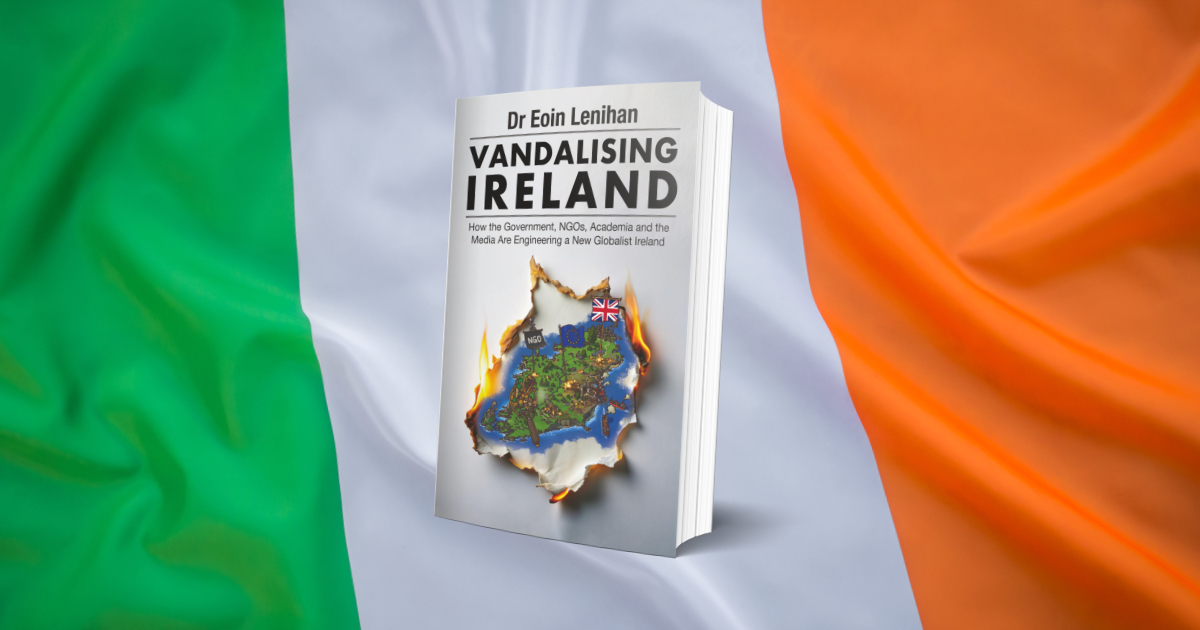
Vandalising Ireland: How the Government, NGOs, Academia and the Media Are Engineering a New Globalist Ireland
Eoin Lenihan
Western Front Books
October 2025
298 pages
ISBN: 978-1959666851
This best-selling recent book had little visibility in Dublin bookshops before Christmas or, with a few exceptions, in the media, a reality that seems to support the author’s thesis that there is a tendency to shut down debate in modern Ireland. The book’s success also points to considerable public interest in its arguments.
Its central argument is that the Government, the NGO “industrial complex,” and the media have “conspired to vandalise Ireland” (p. 234) and are engineering a new “globalist” country in its place.
It includes chapters on the immigration issue, politics and democracy, culture and identity, migration and race, NGOs and universities, the media, and “Ireland 2.0,” which includes recommendations for the future. The book has extensive notes and a detailed bibliography, but an index would have been useful.
Dr Lenihan is a journalist and researcher from Clare who has lived recently in Germany. He holds degrees in history and archaeology from NUI Galway, and a doctorate in pedagogy from the University of Augsburg.
The book places significant emphasis on migration, in a context where over a fifth of the population in 2024 was born abroad. The author argues that there is strong public support for a more restrictive migration policy but that successive Governments have ignored this support and thus ridden roughshod over the electorate.
Governments, Lenihan maintains, have had a “no veto, no consultation” policy on the establishment of migrant centres in close-knit local communities. There has been, he argues, a “catastrophic failure” in migration policy, including a “broken” asylum system. He refers in this context to the sharp rise in asylum-seekers from under 3,000 in 2017 to well over 13,000 in 2022, points to significant numbers of asylum-seekers arriving in Ireland without appropriate documentation, and critiques the brushing aside by Government of local concerns about migrant centres and about their impact on tourism in towns like Lisdoonvarna, Co. Clare.
The author documents the regrettable violence associated with certain immigration protests but ascribes most of the responsibility to State and Garda approaches. According to Dr Lenihan, “the heavy and authoritarian hand of the state can reach out from Dublin at any moment and turn ancient and peaceful villages upside down overnight” (p. 249) without any meaningful recourse for the local population. Yet, he suggests, the broader Irish public has never given the Government a mandate to “utterly transform” the nation.
Dr Lenihan’s book also covers the media. The migration and media themes are connected in that, according to the author, the media have not been doing their investigative and “holding to account” duty on migration issues.
“Lies of omission” by the media include their under-reporting of the scale of International Protection Accommodation Services (IPAS) centres and their failure to highlight the undemocratic nature of the Government’s actions in ignoring the core concerns of local protesters about proposed new centres for asylum-seekers.
Lenihan maintains that the media are increasingly dependent financially on the State and that this dependence militates against their ability to hold the State accountable. He also points to a peculiar pattern of political reporters moving to PR jobs for Government, apparently without any great discomfort. His book presents the media as doing the bidding of the Government, though one could also argue that successive Governments have gradually conformed to radical voices in the media in recent decades, for example on the abortion issue.
His chapter on the “Social Justice Industrial Complex” is critical both of what he terms “Social Justice” NGOs, such as the National Women’s Council or the Immigrant Council, and of “Social Justice” courses in the universities (for example, Black Studies and Critical Race Theory, Queer Theory, Gender Theory, etc.), which provide both ideological foundation and personnel for the NGOs. He notes that following Catholic decline in Ireland, these “Social Justice NGOs” have replaced NGOs that were often previously Catholic.
The terminology used here can be confusing. The term “social justice” has a respected place in Catholic social thought and features in many Church documents. For example, Pope St John Paul II, in a 1999 document, Ecclesia in America, maintained that “the globalised economy must be analysed in the light of the principles of social justice” (par. 55).
Dr Lenihan’s critique is of “Social Justice” theories that can be linked to cultural Marxism. He contends that they “emerged from the mid-twentieth-century postmodernist movement and are built on radical scepticism of any claim to objective truth” (p. 146). They see Western societies, “built to suit the needs of heterosexual white men,” as “the pinnacle of oppression” (p. 147). These theories, he argues, and the NGOs that propagate them, have an excessive influence on educational programmes and public policy.
In the economic sphere, Dr Lenihan offers a strong critique of the currently favoured foreign direct investment (FDI) model in Ireland. This model, backed by almost all Irish parties, is based, he asserts, on an assumption of infinite GDP growth propped up by unlimited legal immigration.
According to the author, successive Governments have abandoned Irish workers by pursuing a tech industry for which native workers do not exist. He maintains that 1996 was the last year in which FDI recruitment was largely supported by the native population.
Large overseas tech companies are employing wealthy immigrants, the author maintains, who are pricing young Irish workers out of the housing market and thus pushing them towards emigration. A survey in May 2024 by an EU body, Eurofound, reported that 40 per cent of Irish people in employment aged between twenty-five and thirty-four years were still living at home, compared to 12 per cent of Germans and French and 2 per cent of Swedes.
According to Lenihan, Ireland is a “crippled democracy” in which Ireland’s economic destiny has been taken out of its own hands. In his view, the Government should encourage only those multinationals that fit the graduate profile of Irish universities.
Lenihan’s final chapter sets out the author’s ideas for the future. These include enforcing migration laws, stepping up deportation of illegal immigrants, pruning and shaping the FDI economy, separating NGO bodies and the Government, insisting on “viewpoint neutrality” without ideological baggage in schools, protecting freedom of speech, producing more STEM graduates, supporting domestic industry, turning universities into innovation hubs, harnessing fishing rights and gas reserves, and ceasing to “prop up” the national media.
He also makes a case for “cultural renewal,” including the championing of local heritage, on which political renewal will build. In politics, he calls for a “big-tent right-wing movement that can accommodate traditional Catholic conservatives, à la carte Catholics, wider Christian denominations, and non-religious conservatives”
(p. 245).
The book thus strongly espouses “conservatism,” and more specifically an economically laissez-faire and socially conservative Government. This reviewer generally looks for guidance to the social teaching of the Catholic Church rather than to “conservatism,” but I can see some common ground between Lenihan’s bottom-up vision of policy development and the Catholic principle of subsidiarity.
I would view more favourably than the author the Church’s historical contribution in Ireland. He maintains that Catholicism was “entwined” with the Irish nation during centuries of persecution but had “extracted itself” from the people in the mid-nineteenth century. This seems a negative historical reading of necessary Church rebuilding after Catholic Emancipation and the Famine.
In more recent times, after independence, he suggests that Fianna Fáil and Fine Gael socially, morally, and in matters of education “abdicated responsibility” to the Church. While such perspectives are understandable in the light of the grave abuse scandals in some Church-run services, one could also argue to the contrary that the Irish State owes a significant debt to a Church that pioneered many services well before independence, often in a context of great poverty, services that continued afterwards and would probably not have existed otherwise or, at least, not until much later.
Moreover, this trend was not unique to Ireland. In countries like Italy, Catholic and workers’ organisations played a key role in the provision of welfare from the nineteenth century onwards, though Catholic charitable provision in Italy goes back centuries before that.
In France, after the Revolution and later anti-clerical laws, State authorities worked actively to prevent Catholic bodies from continuing the significant social contribution they had previously made. French Governments were operating on the basis of a “top-down,” monopolistic view of the State, which failed to respect the important contribution of voluntary organisations, or “intermediate bodies,” particularly those with a Catholic ethos.
Any argument, in other words, that the State should monopolise social provision, or ought to have done so in twentieth-century Ireland, is highly questionable. On the other hand, it is undoubtedly true, as Lenihan argues, that the recent decline of the Church, especially after the abuse crises, has led to an identity crisis in Ireland.
This is an extensively researched and well-written, if somewhat polemical, book. One has grown accustomed to left-wing polemics in Ireland, but right-wing polemics are more of a novelty. The author displays courage and research ability in tackling certain under-examined subjects, such as the financing of the media or the strange ideology of some university courses. Perhaps inevitably, given the vastness of the topic, there are some gaps in this passionate reflection on the nation. Thus, the Irish language today, the place of Northern Ireland in the Irish nation, Irish sovereignty versus EU federalism, and the pro-life issue, with its significant demographic implications, feature little, though the author does discuss the decline of Irish in earlier centuries.
On migration, the anxieties articulated by Dr Lenihan are also playing out elsewhere, and this subject should be as open to analysis as any other area of public policy. The votes for Brexit and Donald Trump, and the rise in support for the French Rassemblement National party, were all motivated, at least in part, by concerns about high immigration, and it would seem unwise to ignore similar concerns here.
The arrival of thousands of people from overseas in a short period of time, including large numbers from the war in Ukraine, has undoubtedly placed major additional strain on housing, healthcare, and education systems. Irish opinion polls consistently point to substantial public concern about high levels of immigration as well as strong opposition to any far-left, open-borders policy.
On the other hand, Catholics must keep in mind the strong emphasis placed by the universal Church on the rights of migrants and the huge practical support Church agencies have given them. Here in Ireland, the commandment to “love your neighbour,” the Catholic bishops stated in a letter on immigration in 2024, calls us to care for everyone, regardless of background. That letter also noted that the Church and public services and nursing homes benefit greatly from the valuable contribution of people from overseas.
According to a recent definition, the nation is “a community of destiny forged by history.” Dr Lenihan’s hard-hitting defence of the nation is more likely to appeal to like-minded than unlike-minded readers. Nevertheless, it opens an important debate on Irish identity and the Irish nation, on the direction of the country at this time, and prompts serious reflection on the rights and appropriate priorities of that nation, whose identity has been forged over many centuries, in the changed circumstances of today.