
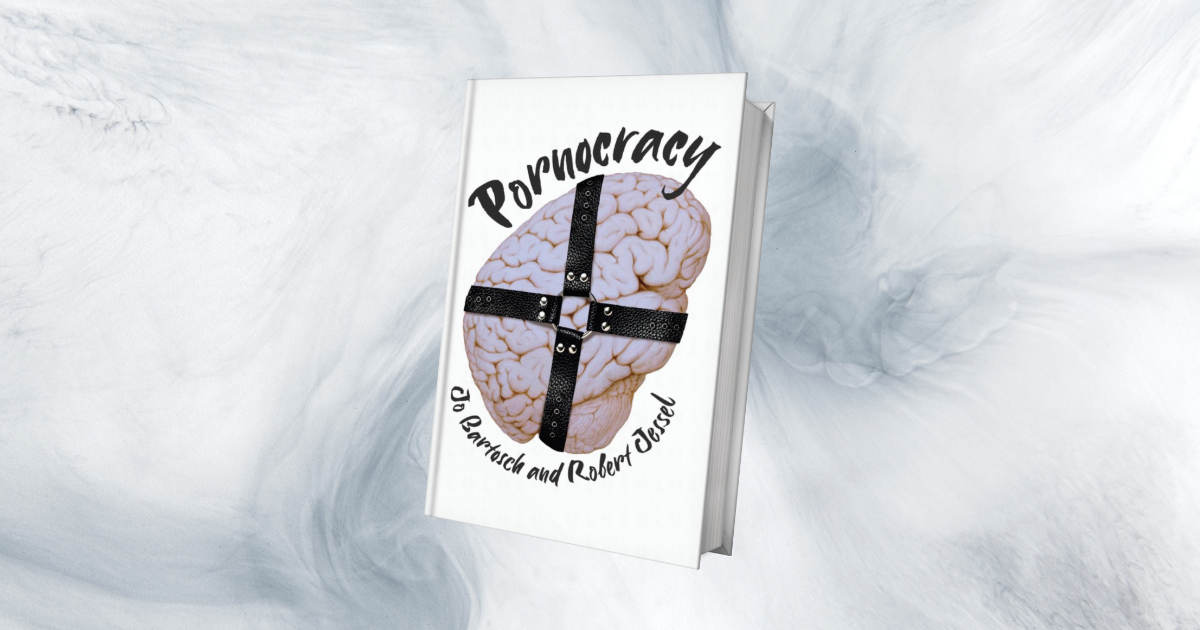
Pornocracy: How Porn Has Hijacked Our Culture
John Wiley & Sons
Oct. 2025
192 pages
ISBN: 978-1509565146
It is far worse than you thought, if you had encountered the horrors of Pornhub and the other ‘tube’ sites recently. Pornography has been around for millennia, but it is now an industry whose largest four websites get much more traffic than the ‘normal’ internet does and are worth much, much more than Hollywood (USD $80bn per annum at least). This book contains evidence of every study it can find on the subject, and some claim perhaps 45 per cent of men are in porn’s clutches and look at it frequently. It is horrifying to consider the fact that ‘Pornhub’, the largest of these bastions of evil, removed 80–90 per cent of its content from 2020–24, as, under pressure from a campaign launched on X (formerly Twitter), they could not confirm that their videos were not depicting rape or actual child sexual abuse material (CSAM).
We learn of the reach of these videos and the catalogue of abuse and misery from ‘performers’, whose humanity is robbed from them in content that is now designed to be as debauched as possible. It emerges that 75 per cent of women caught up in this industry have been homeless at some point in their lives, that many come from sexually abusive upbringings, and that they last in the industry an average of eighteen months. Some of them need colostomy bags for the rest of their lives due to injuries. Had you heard that young women have a great time making money on OnlyFans, the self-created-pornography site? They degrade themselves for £149 per month on average. Welcome to sexual liberation as it really is today: a gulag. Right now, perhaps 200 million people, mostly men, are watching these videos.
Naturally, this is a difficult subject to read about, and the book is, rightly or wrongly, attempting to shock the reader with the gruesome details of what is happening behind the screens and in society and culture. It is clear that ‘Big Porn’ actively wishes to trap the attention, imagination, and, naturally, the income of users in the same way as the rest of the internet giants do. Their abominable content constantly refreshes and gets more extreme to keep satisfying the ever more bored user, who requires deeper debauchery to continue getting excited. The similarities to drug abuse are noted, and studies are provided on the equivalence. It is demonstrable from the book’s evidence that videos featuring titles such as ‘incest’ or ‘punishment’ will appear to new users rapidly, encouraging them to watch abuse and simulated rape for sexual pleasure. What ends up happening, then, is that pornography immediately pushes users to content featuring the abuse of women and children.
Where is the law in all of this? Are these films actual abuse, crimes? It is hard to tell what is criminal, hence the millions of videos being removed from the biggest site over the past few years. It is not a crime to pretend one is an underage teenager being sexually attacked by a teacher or family member (this is what porn is now). But the issue of self-filming can be understood more clearly when we see that 90 per cent of child pornography is produced by children themselves—coerced by evil people who have hunted them online and tricked and bullied them into doing it. The perpetrators are everywhere, and it is easier than ever to bypass the legal barriers that do exist for getting filmed sexual attacks on the dark web and using special search terms on the standard internet. The book explains that actual recorded sexual attacks for which people have been imprisoned are prosecuted from the films they have made. There is testimony from children who have been attacked and had the video posted online, then been unable to stop the crime from being viewed by millions of people. The virtual space has created the capacity for the dehumanisation of our fellow creatures on a scale it is hard to conceive. The ‘pornification’ of relationships has left many women fearful of men: more women than ever have reported being strangled during consensual encounters with men in bed.
By now, you might be struggling to read on, but stay with me. The book demonstrates the sexualisation of children via ‘normal’ websites, not pornographic ones. Gone are the days of seeing a naughty magazine or DVD somewhere on a shelf. It emerges that children (of whom in UK research perhaps a fifth have seen pornography by age eleven) encounter pornography by accident in two-thirds of cases, and not on dedicated pornographic sites but most likely X (formerly Twitter), Instagram, Snapchat, and TikTok. We may have expected this, but it shows that the main internet giants must be making plenty of money from their products (which is us) and are not keen to stop the attack of pornographic content on their biggest user base (our children). To illustrate this, we now have the emerging ‘deepfake’ technology (wherein a person can be undressed and placed into an obscene film or photograph), which Elon Musk has defended as ‘free speech’, since Grok (his AI) is pioneering this. If you needed convincing that children should stay away from social media, also be convinced of the following: keep their pictures off the internet.
Why is there no greater outcry against this? It seems institutions are entirely compliant. The best example in the book is Childline UK (NSPCC) in 2021, whose ambassador, Dame Esther Rantzen, said that children ‘are telling us very clearly that [porn] is having a damaging and upsetting effect upon them’. Seems like good feedback, but, alas, a mere six days later, the charity’s staff posted a video promoting pornography:
[The UK’s] advice line for young people … published an online YouTube video telling children “porn is fun to watch” and “sexy to enjoy”. It directed young viewers to a list of categories—including BDSM and hardcore—they might choose to look up. (Generation Porn, p. 64)
The authors also point out that the WHO and UNESCO’s adoption of ‘Queer Theory’, or a ‘sex-positive’ philosophy, leads to guidance statements that seem to encourage the debauching, sexualisation, and victimisation of children quite clearly: ‘Young people are sexual beings’ (UNESCO) and ‘From birth, [all children] are engaging in sexuality education’ (WHO). The words are worryingly close to those employed by paedophiles in justifying their crimes.
It is hard to refute the horrors of pornography, but equally frustrating to read Pornocracy, as, while outlining in gory detail the scourge of pornography, it refuses any framework for discussing the subject beyond the idea of a power struggle. The text is falling over itself to tell you a gruesome story about the worst thing to happen to the world since the atomic bomb but cannot explore any of the most basic questions of humanity, morality, sexuality, and personal responsibility. We are told early on that:
The moral duty to resist the ambient misogyny of the Pornocracy … is beyond the scope of this book … [but] if we continue to defend pornography as a matter of personal freedom, the fate of women in the West may come to resemble that of women living in theocracies. (Introduction, p. 3)
The whole book sounds like this. In its effort to sustain its energy and avoid discussing morality, the text makes exasperated statements on the lack of success within the cultural revolution: ‘Half a century of feminist-led anti-porn theory has made a negligible impact on men’s willingness to be aroused by the degradation of women.’ (How Porn Changed Our Brains, p. 37)
It may seem indelicate to point out that it is an oversight in a book on pornography—which is about simulating sexual arousal—not to ever discuss what ‘being aroused’ is actually for. We hear, from research into mammals who like to have multiple partners, that ‘our nature is depressingly easy to manipulate [by porn]’ (How Porn Changed Our Brains, p. 27). But there is no space to consider what might be possible in considering human nature and its distinct customs and moral potential. Much is rightly made of the evils against women, but the analysis rests only within the framework of all sexuality as a Marxist power struggle where one ‘side’ wishes to dominate the other. This rather leads us to a place where sexual degradation and debauchery are never connected with the sexual revolution, which has pushed sexual ‘liberation’ upon us and touted the destruction of married commitment between the sexes in the past fifty years.
But the shrill tone of the book cannot hide the unintentional, thorough, and resounding point which is there for anyone to see: any impression of freedom and liberation via the sexual revolution is completely and utterly false. As a read, then, it is similar to Solzhenitsyn’s The Gulag Archipelago for the shocking testimony of what is taking place: torture, rape, dehumanisation, and the corruption of nefarious power. But Solzhenitsyn knew exactly what was wrong with Soviet Russia, and this book shows that contemporary journalists are still lying to themselves about what the collapse of the family, contraception, abortion, and the attack on the idea of marriage and children have done to us in the West. To demonstrate the point, the first time the word ‘mother’ is used is, I think, on the second-to-last page of the book. You do not have to be Pope St John Paul II to point out that the deliberate rejection of family roles on behalf of both sexes, the treatment of all restrictions on sexual desire as a pathology, the plague of no-fault divorce, and self-determination as our only value have ploughed the ground for pornography to flourish in the West.
So, if the ‘pornocrats’ are to be stopped, what do we do? After railing against these evils, one author (Jo Bartosch) praises feminists for refusing any relationship to men, and the other (Robert Jessel) argues for ‘shame’ as the solution, so that men can feel bad about pornography, and then wonders if ‘somehow, we [can] reforge the link between sexual intercourse and love’. Well, it would not do to be proud and say ‘I told you so’, but the thousands of journalists and writers who have attacked Humanae Vitae and Catholic social teaching for over fifty years might be about to discover how right the Church has always been on human sexuality. We might, after all, be heading for a revival of faith that has begun in the gulags of the sexual revolution, as ‘free love’ admits it has nothing to offer but a slavery that is evident for all of us to see.