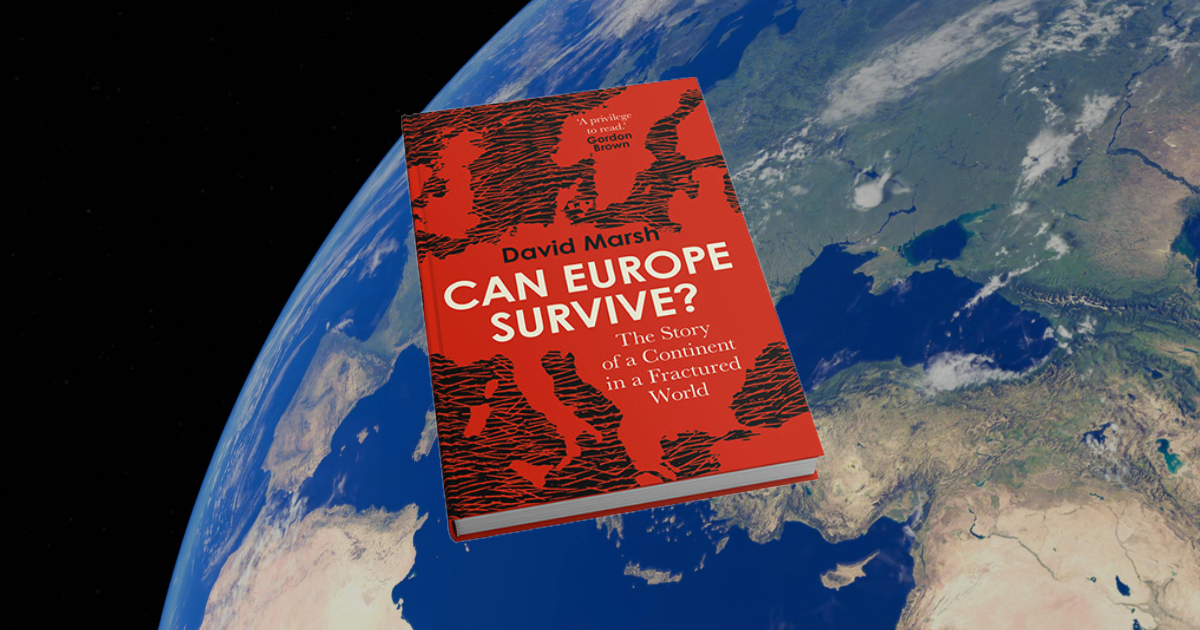
Can Europe Survive? The Story of a Continent in a Fractured World
David Marsh
Yale University Press
November 2025
528 pages
ISBN: 978-0300273007
David Marsh is a longtime journalist specialising in financial, economic and political matters in Europe, and is also a former European editor of the Financial Times. There are few better placed to explain how Europe has become so plagued by difficulties. Published in October, Can Europe Survive? The Story of a Continent in a Fractured World represents his attempt to do just that.
It is a masterful work, born of an astonishing amount of hard work. The thousands of footnotes, the 160 interviews with authoritative figures, and the vast bibliography, all of it taken together represents the very best of what journalism should be. There has been such a deluge of bad news that it is quite striking to consider it all at once. Russia is waging a brutal conventional war on Ukraine while also engaging in hybrid warfare against other parts of a militarily feeble Europe. Following the return of President Trump, the American security blanket under which Europe has dozed happily has been partially pulled off, exposing the nakedness of the junior partner in this transatlantic relationship.
The creation of the EU Single Market was meant to generate prosperity for all parts of Europe. As highlighted by the EU’s own Letta and Draghi reports, a major economic gap has developed between Europe and the US. Marsh cites figures showing that “the EU accounts for just 5 per cent of global money in venture-capital funds, against 52 per cent in the US and 40 per cent in China”. New and transformative technologies are developing quickly, but not here. Marsh notes that the high-tech American giants such as Apple, Microsoft, Nvidia, Alphabet and Amazon each have “stock market capitalisations of $2–3 trillion in 2024, roughly equivalent to the combined size of Germany’s top-forty stock-market-listed companies”.
A generation ago, the EU had a good story to tell. The newly liberated nations of central and eastern Europe were flocking to join it, and a pro-integration consensus existed across the bloc. Ambitious treaties like Nice and Lisbon were being drafted and approved (even if we forget the occasional need to hold a second referendum when the voters had made an initial mistake). National currencies had been discarded and replaced with the euro, and it was a mainstream belief that there would soon be something akin to a United States of Europe, ready to take its place as a major political, economic and military force in this world.
Yet now populism is in the ascendancy. Britain has departed the Union, with the divorce damaging both partners. The Franco-German alliance is dysfunctional, and both of those countries may soon elect governments radically different to what we have known in the post-war era. From the perspective of the true believer in the European project, much has gone wrong, but why, and how?
Marsh lays some of the blame at the door of the instability which has become a feature of the political system in many countries. He draws an interesting contrast between today’s short-lived national leaders and the political leadership which was in place when the Berlin Wall came down. Leaders such as Germany’s Kohl, France’s Mitterrand, Britain’s Thatcher and Italy’s Andreotti had acquired vast experience in the years leading up to this, and were well positioned to take the visionary steps which followed. On this point, however, the author appears to get the order of events wrong. In many cases, political instability has been the direct result of poor decisions by established figures, as when Angela Merkel’s open-door refugee policy led to the rise of the Alternative für Deutschland (AfD) party. To some extent, though, what he writes is true: today’s leaders and today’s governments are weaker than their predecessors.
Germany’s struggles occupy much of the attention of the author, who interestingly writes comparatively little about France. Not only does Germany’s successful reunification seem a distant memory, even the Merkel era now appears remote, for reasons which are described very lucidly. Much recent political and economic analysis attributes German malaise to the disruption of the supply of cheap Russian gas to German industry, but there is much more to the German crisis. As Marsh puts it, “German bets on continued stable relationships with China, America and France all turned sour at the same time”. German producers were increasingly looking to the Chinese market, but this is now more difficult in an economically fracturing world where the Chinese–Russian alliance has changed the calculations for European leaders, and made the American security partnership more important than ever at the precise moment when America became deeply unenthusiastic about paying for Europe’s defence.
Marsh is not shy about pointing a finger of blame at the “widely overestimated” Angela Merkel, whose policies have paved the way for this disaster. He quotes an experienced German ex-diplomat who describes how post-war chancellors have successfully pursued long-term strategic objectives. Merkel’s approach, in contrast, was one of short-termism, and the costs have only become clear after her resignation.
A surprising amount of the book is dedicated to the drastic deterioration in the relationship between the major European democracies and Russia, which culminated in the dramatic all-out invasion of Ukraine. Interestingly, and without in any way seeking to absolve Vladimir Putin of his responsibility for starting that brutal war, Marsh emphasises the mistakes which were made by the West following the Cold War. While he makes clear that it was understandable that NATO membership was attractive for the countries which had just emerged from under the Soviet shadow, the author makes a convincing case, even to this sceptical reviewer, that Russia was wronged by the US-driven process of NATO enlargement. “[T]he West failed, despite much professed benevolence, to give the Soviet Union, and then Russia, sufficient respect and recognition as a fallen, depleted and wary one-time superpower to prevent it lurching back in pursuit of the lost trappings of triumph,” he argues.
One of the most interesting conversations described here is with the Czech career diplomat Štefan Füle, who served as the European Commissioner for Enlargement in the run-up to Putin’s initial invasion of Ukraine in 2014. Füle expresses regret that more was not done in those years to persuade the Russians that greater EU–Ukraine economic ties were not a threat, and to try to bring Russia into this process. Ultimately, there will never be a way of knowing whether the flattering of Putin and like-minded Russian imperialists would have changed anything in those years. Marsh quotes a speech Putin gave in St Petersburg in 1994, when the then minor official blamed Mikhail Gorbachev for the “liquidation of the Soviet empire” and lamented the fact that former Russian territories had been given away to countries like Ukraine. There is no point asking what-ifs or blaming the West for what he has done. These sentiments were deep-rooted, and it was not Western actions but persistent European weakness which encouraged the bear to attack.
That assault could not have been sustained over the last four years without major economic support from China. In fact, previous US estimates suggested that 90 per cent of the imports Russia needs to keep the war going come from China. More importantly, this has dashed the hopes of Merkel and others that the EU could develop a lucrative trading relationship with the rising superpower in the Far East. Changes in the structure of the Chinese economy have coincided with changes on the geopolitical scene. China is no longer the producer of cheap and unsophisticated products; it is now at the cutting edge of advanced manufacturing and high-tech industries, including AI. Crucially, this means that China is no longer just a partner or an export market. Instead, it is now a competitor to Germany and Europe more generally, and it dominates entire sectors and supply chains in areas like renewable energy.
Once again, the tables have turned and Europe is suffering as a result. It is in this context that the one-sided US–EU trade deal negotiated by President Trump became a reality in 2025. It was not so much that Trump knows the art of the deal, but that he recognises a weak negotiating partner when he sees one, and ruthlessly exploits it.
There is so much in this extraordinary and illuminating book, but there is something missing too. Economics, fiscal and monetary policy, war and peace all have their place in understanding where Europe and the world stand. Yet there is so much more occurring under the surface that Marsh chooses not to explore. At the heart of the crisis in Europe is not economic stagnation or military unpreparedness. Europe has stopped believing in itself because Europe has ceased to understand itself.
Confronted by the presence of large populations of newcomers with radically different beliefs and identities, European societies, particularly in the prosperous west, have become fragmented in a way that has few historical parallels. In a particularly noteworthy aside, Marsh attempts to define the “European way of life”, suggesting that its first component is “multiculturalism”. No self-respecting civilisation would consider this to be the basis of its identity. China and Russia certainly do not, and one side of the American political spectrum rejects such notions as well.
Trump’s controversial new National Security Strategy, published shortly after this book came out, raised eyebrows by identifying the greatest threat to Europe as being the “stark prospect of civilisational erasure”. Perhaps this is too harsh, but an ancient civilisation which can think of nothing more important to its self-identity than multiculturalism is well on its way to erasing itself. Marsh writes that “Europe, and that includes the United Kingdom, needs to come together and redefine what is its ‘own good’”. Yet can a Europe which cannot define itself culturally, spiritually or philosophically ever hope to be able to define its own good?
In the long term, Europe’s economic, cultural and demographic survival will be dependent on finding answers to questions like this. In the short term, Marsh makes clear that the dynamic which gave rise to the shocks and humiliations of 2025 is not likely to be reversed: “Working with rather than against America must be the order of the day”. No surprises there. After all, there is no other alternative superpower which a sickly Europe can latch on to. This is a sad state of affairs indeed.