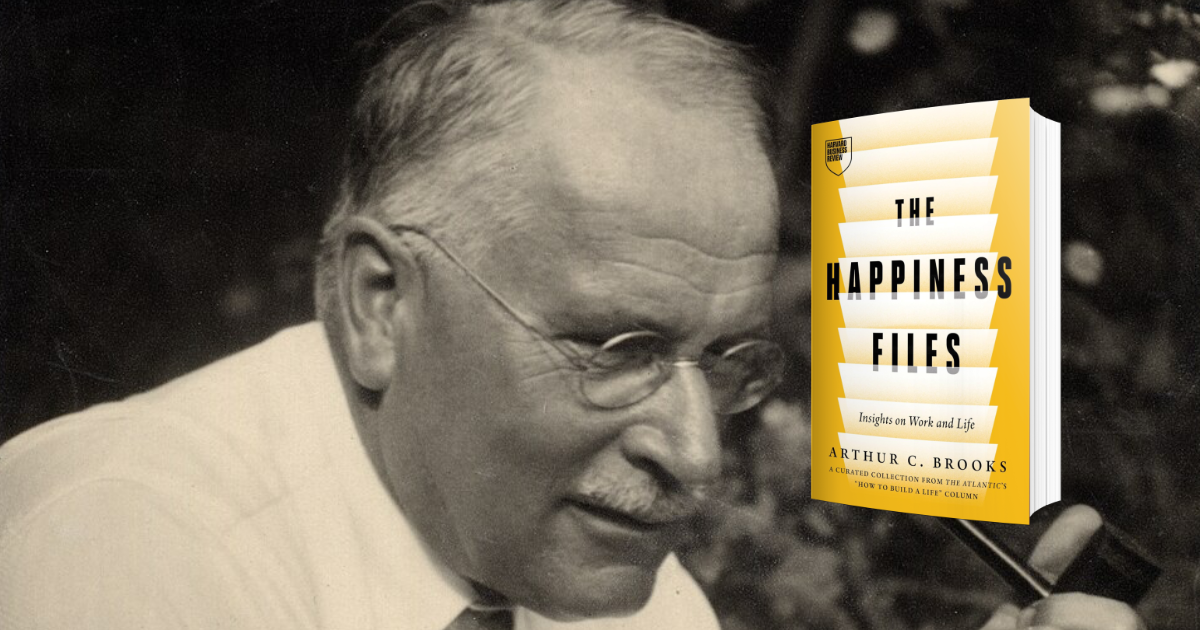
The Happiness Files: Insights on Work and Life
Arthur C. Brooks
Harvard Business Review Press
August 2025
272 pages
ISBN: 979‑8892792264
The Happiness Files: Insights on Work and Life is the latest book by the American academic Arthur Brooks. This former political philosopher has been on quite a journey since he left his prestigious job at the helm of the American Enterprise Institute (AEI), America’s foremost centre-right think tank. These days, he devotes much of his time to studying the science of human happiness while also lecturing at the Harvard Business School. His previous book—2023’s Build the Life You Want—was co-authored with Oprah Winfrey. The Happiness Files is drawn in part from the weekly columns on this topic which Brooks writes for The Atlantic.
Even in an era marked by a worrying decline in reading, there is an insatiable public appetite for self-help books. There is no shortage of glib writers seeking to prosper within this genre. Brooks offers something more substantive though and, shed of his previous literary attachment to Oprah, his work is worth taking seriously. Each essay here is divided into two sections. The first part deals with the academic research and empirical evidence about the specific subject, and the second part focuses on practical applications which readers could make part of their own routines. He urges his readers to think of their lives as start-up businesses and to manage them accordingly, but not in a materialistic sense.
‘The right denomination of rewards for the start-up life is happiness itself, with a focus on love, enjoyment, satisfaction, and meaning,’ Brooks writes. ‘The objective is to live and work in such a way that brings more of these things. Since we are naturally distracted by worldly resources instead, this task requires that we live in a fully awake way, alert to the mistakes we naturally make and putting forth the effort to live the way we intentionally want, not just according to how we feel.’ Brooks offers no quick-fix solutions. Instead of promising a life of bliss, he lays out a road which could lead to increased happiness and contentment. Above all else, he emphasises the importance of the road itself.
‘The key insight behind a career that consistently raises your well-being (besides not letting it take over your entire life) is progress. Humans get satisfaction not from arriving at a destination, but rather from making tangible progress toward it. Indeed, one of the great errors people make in their careers is assuming that hitting a particular goal—a sum of money, a particular title, retirement—will give them the happiness they seek,’ he explains. The old adage that money will not make a person happy has a scientific basis to it, as Brooks cites a LinkedIn survey showing that workplace stress falls when people reach average levels of income before rising steadily when people enter the highest-earning brackets. More importantly, he points to a 2010 academic paper by two Nobel laureates which found that though the general quality of life rises as people earn more, the actual happiness experienced flattened out at an annual salary of around $75,000. Analysing subsequent research published in 2021, Brooks revises that figure upward to around $100,000 (not that different from the original estimate when inflation has been taken into account), while adding that ‘at even higher levels there is very little extra wellbeing to be had with more income.’
His practical guidance on how to find more happiness and meaning is for successful people to give more money away, or to redirect more of their time into non-remunerative activities by volunteering or by becoming more engaged in their religious community. Brooks affirms that happiness can be bought if people use their material gains to help others or to remove stressors so that more of their precious time can be spent with family and loved ones. Surveying the realm of work, Brooks identifies the widespread dissatisfaction with excessive work meetings, the prevalence of video calls, and the ‘always on’ mentality as being key issues making people miserable. He suggests ways to improve, including the avoidance of any discussion about work on certain days or at certain hours—breaks which he suggests could function ‘like little sabbaths.’
Much unhappiness can be traced to the workplace: whether that be due to interpersonal difficulties, the stress caused by economic changes, or simply the many instances where people are not suited to their current professions. In 2023, there was large-scale coverage of a survey by the job-search company Monster which showed that 96% of American workers were looking for a new job. People are looking elsewhere, but not necessarily for the right reasons. For many, a feeling of being unfulfilled in their current role carries with it an unstated belief that finding a new job will change everything. Brooks wisely challenges this assumption, while pointing to the danger of people trying to ‘look for our overall wellbeing in what we are doing to earn a living.’
Drawing together the various strands of his argument, Brooks references the work of the Swiss psychologist Carl Jung and tries to summarise Jung’s earlier advice about achieving happiness: that you should seek incremental progress; that you should attend to your health; that the cultivation of deep relationships is vital; and so forth. Brooks suggests that the final component of Jung’s summarised advice could be stated as follows: ‘Find a path of transcendence—one that explains the big picture in life and helps you comprehend suffering and the purpose of your existence.’ His own updated suggestions follow, and are similar in tone, including the vital suggestion to ‘Practice your religion.’ This is what sets this book apart from so many similar books which are lacking in depth—Scott Galloway’s recent NYT bestseller Notes on Being a Man being a good example.
Its author does not pretend that total happiness can be attained in this world, but he does lay out a thought-provoking and carefully considered path towards what he calls happierness. For this he deserves credit, and The Happiness Files deserves to be the first option for anyone seeking literary guidance in how to live well.