
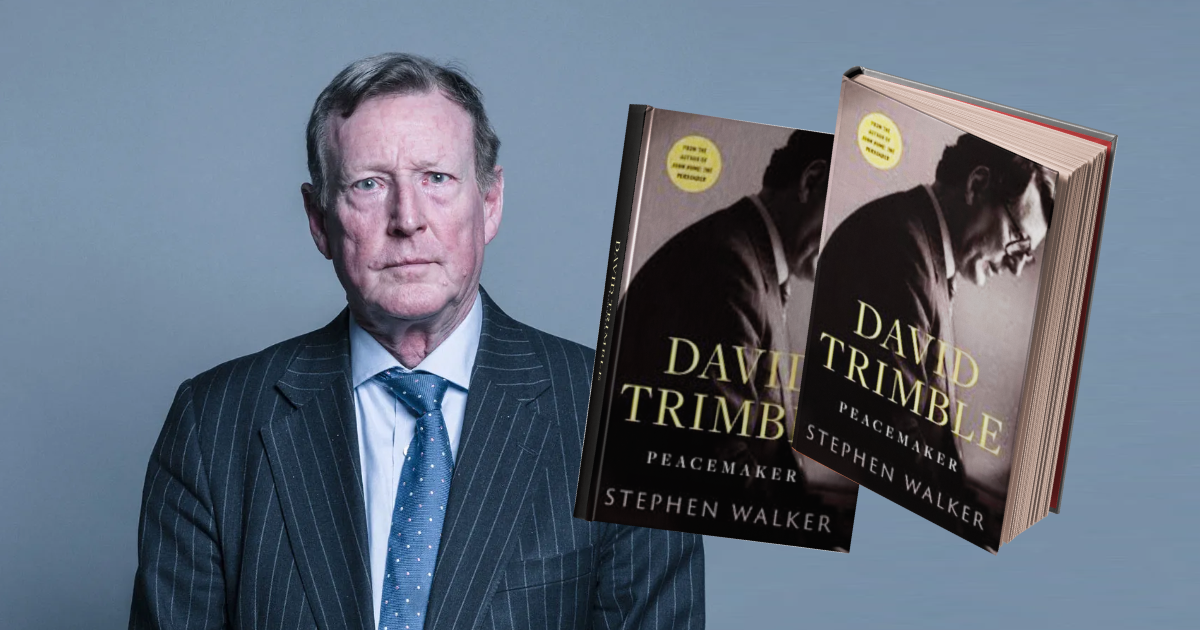
David Trimble: Peacemaker
Stephen Walker
Gill Books
September, 2025
432 pages
ISBN: 9781804581926
Growing up, my mother often shared stories with my siblings and me about her years as a young teacher in West Belfast during the 1990s. She would leave her family home in Toomebridge, on the Antrim–South Derry border, and travel into a city marred by conflict. Her commute from rural to urban often meant passing through multiple British Army checkpoints. Journeying along the Falls Road, she encountered constant reminders of the Troubles: damaged buildings, burned-out vehicles, RUC cordons, and even more checkpoints. She would end these stories with a familiar refrain—that we, her children, did not know how lucky we were. My father would silently nod his head in agreement. Now, in my mid-twenties, I think I agree with her, too.
My own commute to an office in the heart of Belfast City Centre could not be more different. I board a bus along the Ormeau Road and travel into Town with little to worry about beyond unreliable bus timetables and finding a coffee shop with a short queue for my morning caffeine fix. The most striking feature of the journey is not what is present, but what is absent—the quiet, hard-won disappearance of fear from the ordinary act of going to work.
The transformation of a society from conflict to peace is rarely straightforward. This was certainly true of Northern Ireland’s peace process, which culminated in the signing of the Good Friday Agreement in 1998 and brought an end to three decades of violence and bloodshed. The names of John Hume, Mo Mowlam, Seamus Mallon, Bertie Ahern, Tony Blair, Senator George Mitchell, David Irvine, Gerry Adams, and Martin McGuinness are rightly recalled for their pivotal roles in securing that settlement. They and many others are widely regarded as the architects and the peacemakers of the Agreement.
One name, however, often fades at the margins of that story: that of David Trimble.
Stephen Walker, a seasoned former BBC journalist with more than three decades’ experience covering Northern Irish politics, has taken a very different approach to retirement than most. After writing an acclaimed biography of John Hume (reviewed in Position Papers, March 2024), he has turned his attention to one of the other main figures of the peace process—David Trimble.
In his new book, David Trimble: Peacemaker, Walker explores the history of a complex character who still divides opinion to this day. Walker has produced the first full-length biography of one of Northern Ireland’s most consequential—and contested political leaders. Drawing on over 100 interviews with family members, political figures, and journalists, Walker presents a layered narrative of Trimble’s journey from law academic to Nobel Peace Prize–winning statesman at the heart of the Good Friday Agreement.
This is not a sanitised account. Walker’s Trimble is a man of principle and contradiction, a man of peace and division, a man of ambition and doubt, who inspired deep loyalty and even deeper loathing.
Indeed, throughout the sweep of Trimble’s life, Walker has masterfully captured the dichotomies that made up Trimble: his brittleness and power, his cunning and naïveté, his highs and lows, his glory and tribulations, his domineering arrogance and his crippling doubt, as he moves slowly from the margins to the centre stage of Northern Irish politics, when he made one of the most crucial decisions in all of Northern Irish history: the signing of the Good Friday Agreement.
Some will question the title of the book, Peacemaker, given Trimble’s early support of Vanguard and his antics on the Garvaghy Road in the summer of 1995, which led one senior Northern Ireland Office official to describe his behaviour as “disgraceful”, while another noted that “the dreadful Trimble did his best to obstruct and spoil” an agreement in Portadown during the height of the marching season.
The image of the sash-decorated MP walking hand in hand with DUP leader Ian Paisley in Portadown, part of Trimble’s constituency, to celebrate the fact that 500 members of the Orange Order had just completed a highly controversial march from Drumcree Parish Church along the mainly Nationalist Garvaghy Road and confronted a line of RUC men in riot gear—an image that makes up the inside cover of this book—did much to confirm Nationalists’ worst fears.
Walker does not shy away from this history. Nor does he flinch from recounting episodes that sit uneasily with any later claim to peacemaking. One particularly shocking episode is recounted by former President of Ireland Mary McAleese.
On a Monday in January 1972, law student Mary McAleese walked down the avenue at Queen’s University towards the library with a heavy heart. The day before, the Parachute Regiment had opened fire on civil rights marchers in Derry, killing 14 innocent civilians. It was one of the darkest days in what would amount to nearly 30 years of dark days.
Coming the opposite direction was a smiling David Trimble, then a brilliant young law lecturer at Queen’s. He remarked to her and a companion, “Isn’t it a wonderful day?” The future President of Ireland was taken aback, “because he wasn’t the kind of person who ever greeted you”.
McAleese tells Walker: “On that day, he was very, very friendly.” Trimble had “gone up and down the road looking for Catholics to greet”. Then it dawned on her: “It wasn’t actually a reference to that day at all, but a reference to the day before. You see, he was nakedly sectarian, you know, back in those days.”
On that fateful Sunday, 21-year-old Martin McGuinness was the second-in-command of the Provisional IRA in Derry.
It was 45 years later in March 2017, when David Trimble sat down and wrote a letter to Martin McGuinness, who was on his deathbed. Trimble took it upon himself to acknowledge how far the hardline republican had travelled to help secure peace.
If McGuinness had been well enough to reply, he might well have noted that David Trimble had taken a journey that was every bit as arduous, circuitous, and difficult. But that is how peace is made—it is rarely straightforward. As Walker persuasively points out, there can be little doubt that Trimble was central to peace in Northern Ireland.
It is precisely because Walker confronts these moments directly that the later transformation carries weight. Trimble’s evolution was neither linear nor inevitable. It required what Walker describes, implicitly and explicitly, as an act of political and moral reimagining—not the abandonment of Unionism, but its recalibration.
That recalibration came to a head during the multiparty talks leading to the Good Friday Agreement. Trimble’s role in those negotiations was neither decorative nor symbolic.
As leader of the Ulster Unionist Party, he carried the largest bloc of Unionist support into the talks, and with it, the capacity to make or break any settlement. Walker shows how Trimble repeatedly chose to remain at the table when withdrawal would have been safer, how he absorbed internal dissent while engaging with former enemies, and how he accepted ambiguity—particularly on decommissioning—in order to secure a broader constitutional settlement.
As the talks came to a head on Good Friday, 10 April 1998, Trimble spoke about the issue of decommissioning on the phone to Bill Clinton, the then US president. He obtained a letter of reassurance from Blair, but some party colleagues, such as Jeffrey Donaldson, were still dissatisfied.
Recent declassified state files revealed that five years after the Good Friday Agreement, Downing Street knew the IRA was still engaged in mutilation, developing weapons, gathering intelligence, targeting, and intimidation. Trimble’s concerns appear to have been rightly founded.
Senator Mitchell recounts: “I sat at my desk and I think I kind of dozed off. Then the phone rang, and it was maybe 4.45, ten to five, and it was Trimble. I remember the words exactly: ‘How are you, David?’ And he said, ‘We are ready to do the business.’ Those were his words.”
At 5 p.m. it was confirmed, in the presence of the media, that agreement had been reached.
The cost of that decision was immense. Trimble was denounced as a traitor, a sell-out, a Lundy—accusations that cut deeply for a man who regarded himself as a Unionist to the core.
Yet it was the same figure lionised at Drumcree in 1995 who, just three years later, led the Ulster Unionist Party into government with Sinn Féin. As Bertie Ahern later observed, “Without David Trimble there would be no Good Friday Agreement.”
As his daughter Vicky says of him: “Without my dad, we might not have peace in Northern Ireland.” And she is right.
To get to that place, Trimble had to perform some pretty sinewy moral gymnastics, and while his place in history as one of the architects of peace in Northern Ireland is secure, this book shows what an odd character he was.
He could not abide the Labour Northern Ireland Secretary of State, Mo Mowlam, feeling Tony Blair, not her, was his equal.
Four years after the Good Friday Agreement, he told an Ulster Unionist Party conference, without a trace of irony, that the Republic of Ireland was a “pathetic, sectarian, mono-ethnic, monocultural state”.
It was as if, having done the peacemaking deed, he could barely bring himself to make it work. Eamon McCann described Trimble winning the Nobel Peace Prize as “winning the lottery without buying a ticket”.
As Mary McAleese said of Trimble: “The arc of change for someone like him was really quite remarkable, and so there must have been someone quite remarkable in his life … And I credit Daphne with a lot of that.”
Life after the Good Friday Agreement and the Nobel Peace Prize was difficult for Trimble. Implementation of the Agreement faltered, trust eroded, and Trimble felt increasingly isolated—convinced that republicans and the British government alike had failed to honour the spirit of the Agreement, particularly on decommissioning.
Within seven years of sharing the Nobel Peace Prize, he lost his Westminster seat to the DUP. Embittered with Unionist politics rather than Unionism, he joined the Conservative Party in the vain hope of having an influence on the wider politics of the United Kingdom, but although he was ennobled into the House of Lords, Trimble’s time had passed.
In its historical framing, Peacemaker makes clear that historical judgement operates on a longer timescale than party politics. Trimble’s political transformation—from a figure associated early on with militant Unionist activism to the architect of a power-sharing settlement—reflects the broader arc of the Northern Irish conflict and its peace process. His willingness to break with Unionist orthodoxy, even at great personal and political cost, encapsulates the painful but necessary compromises contained within the articles of the Good Friday Agreement.
In David Trimble: Peacemaker, Stephen Walker invites the reader to look again at a man whose contribution to peace was both decisive and deeply costly. What emerges is not a figure seeking admiration or consensus but one prepared to endure isolation, misunderstanding, and political defeat in pursuit of something larger than himself. Trimble’s life, as Walker presents it, was marked by an unshowy seriousness—a belief that leadership, at its most demanding, requires the courage to act without applause.
Walker’s definitive biography thus serves not only as a life story but as a lens on an epoch: the dawn and twilight of the Troubles, the negotiated Agreement, and the fragile peace that followed.
Trimble’s legacy remains uneasy and unresolved, particularly within the tradition he once led. Yet Walker’s account makes clear that the peace secured in 1998 was not inevitable, nor was it free. It required figures willing to fracture old certainties and to absorb the personal consequences of compromise. Trimble was one such figure.
Time has a way of softening political rancour and sharpening historical judgement. Read in that light, Walker’s biography stands as both a reassessment and a quiet act of restoration, placing David Trimble where he belongs—among those whose willingness to risk everything helped draw Northern Ireland back from the edge, and whose true measure may one day fully come into view.