
“Can anything be imagined so ridiculous, that this miserable and wretched creature [man], who is not so much as master of himself, but subject to the injuries of all things, should call himself master and emperor of the world, of which he has not power to know the least part, much less to command the whole?”
― Michel de Montaigne
“He don’t know it’s anything he can’t know.”
— Flannery O’Connor, The Violent Bear It Away
Years ago, I was invited to take part in my wife’s book club. Okay, let me be more clear: All the husbands were invited to be part of our wives’ book club. After meeting monthly and immersing themselves in works like Year of Wonders: A Novel of the Plague or Comfort Me With Apples, they delegated one of the husbands to select a book for the year-end dinner and discussion. That year, with the mantle of decision resting heavily upon my shoulders, I selected Joseph Persico’s
Nuremberg: Infamy on Trial. And, to be honest, with 560 pages of size ten font, it wasn’t the most popular choice, but it did generate spirited discussion.
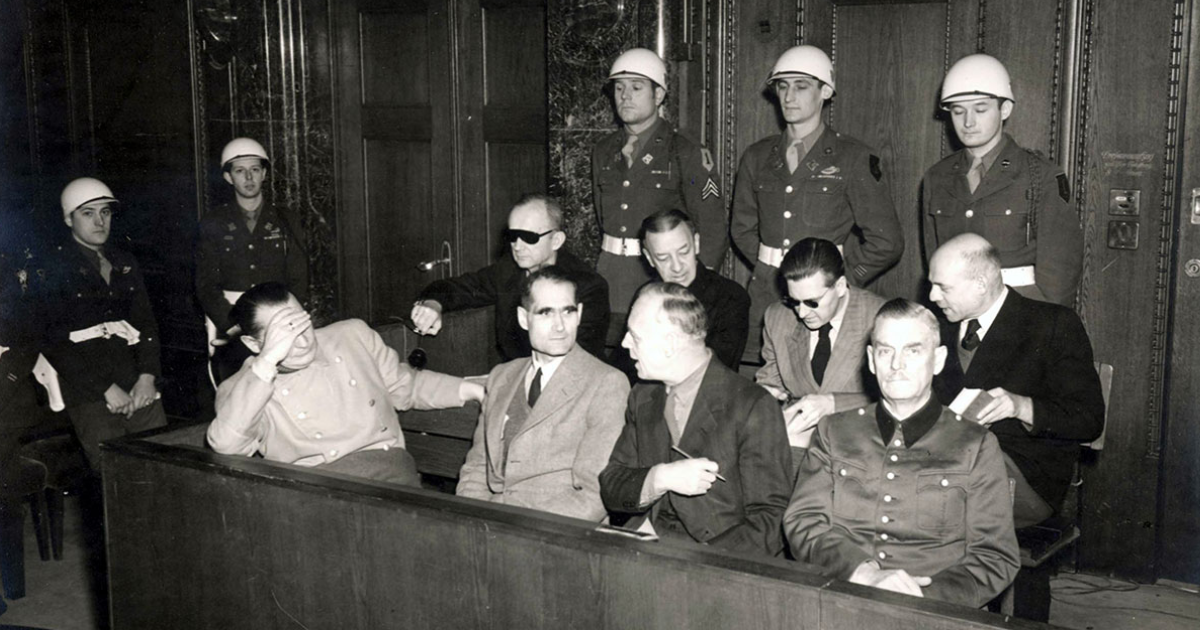
The Nuremberg Trial generally refers to the most famous trial—the International Military Tribunal—of the most high-ranking Nazi officials held in Nuremberg, Germany, in 1945 and 1946. Nuremberg was the city notoriously known for its visually spectacular Nazi Party rallies, as well as the infamous Nuremberg Laws that marginalized and, ultimately, demonized the German Jewish population. Of note, twelve additional trials, the Nuremberg military tribunals, were subsequently held between 1946 and 1949 to prosecute various factions like Nazi doctors, SS officers, and complicit industrialists. Even more occupation zone trials (in domestic and military courts) involved thousands of trials held in Great Britain, France, the United States, and the Soviet Union for “lesser” war criminals. Finally, hundreds of latter-day German trials were held after 1949 for Nazis identified and apprehended late but still due to face justice.
Nuremberg: Infamy on Trial dealt with the first and most famous trial, which prosecuted twenty-two eminent Nazi officials, including Hermann Göring, Hans Frank, Alfred Rosenberg, Albert Speer, Julius Streicher, and Rudolf Höss. The presiding judges came from the United States, the Soviet Union, France, and Great Britain.
In our book club, we discussed (in what I deemed a riveting conversation over chicken and pasta) the various rationales of the Nuremberg defendants, including claims that they were “just following orders,” assertions that the tribunal was illicit in exacting ex post facto law (aka “victor’s justice”), protests that an individual can’t be held responsible for an official state act, and an accusation of tu quoque: “You did it too.”
Recently, memories of that book and our book club conversations stirred when my family watched the new film Nuremberg. This film, starring Russell Crowe (as imprisoned Reichsmarschall Hermann Göring) and Rami Malek (as US Army psychiatrist Douglas Kelley), spends less time on the nuances of legal strategy and more on the attempt to anatomize evil. Throughout the film, we witness Dr. Kelley demonstrate his rather unorthodox approach to attending to his patient. Rather than addressing the psychological issues that arise in his patient or fundamentally assessing him for an insanity plea, Dr. Kelley makes a project of Göring (and for personal gain). In so doing, the good doctor seeks to match Göring in verbal bobs and weaves, looks for tells that might betray inner secrets, and strives (in a clumsy chess match) to outwit someone who is obviously trying to outwit him. No matter Malek’s eccentric acting talents and Crowe’s studied gravitas, the storyline (and the doctor-patient relationship) falls flat.
Part of the reason, in my opinion, for the failure of this characterization of Göring and Kelley’s relationship is the high-toned, all-too-credulous, worn-out notion that evil can be medicalized or that, quite simply, “science can answer this.” The bright-eyed devotees of scientism believe all too easily that the intangible, the ineffable, the materially inexplicable notion of evil could simply be submitted to the “infallible” scientific method and solved with studied effort followed by delicious satisfaction.
However, whether it is upbringing or neurotransmitters, trauma or social isolation, books read or speeches heard, true religion lost or warped religion found, there is no perfect key that fits the lock on evil. Evil is, as Winston Churchill once said of Russia, “a riddle wrapped in a mystery inside an enigma.” Now, to be sure, Nuremberg
shows us moments where Dr. Kelley makes breakthroughs, but then he is confounded. His path is straight, but then it is meandering. As one would expect, this leads to recurrent (and expected) frustration. And yet, it doesn’t lead Dr. Kelley to assert that his attempt to capture, dissect, study, and systematize evil was a fool’s errand. Rather, he is vexed: He still believes in the illusion that one can box up and explain evil, but it’s just that he wasn’t up to the job.
But evil is more complicated than that. After years in the Soviet Gulag, a truth about evil alighted upon Russian dissident Aleksandr Solzhenitsyn:
Gradually it was disclosed to me that the line separating good and evil passes not through states, nor between classes, nor between political parties either—but right through every human heart—and through all human hearts. This line shifts. Inside us, it oscillates with the years. And even within hearts overwhelmed by evil, one small bridgehead of good is retained. And even in the best of all hearts, there remains . . . an unuprooted small corner of evil.
“The self,” G. K. Chesterton lamented, “is more distant than any star.” And even Albert Einstein, who at times pronounced “authoritatively” on areas outside of his expertise, got it right when he confessed, “The real problem is in the hearts and minds of men. It is easier to denature plutonium than to denature the evil spirit of man.” Evil is complicated. It is not scientific.
Nuremberg made an attempt—in two hours and twenty-eight minutes—to capture a seismic evil committed by oversized personalities and prosecuted on a grand, international scale. To be sure, it was a noble attempt. However, the story may have been more successful if it were a bit more humble. At the end of the day, the justice of the victors will never compensate for the fifty million dead on the European side of the war. At the end of the day, some psychological theory would never fully explain the depths of Nazi evil. As G. K. Chesterton wisely observed, “The morbid logician seeks to make everything lucid, and succeeds in making everything mysterious. The mystic allows one thing to be mysterious, and everything else becomes lucid.” Ultimately, our systems of justice and our intellectual apprehensions stop at the water’s edge of the fathomless depths of evil. Therein, we are left speechless with faith in God’s justice to address evil’s dark mystery.
Nuremberg can’t give us answers; it simply leaves us mute in our questions. May God above answer them one day.
Tod Worner
Tod Worner is a practicing internal medicine physician and is Editor-in-Chief of Evangelization & Culture—the journal of the Word on Fire Institute—and Evangelization & Culture Online. He also hosts the Evangelization & Culture Podcast.