
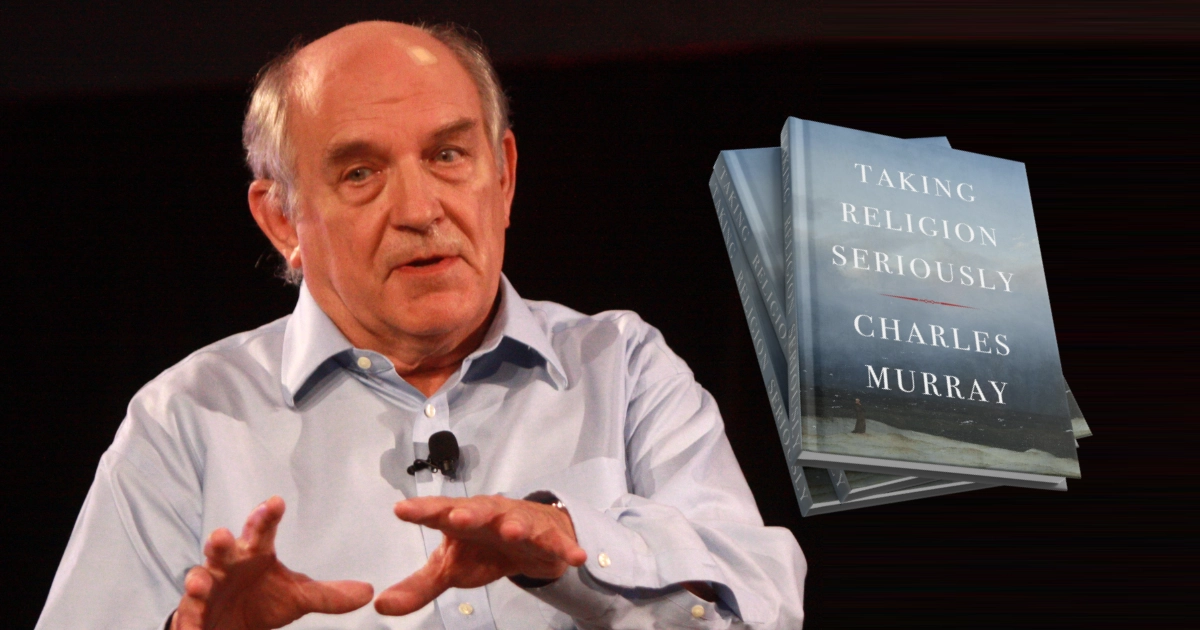
Taking Religion Seriously
Charles Murray
Encounter Books
October 14, 2025
152 pages
ISBN: 978-1-64177-485-7
Charles Murray is arguably America’s greatest living social scientist, and his most famous books have changed the trajectory of American discourse. Losing Ground (1984) challenged the efficacy of the American welfare state and helped enable the subsequent welfare reforms of the 1990s. The Bell Curve (1994) ignited a firestorm of criticism but drew necessary attention to the role of human intelligence in explaining personal outcomes. Coming Apart (2012) provided the best framework for understanding the recent social, political, and economic changes that have reshaped America and much of the West. His bibliography, like his intellect, is extraordinary. Now, as he approaches his eighty-third birthday, Murray has written a book about his long journey from agnosticism to Christianity.
At just over 150 pages, Taking Religion Seriously is unusually short by his standards. It is divided into two parts, with the first section focused on the evidence for God’s existence and the latter focused on Christianity more specifically. Murray has an audience in mind—the “millions [who] are like me when it comes to religion: well-educated and successful people for whom religion has been irrelevant.” These are people who exist in cultural milieus similar to that which Murray lives in: people who “grew up in secular households or drifted away from the faiths in which we were raised, and never looked back.” His request to his secular readers is that they thoroughly examine the empirical evidence available, and he points toward leading authorities across various fields.
He asks for no leap of faith. “Bring to the question of your soul the same critical faculties that you have brought to more prosaic empirical questions using the same tool—good evidence—that you have always used to make up your mind,” Murray urges. His own churchgoing (as a Presbyterian) ended when he left his Iowa hometown and went to Harvard in the early 1960s. There, in an atmosphere marked by disdain for religion rather than outright hostility, the prodigy ceased to engage with religious questions. When he told his father that he no longer believed in the fundamental claims of Christianity, he was surprised by the response. His father also did not believe in an afterlife but felt that regular churchgoing was a good habit and provided a reminder of his responsibility toward others.
Murray’s wife, Catherine, experienced a similar drift away from religious practice, but the birth of their daughter in the 1980s triggered something deep inside her—namely, a recognition that she loved her child “far more than evolution required.” She began to explore faith more seriously and eventually found a lasting home in a Quaker community. Like his father before him, Charles began to accompany her to Quaker meetings out of a sense of familial duty but without developing any religious faith. That took much longer, and the details make for an absorbing read.
For the author, the scientific issue comes first—unsurprisingly. He outlines the evidence regarding the origins of the universe and the extraordinary improbability of that process resulting in conditions permitting the existence of life. Studying this allowed him to come to the conclusion that God existed, but the existence of the soul required further proof, which came in the form of growing evidence about near-death experiences (NDEs) and—more interestingly still—terminal lucidity. In a not insignificant number of cases, patients with conditions such as dementia occasionally experience an incredible mental rally immediately prior to death, where they can suddenly recognize family members and speak coherently again. Evidence about these inexplicable occurrences undermined Murray’s view that consciousness exists solely within the brain. There had to be something more.
That explains why Murray came to believe in God and the human soul.
As for his conversion to Christianity, the roots of the process were found in the research he undertook when writing his magnum opus, Human Accomplishment: The Pursuits of Excellence in the Arts and Sciences, 800 BC to 1950, which came out in 2003. During the lengthy research process, the author’s preconceptions about religion (and the Catholic Church in particular) were shattered by his growing awareness of how faith and reason had walked hand in hand, and how the institutional Church and its members had played such a major role in making or facilitating key achievements and discoveries. Aside from rejecting the view that Christianity has been opposed to science, Murray also sees the decline in the quality of the arts from the late nineteenth century as being linked to growing secularism.
In an artistic world dominated by nonbelievers, individualism has triumphed and the key notion of what art is for has been undermined. “[W]hen religion no longer supplies a framework for thinking about the good, true, and beautiful, artists tend to make their work about their personal preferences, and those preferences tend to be banal or wrong-headed or both. That’s one of the reasons that the high culture of the twentieth century seems so pallid in comparison with the high culture of the preceding five centuries,” he writes. It is not surprising that he would take such a stance. Human Accomplishment, written long before Murray came to Christ, concludes with a memorable paragraph about those craftsmen who carved gargoyles atop the Gothic cathedrals: “It was said that they carved for the eye of God. That, written in a thousand variations, is the story of human accomplishment.”
St. Josemaría Escrivá used to show people sculptures on top of the cathedral in Burgos to make the same point. For all its material comforts, this secular age produces nothing that inspires the same reverence as what went before. Just as he reexamined his preconceptions about religion and science, Murray began to focus on modern biblical criticism and came to reject much of the skepticism with which it is infused. Rather than questioning the historicity of the Gospels as he had been subtly socialized to do, upon examining the evidence, he came to believe that the texts were strikingly credible and that the process of writing them began within forty years of the Crucifixion, when key witnesses were still alive.
Externally, Charles Murray does not appear to have changed. Judged on his interviews, he remains the thoughtful and insightful intellectual he has always been. Internally, things are much different. He writes that he no longer fears death, and this committed libertarian no longer believes he has the right to end his own life if he wishes to. Murray’s book is highly significant and provides further evidence of the religious shift taking root. Its primary significance is as a learning resource for the intellectually curious. In this, Murray builds upon the insights provided by Tom Holland in Dominion as well as the work of many other writers who are now taking Christianity seriously for the first time in decades.
Secondly, Murray’s book has particular value to those of us who seek a deeper understanding of God but find religious faith hard to acquire. The author has been a regular attendee at Christian services for decades and has come to believe in many of the core tenets of Christianity, but he describes himself as having a “perceptual deficit” when it comes to prayer and spirituality. Many in the pews can surely relate to the experience of spiritual aridity. Many struggling souls are inclined not to go to church at all on account of this, while knowing on some level that they should. Kierkegaard’s words about the seeking of faith itself being an act of faith are important ones, and if a religious revival is to come about, the Church will need to reach people like Murray, who freely acknowledges that he is far from devout.
“My meandering pilgrimage to belief has been devoid of divine revelation. Many people assume as I once did that to start taking religion seriously requires some sort of ‘born again’ moment. Not necessarily,” he writes. He “has yet to experience the joys of faith,” but knows that all is not lost. “When I am around Catherine and others who have, I sometimes feel like a little boy whose nose is pressed against the window watching a party he can’t attend. I’m not done trying to join the party. Perhaps the door will open eventually, but even if it doesn’t, I have much to be grateful for. My haphazard pilgrimage has already led me to believe that I live in a universe made meaningful by love and grace. That’s a lot.”
James Bradshaw
James Bradshaw writes on topics including history, culture, film and literature.