
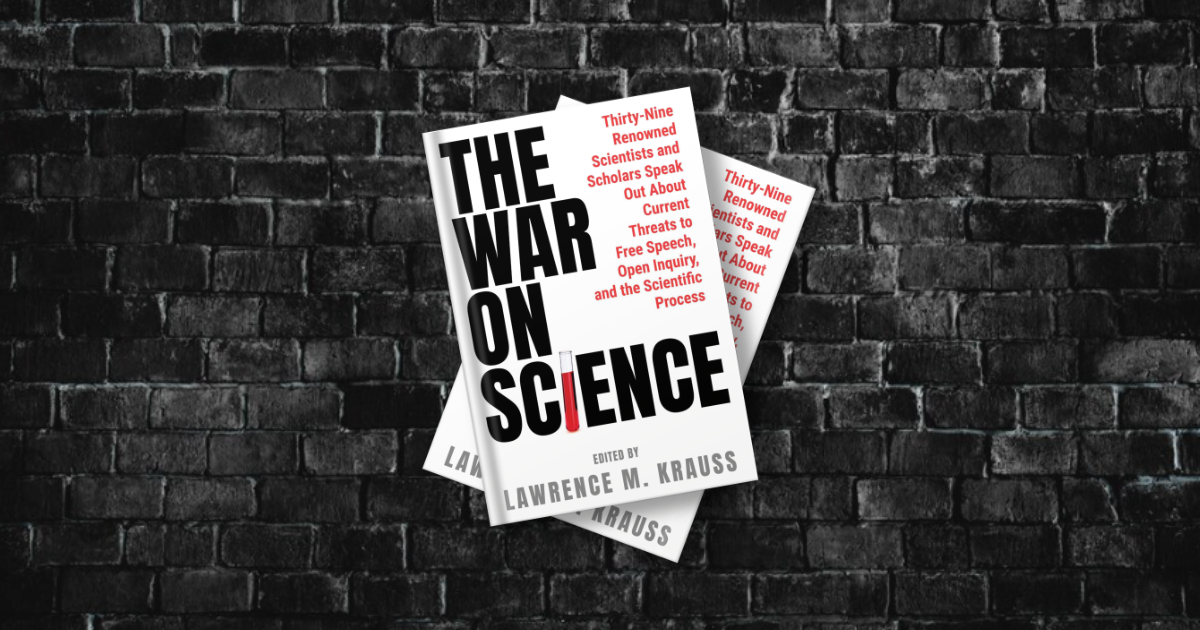
The War on Science
Lawrence M. Krauss (editor)
Forum / Swift Press
25 September 2025
304 pages
ISBN: 9781800756182
Laurence Krauss remembers a happier time in the academy when, in 1996, a fellow physicist (Alan Sokal) published a spoof paper called “Transgressing the Boundaries: Towards a Transformative Hermeneutics of Quantum Gravity.” The “research” was deliberate gobbledegook which poked fun at postmodern humanities studies by asserting that physics “cannot assert a privileged epistemological status” over others. Fast forward nearly thirty years, and the National Academy of Sciences (NAS) in the U.S. awards its highest honour for science communication to a paper entitled “Making Black Women Scientists Under White Empiricism: The Racialisation of Epistemology in Physics.” This time, the paper, which is full of the same nonsense as the spoof, is no joke.
Before Krauss compiled this volume, he authored a dozen books on physics. He clearly loves his subject and is not alone in his concern about what he views as an ideological transformation of universities in the U.S. and beyond. The collection comprises essays on various topics around ideology and science, the contributions of twenty-two experienced and often tenured professors in fields from physics to biology, medicine, mathematics, philosophy, and social science. Each of them is writing in this book about the grim reality they face: contested concepts like “diversity, equity, and inclusion” (DEI) policies becoming orthodox, and on which academics must effectively swear oaths to join faculty staff in leading institutions. The book gives extensive testimony of respected colleagues, including the authors themselves, who report being smeared or blacklisted for expressing the view that biological sex is binary—resulting in accusations of transphobia and, in some cases, threats to their families. Finally, the volume details the silencing of research in scholarly journals that may offend (on the basis of “systemic racism” and other dubious grounds) and what can and should be done to open up proper discourse again. As a read, it is part narrative experience on the part of scientists, part debunking of the weakness of woke concepts, and part defence of science and the purpose of the university.
It starts with a harking back to Soviet Russia and the infamous Lysenko affair, in which a political and unscientific individual attempted to revolutionise farming practices with bogus propagation theories that led to famine—first in Russia, then, as the theories were adopted there, in China. Richard Dawkins tells the story, drawing comparisons between Lysenko’s ideological assertions in biology and what he characterises as the aggressive tactics of transgender activists today in mixing political will with hard facts. He himself is the highest-profile victim of blacklisting by such agitators in the book, as he was recently booted from the American Humanist Society for daring to question why choosing one’s race is not allowed, but choosing one’s gender (which is actually fixed, while races mix) is. Dawkins experienced being silenced, deplatformed, attacked, shunned, and maligned for questioning gender ideology—a pattern repeated across disciplines according to the book’s contributors.
We learn that scientific journals have implemented actual censorship of research that “may be deemed to cause offence now or in future,” with well-known journals such as Nature implementing censorship of research likely to draw complaints from transgender advocacy groups and DEI administrators. Lists of papers that have been pulled down and removed are provided. Scientists who wish to question research claiming that human gender exists on a spectrum, or that patient-physician racial concordance improves health outcomes, or that gender-affirming care for minors reduces suicide rates, have to publish their research these days in the Journal of Controversial Ideas. Whereas, since major academic and governmental organisations have decided that they are filled with “systemic racism,” papers such as “Observing Whiteness in Introductory Physics” are given their place in peer-reviewed publications. The highly questionable Marxist theories behind race and gender are now orthodoxy. Criticism is silenced, meaning scientists, whose jobs may suffer, are afraid to speak out. Nearly every essay takes time to point out that, as Alan Sokal puts it,
“[F]reedom of debate legitimizes knowledge. . . . If the ‘progressives’ are 100 percent correct on every subject, censorship of opposing views is still harmful to their own cause as it undermines the good reasons for anyone else to adopt their ideas.” (How Ideology Threatens to Corrupt Science, Alan Sokal, p. 79)
One remarkable insight that plays out across the essays is the extent to which the scientific community itself, rather than outside forces, is seen as the main antagonist. Niall Ferguson points out in his essay “The Treason of the Intellectuals” that the plight of Jewish German intellectuals from the 1920s onward—who were delegitimised, marginalised, and ultimately, if they did not flee (as Einstein and others did), arrested and killed—bears disturbing parallels to “the willingness of trustees, donors, and alumni to tolerate the politicisation of American universities by ‘woke’ progressives, adherents of ‘Critical Race Theory,’ and apologists for Islamist extremism.” He points out that it was the intellectuals in Germany who were so keen on National Socialism and warns the academy:
“Anyone who has a naïve belief in the power of higher education to instil ethical values has not studied the history of German universities in the Third Reich.” (p. 87)
Probably the most telling story from a tenured professor is Dr. Sally Satel, who holds an external teaching post at Yale. Due to her publishing of research that questioned the benefits of Critical Race Theory in medicine, residents at Yale, on hearing her talk on an unrelated topic, complained of feeling “unsafe.” She details, along with a later essay on “DEI in Science and Medicine,”
“[A] deeply worrisome experiment [is] underway across American medical schools: the morphing of the role of physicians from healers to activists and of medicine from promoting health to advancing social justice.” (Sally Satel, Social Justice, M.D., p. 159)
The book makes a compelling case that ideology, particularly theories of systemic racism and gender fluidity, has led to significant upheaval in academic circles. The best example related to this is from lockdown in 2020, when an epidemiologist, cheered on by 1,200 colleagues who wrote in to support her, claimed that, during the riots that broke out in 2020, “the public health risks of not protesting [after George Floyd’s death] to demand an end to systemic racism greatly exceed the harms of the virus.” So much for “following the science.”
The contributors roundly criticise DEI policies for undermining academic merit and, they argue, doing more harm than good. Several contributors claim that Albert Einstein, himself a refugee from the Nazis, would be unable to apply for positions in some U.S. university departments today due to diversity hiring policies. Dorian Abbott of the University of Chicago, however, has pushed back in his own department and uses his essay to encourage others to do so. His Ukrainian wife described the situation facing academics as reminiscent of “the Soviet times my mother told me about.” Abbott, who had been keeping his mouth shut about DEI and woke policies in his department, decided:
“That was enough to convince me. Not in this country, not on my watch. My wife’s mother is a teacher. In the aftermath of communism, she brought home the old propaganda books from school about Lenin and his pals . . . to burn them to stay warm in the winter. Lenin’s system failed so utterly that people had to burn the old propaganda just to stay warm. And no small part of this failure was that they had allowed science to become politicised.” (Dorian Abbott, “Three Principles, Three Fables,” pp. 261–62)
The volume includes the contributions of social scientists and philosophers and details the extent to which, in particular, women in the academy have faced deplatforming and threats for speaking out against prevailing orthodoxies on gender issues. Most of the essays point out that this has a chilling effect in science and across the academy, because the technique of DEI departments and ideologues has been the aggressive silencing of dissenters through demands that they be fired, silenced, or subjected to personal threats. Many non-tenured teachers and young academics are staying silent, and the book is clearly being used by these authors to appeal to their colleagues. This is important to all of the academy because, as one essay points out,
“[W]hat’s happening now is different. . . . Recent attacks on science are more general than before, spreading into every field. . . . Political climate changes, including the rise of identity politics, have caused scientists on the Left to use their own fields to signal ideological virtue and membership in a political ‘tribe.’” (Jerry A. Coyne and Luana S. Maroja, “The Ideological Subversion of Biology,” pp. 151–52)
Much of the discourse in the book focuses on what the authors characterise as institutional virtue signalling (such as institutions openly decrying themselves as “racist”) and the collapse of real diversity in discourse that has resulted. While the book includes thoughtful proposals for reform, it lacks any sustained discussion of the academy’s shift from its Christian origins. No one really gets into the origins of the academy, but they do theorise on its state. Gad Saad, author of the bestseller The Parasitic Mind (2020), talks, as an evolutionary biologist, about the “parasitic ideological rapture” of institutions. He explains that he “searched for a framework” to understand how “so many of my colleagues were espousing truly anti-reason, anti-reality, and anti-science ideas.” (Gad Saad, “Universities as Dispensers of Parasitic Ideas,” p. 91.) Attractive and erudite though his concepts are to those searching for a description of the problem, neither Saad nor anyone else in the book makes any real effort to examine the academy in anything but the most immediate sense. Perhaps the greatest shortcoming, then, is that none of them examine where shared values—and their collapse—could be sought out.
The only effort to sum up some kind of moral argument, aside from the historic warnings from the Soviets and Nazis, comes from Richard Dawkins, who attempts, predictably, after complaining about the lack of scientific rigour in the Soviet era, to blame transgenderism on the Catholic doctrine of transubstantiation. His attempt to link them seems to be based on the fact that the prefix “trans-” is present. Why does he insist on trying to blame religion for not demonstrating anything real, then blame it for the real problems of the world?
Which is the unfortunate summation of the book as a whole, despite its important content and honest methods. All academic fields are besieged now. But without any purpose for fairness, rigour, true diversity of viewpoints, dignity, and the concept that changing one’s mind is possible, any academy is inevitably going to end up in the hands of the powerful, whoever they are. Unless it can recover its foundational commitment to open inquiry and intellectual humility, one fears that Harvard, Yale, and universities throughout the West will decline from their fine and trusted positions and be regarded as mere ideological playgrounds on the Left. One hopes this volume helps more academics recognise the scope of the problem. Will they save themselves? Who knows? One essay in the volume ends with a poignant quote from Plato that may sum up the real need, which is courage:
We can easily forgive a child who is afraid of the dark; the real tragedy of life is when men are afraid of the light.
Dominic Perrem
Dominic Perrem is National Director of Alpha Ireland, where his work focuses on evangelisation and reaching people outside of the Church. Before this he worked in the book publishing industry, and as a presenter for Spirit Radio. He lives in Meath with his wife, Annie and seven children.