
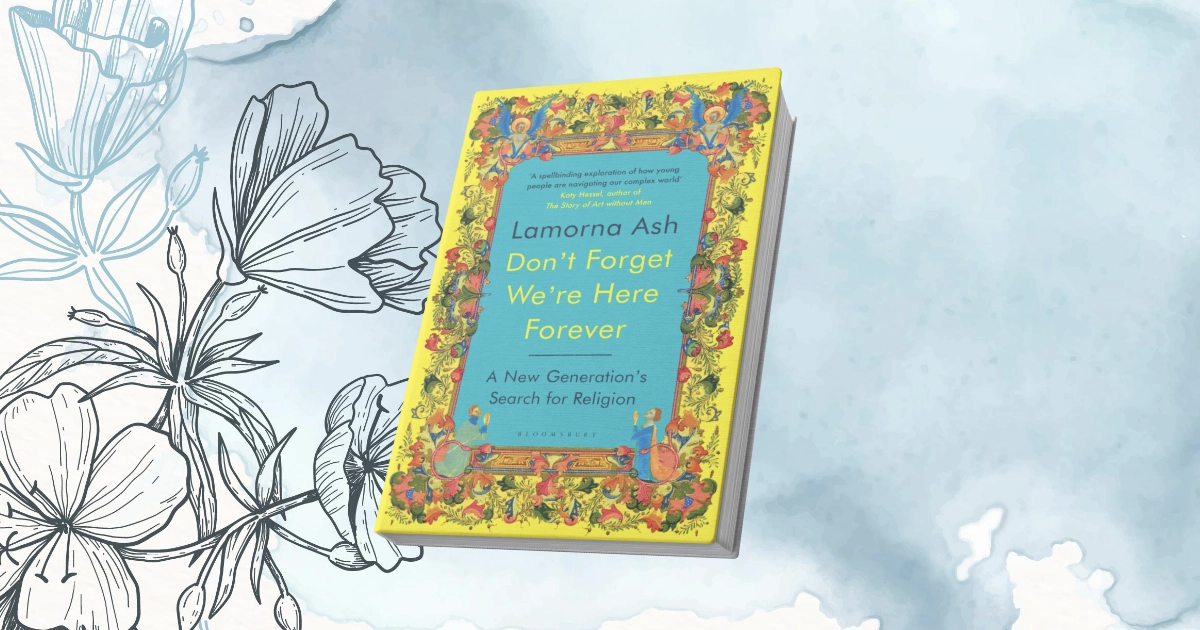
Lamorna Ash
Don’t Forget We’re Here Forever: A New Generation’s Search for Religion
Bloomsbury Publishing
July, 2025
352 pp.
ISBN 978-1-5266-6314-6
Heterosis: the phenomenon whereby any given offspring exhibits superior qualities compared to its parents. Many in my generation are bearing an existential crisis that our predecessors never quite faced. The previous generation fought valiantly to “change the world”—to free men and women from the shackles of injustice, discrimination, and oppressive regimes. And they succeeded. Yet, having torn down real tyrannies, they now remain restless, thirsting for liberation—except now, without the captive. Their adolescent protest marches on, seeking the souls of pseudo-oppressors and pseudo-problems like the provision of “gender-affirming care,” the “decolonisation” of history books, and other such abstractions.
Meanwhile, many from my generation awaken to a different, more primal crisis. What is it all about, anyway? Where do rights come from? Isn’t the universe just going to explode eventually? Whence comes the value we presuppose that every individual is endowed with in the first place? Don’t forget these real questions—they lie in our perceptive shadows; they will never be forgotten—they are here forever.
It is against this backdrop that Lamorna Ash embarks on her journey. Prompted by two university friends, Jack and Josh—who had been a rather successful comedy duo—she is intrigued when they end up training to become Anglican priests. Their unexpected “regression” from modernity to the medieval sparks her curiosity. In fact, many more are laughing alongside Jack and Josh. Recent data from a UK YouGov poll conducted in August 2025 shows a significant increase in belief in God among young people aged eighteen to twenty-four. The poll found that 37 percent now say they believe in God, more than doubling from 16 percent in August 2021, while atheism declined from 49 percent to 32 percent in the same period. The author seeks to explore why young people are showing an unprecedented return to faith.
Ash herself comes from the progressive milieu that shaped her: an active lesbian “experimenting with polygamy.” As you read through Ash’s journey, you are not witnessing a reactionary rebel but rather someone wholly fashioned and inculcated by those before her. She wrestles with the angel of a supposedly obsolete age.
Ash begins her wrestling not in silence but in noise—the earnest declarations of evangelicals. At Christianity Explored in London, the Gospel of Mark cuts across her deepest secular instincts, challenging the easy relativism she inherited. It is not that these evangelicals are wholly irrational; it is that they are too rational, too clear, too convinced. When she moves on to Youth With A Mission in Hertfordshire—whose devotion is as energetic as it is contagious—she expects to find zealots. Instead, she finds young men and women who radiate kindness and clarity—the “sort of people who live as though they actually know what life is for.” Their certainty unsettles her, not because it is oppressive, but because it is enviable. Faced with the blunt question, “Suppose you were to die tonight and God asked, ‘Why should I let you into heaven?’” she can only leave the answer blank. In Part I, Ash discovers that Christianity is not a relic but a live question—sharper than the assumptions she carried into the room.
Having been rattled by the evangelicals’ clarity, Ash slows her pace. She turns to the older houses of Christian tradition: Catholic shrines, monastic abbeys, Quaker meetings, and Jesuit retreats. In Walsingham, candlelight illuminates rosary beads; in Iona, silence presses in with monastic force; among the Quakers, she sees worship without pulpit, without sermon—only a democratic intimacy with the divine. Each of these places chips away at her prejudices in quiet but decisive strokes. The silence of the monks, the ritual of the Catholics, the inward stillness of the Jesuits—all refuse to be dismissed as mere “superstition.” Instead, they expose a wound she did not know she carried: the inheritance of progressivism has given her outward justice, but not meaning. If Part I unsettled her mind, Part II disturbs her soul, drawing her into rooms where stillness speaks louder than slogans.
In the final part, Ash finds herself among the tainted half-believers—those who cannot embrace Christianity yet cannot shake it off either. They live as if haunted—hymns sounding, memories returning—by the God they claim not to believe in. Ash herself cannot keep her distance anymore. The reporter dissolves, and what remains is a restless soul who half believes, half denies, and cannot shake the question that will not leave her alone. Gone is the evangelical certainty of Part I; gone is the monastic calm of Part II. What persists is the stubborn grit of Christianity—not easily swallowed, not easily spat out. It is the stone in the shoe, the splinter in the mind—the thing you cannot quite escape.
In the end, Ash cannot escape the gravity of Christianity. The questions she set out to investigate have pursued her too far, and she has been drawn—however haltingly—into the deep end. Yet if this is conversion, it remains lacking in complete form, compromised by the very assumptions she inherited from the age that taught her to forget. Just as my generation wrestles with an existential crisis our predecessors postponed, so too does Ash wrestle with a faith she cannot dismiss yet cannot wholly embrace. With God’s grace, this marks the beginning of the journey rather than its end.
James Garavan
James Garavan is a student of Philosophy & Theology in Oxford University (HMC)