Angela Franks
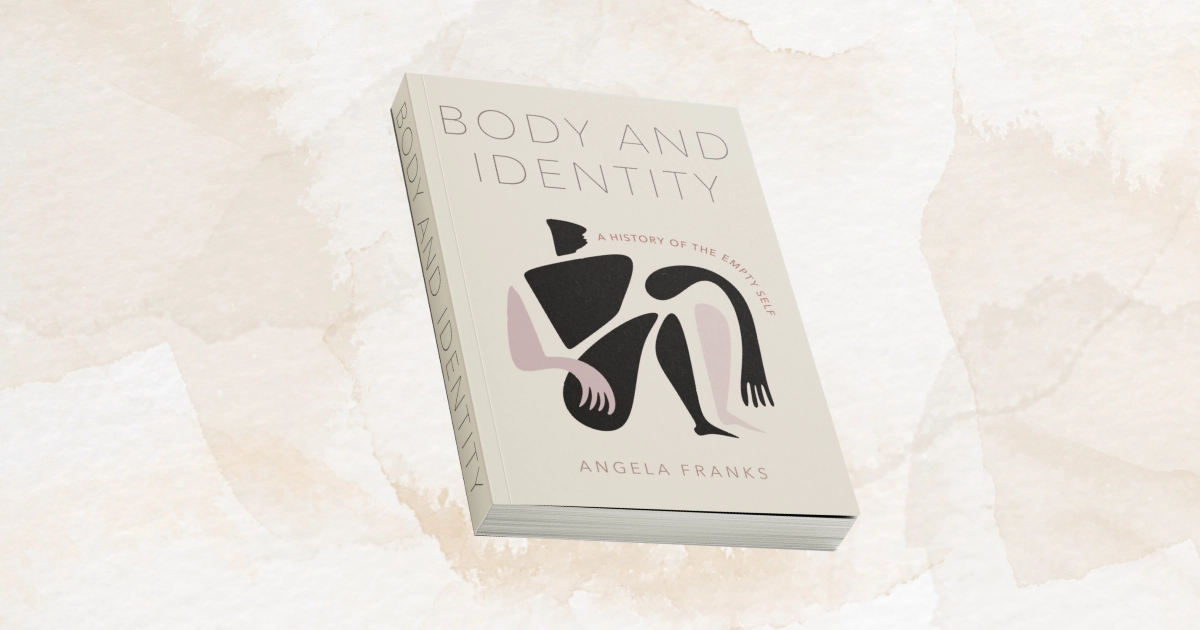
Body and Identity: A History of the Empty Self
University of Notre Dame Press
August 2025
414 pages
ISBN 978-0-268-20968-1
“Body and Identity” isn’t quite what a reader might expect if they skipped reading the subtitle, A History of the Empty Self. In fact, the emphasis is on “history.” The book focuses not so much on the phenomenon of “liquid bodies and empty selves” as on the long history of thought across the disciplines of philosophy, theology, and psychology that shows the question at the core of the current identity fixation is fundamentally the same question—“Who am I?”—that has teased the human mind from the beginning of our civilisation’s history.
The author is professor of theology at the Catholic University of America, but the book is not noticeably pitched at a Catholic or Christian readership interested in better understanding what they intuitively grasp, which is that the confusion and arguments around identity today are rooted in Western society’s abandonment of the faith culture that shaped its values, identity, and institutions over two millennia. Franks gives her readers a thorough recounting of the insights of a long list of thinkers on the core question of existence, ranging from Plato and Aristotle to Montaigne, Descartes, Kant, Rousseau, Hegel, Heidegger, Lacan, Sartre, Derrida, Deleuze, Foucault, Marx, Freud, and Erikson. That list is not exhaustive. She also cites feminist theorists Betty Friedan and Judith Butler. In this densely referenced—almost dizzyingly so for the general reader—414 pages, St. Augustine and St. Thomas Aquinas also get mention, carrying as they do the Christian insight that our most authentic identity is anchored in Christ, in whom “we live and move and have our being.” Jane Austen also features as an illustration of how the “hollow self” is depicted in characters from literature. Not surprisingly, in such a highly referenced study, the book’s 414 pages are bulked up by another 146 of notes and index.
Franks’s scholarly journey circles around on itself, tacks back and forth, alerting the reader sometimes to signposts of where she is heading or what she might revisit in future chapters. She also, somewhat irritatingly, reminds us that a follow-on book, under the same title, will examine the issue of “liquid bodies and empty selves” within contemporary culture. Of course, it’s important to look at “how we got here” to fully understand any event. There are few dramatic societal changes that don’t have historic roots, remote as well as proximate causes. However, Franks’s project of collecting and connecting theories about human personhood and human agency merely demonstrates that the problem of human identity is timeless and has absorbed scholars and thinkers from the time of Plato. Arguably, there has been development in our understanding of ourselves, especially since the fields of social studies, psychology, and psychiatry have joined older disciplines of philosophy and theology in addressing the questions. However, it’s not all about “the science,” so to speak. Ideological leanings and the researcher’s own issues around sexuality feed into their work. It is hardly surprising that the study of our own kind must, to one or other degree, reflect our own personally lived experience, how it feels for us to be our true selves in the flux of circumstances and within the restraints of societal structures.
Much of the finely detailed history of theory Franks offers comes down to the nature/nurture argument. Identity, it’s easy to observe, is an interplay between many factors, including our bodies, “the outer, most visible, most tangible edge of (our) personal complex.” Modernity today is obsessed with the body because we live at a time when “appearance comes before reality.” Our project is about “looking good” rather than “being good.” The reality of the inner self is regarded as liquid and can be anything the individual concerned feels it to be. The task is to present our bodies in a way that corresponds as satisfactorily as possible to the idea we have about our authentic selves. Because modern biotechnology offers many possibilities, the task is realisable in ways previous generations could hardly conceive. Quoting Carl Trueman, Franks writes, “Sex ceased to be what people do and has become what they are.”
As the boundaries of what is possible stretch, our perceived needs and choices follow suit. In an all-pervasive monoculture, individual beliefs, values, perceived needs, and even tastes tend to be set by the dominating ethos. We can see examples of that from the story of Sodom and Gomorrah (where not even ten good men could be found) to Hitler’s Germany, where there was at the very least mass acquiescence in unimaginable horror within what was a highly developed Christianised culture. For Foucault and Marx, it’s about more than the soft force of cultural dominance; it’s also about the coercive force of structures of power. For them, individual freedom comes down to the range of choice permitted under the power structures of any given time and place.
It is undeniable that individual freedom is circumscribed by systems of power, which may or may not be overtly coercive but are nevertheless overpowering in their pervasive and privileged access to opinion shaping, institutions such as mainstream media, schools and universities, and the political establishment. Globalisation enables the ideological monoculturalism that, in seeming contradiction, claims to uphold “inclusivity and diversity.” However, it is a curated idea of “inclusivity and diversity” calculated to flatten and deaden the freedoms perceived to threaten or even challenge the dominant culture’s hegemony.
Franks points out in an expansive description of the physical development of the person that we are formed from the outside in, not the other way around. Even the network of blood vessels takes incipient shape before the heart develops in the embryo. The beginning of human life is the movement of a sperm toward the ovum’s nucleus. In a parallel way, individuals are formed through socialisation within external structures, family, and the other larger institutions of communal and national life that help define us to ourselves and others. However, it’s easy to see that when these structures themselves become liquid and hollowed out, the individual is left with the entire project of forming an identity for himself.
There is a formlessness about modern life that is unique to our age. In Western culture, it’s as if the peak accomplishments of great art and thought systems admit no further organic development. However, this doesn’t explain why the gatekeepers of culture have ceased to admire and celebrate them. The real reason is that their driving force, the Christian faith, has, outwardly at least, gone aground in the sands of materialism, secularism, and a more and more pronounced nihilism and despair. Douglas Murray, in his book The Strange Death of Europe, wrote about the breakdown of form, discipline, and order in all branches of artistic expression. This can be seen too in the culture of faith itself. There is a tendency to stretch religious beliefs to accommodate secularist mores and appease secularist sensibilities. Astutely, Franks notes that “secularism tends to reinscribe what it succeeds rather than overturning it.” One may ask if this task is made easier by the lack of resistance from the structures of authority being supplanted? Whatever the answer, we have arrived at a place where “moral codes are relativised, social roles (are) liquified,” and our human nature itself is “deconstructed.”
This leaves the individual struggling to find his bearings on his own. Following the same pattern of human development that moves from the outside in centres the task of self-creation on “the presentation of self,” on appearance, on the externals that are intended to signify our authentic selves. Franks asks, “How can an authentic self be something we have to construct?” Indeed. The task of “self-invention” puts us in “the grasp of profiteering, capitalist consumption,” which seeks to “territorialise” our desires within its commercial domain and monetise our insecurity. “Consumerist capitalism feeds off the desire for fluidity and freedom and promotes insatiability.”
However, the fact is we cannot ignore or remake our “ordering centre.” Group identity politics appears to offer an “escape from the relentless task of forging our own individual identity.” We can look for a new structure within which to find our authentic selves and socially approved status within the frame of race, ethnicity, sexuality, or perhaps even disability, including newly identified mental and personality “disabilities.” We can also find a home and identity within a radicalising ideology. Franks does not develop this line of discussion, which we can presume will be grist for her follow-on book.
We can presume too that she will explore the impact of digital technology in destabilising the structures of life that anchored identity. The impact of the printing press in an earlier age, followed in time by mass literacy, allowed Martin Luther to disrupt the existing religious order and widely propagate the idea that each man or woman could forge their own relationship with God without the intermediary of church norms, rituals, and interpretations. This idea finds expression with philosophers like Locke and Kant in the idea that “the human being (is) his own final end,” “our world a project, not a cosmos.”
Being ourselves authentically is about self in its totality. We cannot separate our behaviour, beliefs, and values from whatever is innate in it. Of course, there can be a mismatch between what life obliges us to do and what we are best fitted for by nature. Franks cites Betty Friedan in her book The Feminine Mystique, describing the home as “a comfortable concentration camp” for the homemaking woman, undermining her “sense of self” and limiting her choice and freedom. Franks suggests nothing has really changed, in that the sexual revolution has replaced domestic life with a different kind of servitude. Eliminating one kind of control leaves the way open for another “to spring up.” She doesn’t say how single-minded devotion to career or virtual servitude in a dead-end job can leave women with something akin to the same loss of “a sense of self.”
In an interesting allusion to the characters of Jane Austen, Franks finds examples of “the empty self” in a more outwardly settled age. She describes the characters of Henry and Mary Crawford in Mansfield Park, who are obsessed with appearance, money, and rank but totally devoid of moral character, as types of the “empty selves” of our own age. The analogy is open to question. The Crawfords are empty in the sense that they are bereft of virtue and a moral compass. However, the society in which they live and the other characters around them are guided by norms that hold them, as much as anyone else, to account. They are not adrift in a sea of moral relativism and “non-normative norms” as their successors today would be. Henry comes under the spell of a woman of virtue whose heart was already another’s. While attractive to her, it’s clear she would not have trusted her happiness to him in any case because of what she had observed of his character. Without hope of winning her, he turns from the softening effect of her patent goodness and falls back into his dissolute ways with a married woman. Other characters, just as dissolute, in Austen express remorse and repentance, most noticeably Willoughby in Sense and Sensibility. This is all within a literary and contemporary culture of self-reflection, self-examination, and amicable, and sometimes not so amicable, correction and reproof.
In our time, the Crawfords and Willoughbys would not be held to account in the same way. Everything is liquified except advancing data technology, which is credited with a power it simply doesn’t or ever can have. Such is our reliance on the power of technology to gather, collate, and interpret information, and our rejection of the transcendent and numinous, that we have come to understand our own brains as no more than less reliable versions of the software we have created ourselves. The hype and borderline hysteria about how AI is set to evolve into a self-directed power that could turn rogue on its inventors implies that we don’t really believe what we assert, which is that we are free, autonomous beings in control of determining and shaping our authentic selves.
Reading a book that is flagged as the first part of a two-volume oeuvre diverts the reader into speculation about how the arguments will develop in the forthcoming book or if they will peter into irrelevance when the more proximate forces behind modernity’s angst around the nature of self are identified. It will be interesting to see how, and if, the author addresses the more fundamental questions around the very act of knowing itself and the confused and reductive notions that underlie our panic in the face of the “Frankenstein” AI.
Margaret Hickey
Margaret Hickey is a regular contributor to Position Papers. She is a mother of three and lives with her husband in Blarney.