
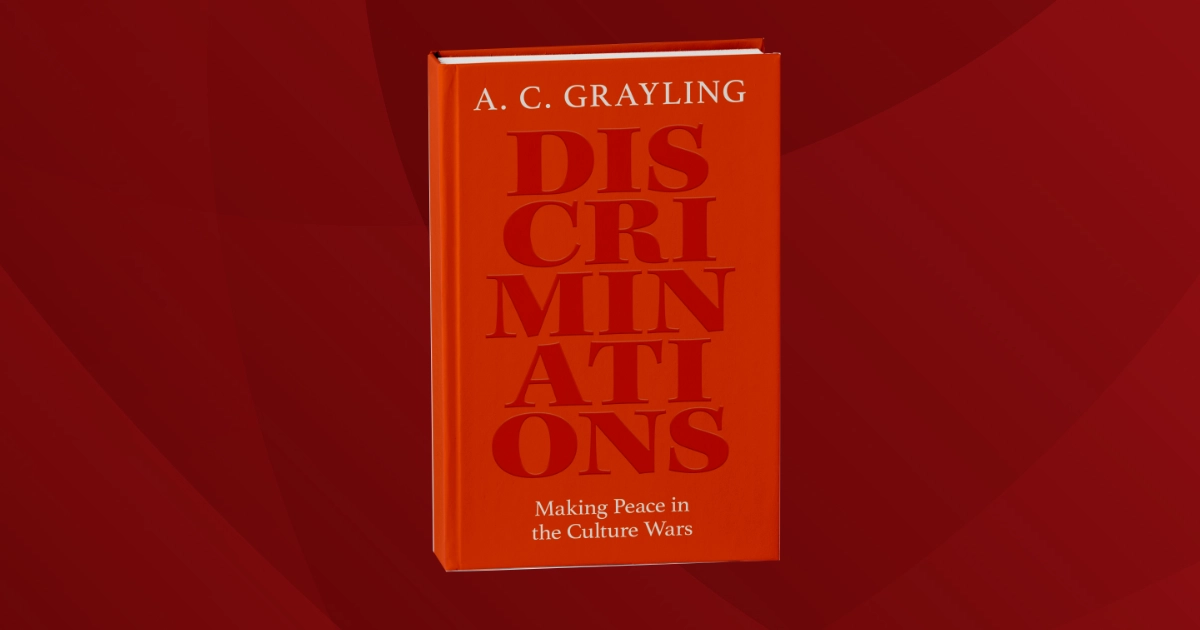
Discriminations: Making Peace in the Culture Wars
A.C. Grayling
London: Oneworld (April 2025)
288 pages
ISBN: 978 0861549962
A.C. Grayling is a well known and prolific cultural commentator and writer. Discriminations is his latest book, in which he tries to plead the case of the “woke” warriors in a calmer manner than the warriors themselves have managed in recent years. Instantly recognisable by his lustrously flowing grey locks, Grayling looks every inch a distinguished eighteenth-century Enlightenment philosophe. A professor of philosophy, he is founder of the New College of the Humanities, now Northeastern University, London. Outside the academic sphere, he is known for his many vocal positions on current affairs, principally Anglophone ones, such as Brexit (remainer) or Donald Trump (not a fan). In fairness to Grayling, he has at least proven himself to be quite principled. Following the result of the Brexit referendum, he packed his bags and moved to Paris, where some of the present book was written.
Grayling lays his own cards on the table very early in the book. He writes in the preface that “I will therefore disclose straight away that my own sympathies, both intellectually and emotionally, lie in the woke direction — more accurately, with the concerns that prompt wokism”. His book centres on the perception among many people that the activities of “woke” activists are extreme and unrestrained, and therefore damaging their cause. “Some of the more activist champions […] act in ways that are said, even by those who agree with them but adopt less confrontational methods, to risk undermining the cause by their action — for example, free speech denial and undiscriminating ‘cancellings’.” One need only recall that Twitter, for example, before Elon Musk bought it, employed vast “moderation” teams, tasked with curtailing the visibility of certain accounts and postings due to the presence of words that might be considered, or associated with, conservatism. It is hard to imagine now, but pre-Musk Twitter was quite totalitarian and one had to carefully guard one’s language in order to maintain a visible presence on the platform.
For Grayling, all of this over-zealous no-platforming and cancelling has turned conservatives into victims among ordinary voters. Furthermore, the strident manner of contemporary woke activism has turned ordinary people away from the causes the activists seek to champion. Think of the wall-to-wall positive coverage that select causes get, which can leave those with concerns or questions feeling that they have no voice or no one to represent them. Concerns around pronouns, bathrooms, and women’s sports, for example, have brought marginal figures such as Donald Trump into the centre, while mainstream politicians, media, and businesses have found themselves marginalised because they have shown themselves to be either too unwilling or too cowardly to question certain narratives.
Grayling writes that “the Left have gifted the Right the moral high ground of ‘freedom of expression’. Given that — apart from its exceedingly high intrinsic value — this freedom is crucial to the Left for calling out the Right and promoting its causes, this is an own goal of spectacular proportions”. This is an important observation from Grayling, even if, in his framing of the matter, he uncritically seems to imply that freedom of expression is somehow the exclusive preserve of the Left.
What is Grayling’s solution to this problem? To be clear, the problem for Grayling is not the varied causes that the woke warriors advocate. The book does not question any of their convictions. The problem is the extreme methods their activists have adopted in order to promote (or simply impose) these convictions on everyone else. For Grayling, the solution centres on delineating and upholding human rights. “In the end, all the issues surrounding social justice are issues about individual rights”, he writes. “By concentrating explicitly and wholeheartedly on rights, there can be victory for all in the ‘woke wars’” (italics are the author’s). Grayling spends time carefully distinguishing between “rights” and “interests” in the central chapters of the book. Individuals have rights, obligations, and interests. Groups have interests. Individuals are more than just human beings. They include other entities such as states, companies, universities, and clubs, which Grayling treats as “corporate individuals”. This grants them rights and obligations too.
These definitions are very generous — it seems that just about any entity can identify itself as an individual and claim the rights due it. Who is left as a group with mere interests, and no rights? Religion falls squarely in Grayling’s crosshairs here. He argues that religions in an organised or institutional sense are irrelevant, in contrast to the individual persons who comprise them. The latter already possess rights as individuals; the former get nothing at all. As Grayling sees it, a person’s religious beliefs matter little more than their political beliefs, and consequently merit as little legal protection. In this way, through some delicate sophistry and linguistic sleights of hand, Grayling manages to expunge religion, its institutions, and its values from any entitlement to rights, while ensuring other corporate entities’ rights are protected.
Such a view is not without its critics, and even contemporary western legal systems such as Ireland and the UK do not hold to it. Yet having gone to great lengths to flesh out this unique perspective, it is not clear what results it would achieve, or how it would further the ends of Grayling’s woke causes. Many people’s concerns on woke matters do not necessarily have religious underpinnings, while many more of those with such concerns would not consider themselves religious at all. Kathleen Stock is probably the most prominent recent example on this side of the Atlantic. Despite being avowedly left-wing and married to a woman, in 2021 she found herself forced out of her professorship of philosophy at the University of Sussex for questioning transgender and gender self-identification orthodoxies.
Stock is one among many who do not neatly fit Grayling’s rather simplistic narrative. Religion has been a thorn in his side (so to speak) for many years. Indeed, in one chapter he fondly recalls Richard Dawkins, the late Christopher Hitchens, and the heady days of New Atheism ten or fifteen years ago. Apart from finally subduing organised religion, a lifelong bugbear of his, it is not clear how his “rights versus interests” approach will change the hearts and minds of a public who are cautious, skeptical, or plain unconvinced by the objectives of the woke activists’ themselves.
The penultimate chapter of the book offers a few practical suggestions to advance the woke programme. Grayling proposes “moderate wokism” as a way forward. He favours the highly controversial Critical Race Theory being incorporated into school curricula: “Arguably, the adoption of Critical Race Theory in schools in the US […] is an example of how progress can be achieved”. Meanwhile for businesses and institutions, the equally contentious Diversity, Equity, and Inclusion (DEI) programmes of recent years are also proposed. It is not clear how either of these highly disputed policies constitute a “moderate” approach, and Grayling does not explain.
Thirdly, he suggests that democratic countries move away from first-past-the-post elections and binary two-party systems in favour of proportional representation. Such setups are “not well suited to societies whose populations are relatively numerous and diverse” and tend to be “insensitive to views and interests of some minorities”. This proposal brings its own challenges. In Ireland’s case, proportional representation has been effective in stymieing government action and diminishing the electorate’s ability to express itself by producing convoluted coalitions with conflicting aims. This has tended to result in policy-making and unpopular or controversial political decisions being outsourced to unelected government agencies, NGOs, and so on. Without wishing to attribute ulterior motives to Grayling’s call for such significant changes to contemporary electoral systems, it would certainly be effective at achieving his socio-political aims, by weakening democratic agency and strengthening the hand of “civil society” groups to claim to speak on others’ behalf.
Grayling is undoubtedly knowledgeable on contemporary issues. He is a prolific writer and his book displays a considerable breadth of reading. However his wide-ranging erudition struggles to conceal a certain superficiality in his argument. He never breaks down the various, and even competing, causes that comprise the woke left. Instead he treats them as a collective, unquestioned whole. This is a disservice to the causes themselves which, if Grayling made some effort to examine more carefully, might produce some grounds for sympathy among his readers, and even reveal hints of truth among their more extreme claims.
For Grayling, it is all or nothing, even though in reality most people’s opinions are more nuanced than this. The average man or woman would wholeheartedly condemn racist discrimination, for instance, but would also very likely express serious reservations about a transgender man joining a women’s sport’s team or using a female bathroom. A more granular approach to the many (and often competing) woke causes would have yielded a more penetrating and mature reflection on the current state of affairs, and made for a more compelling read.
Despite only being published in April, some of the book’s language and ideas already feel a little passé. Grayling employs jargon that twelve months ago, and for many years before, was rife in social and print media, but has now waned — “misinformation”, “systemic”, “Critical Race Theory”, “Diversity, Equity, and Inclusion” (DEI), “consciousness raising”, “privilege”, “unconscious bias”, among others. Like the ephemera they often referred to, the terms themselves have fizzled away, and they no longer hold the oppressive clout across media and social platforms that they once had.
Grayling’s attempts to defend some of the more strange and bewildering neuroses of western, Anglophone culture from the past fifteen or twenty years serve to highlight how much has evolved and dissolved since November 2024. As the book sets out his worldview to the reader, it sometimes feels like an attempt to cling to or re-ground a socio-political edifice that enjoyed overwhelming dominance during the 2010s, but has been slipping away over the past few years.
This leaves the ultimate audience for the book unclear. Those who are wholly supportive of Grayling’s creed have no need of convincing. But to those who are on the fence, or who are sympathetic to some of the causes mentioned but concerned about the extreme methods of woke activists, he offers no concessions. For Grayling, you are either fully on board, or not at all.
David Gibney
David Gibney is a school teacher in Dublin. He holds a Ph.D. in English literature.