
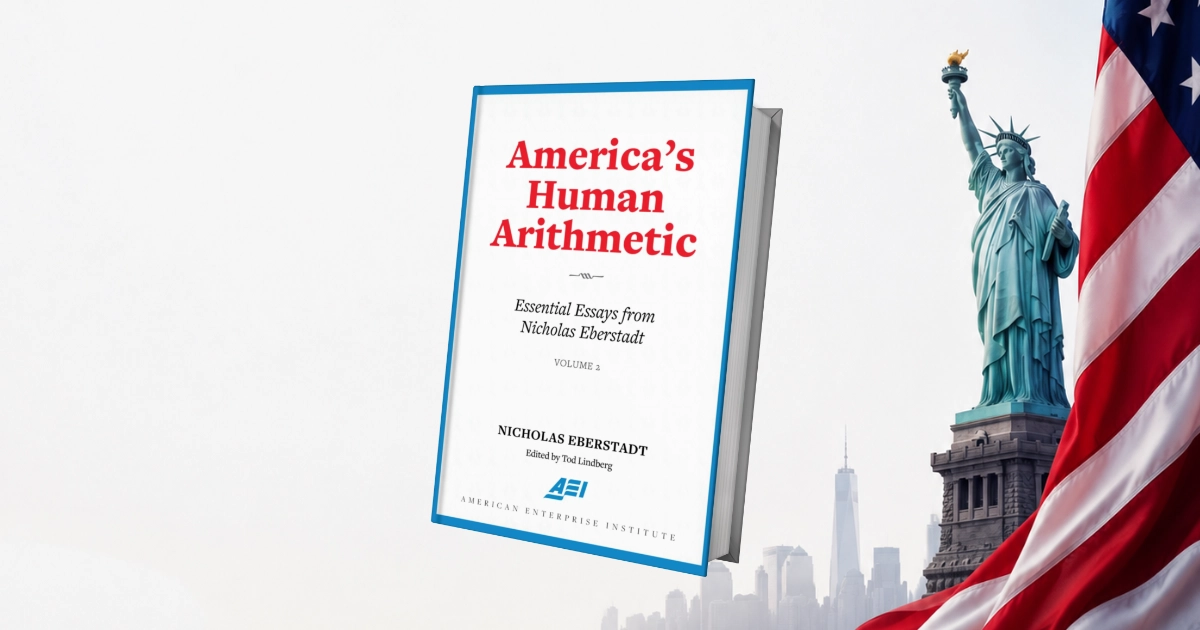
America’s Human Arithmetic: Essential Essays from Nicholas Eberstadt.
Nicholas Eberstadt.
Washington, DC: American Enterprise Institute Press,
2025. 456 pp.
On July 4, the United States of America will celebrate its 250th birthday. What should be a joyful marking of all that the country has achieved could end up being a party that nobody wanted to attend. America’s people appear more politically divided than at any point since the Civil War, the country has been fighting an unpopular and undeclared war, and allies overseas are increasingly aghast. This is not a question of politics or economics though, and a recently published collection of essays by Nicholas Eberstadt demonstrates that America’s growing unpredictability in the world has roots in what has been happening at home. Published by the invaluable American Enterprise Institute (AEI) think tank where the author works, America’s Human Arithmetic: Essential Essays from Nicholas Eberstadt spans the areas of sociology, demographics, geopolitics, labour economics, and much more besides. Those familiar with the author’s work will not be surprised at how one researcher can demonstrate such expertise across so many fields.
Husband to the great Catholic writer Mary Eberstadt, Nicholas has dedicated much time to studying the phenomenon of the declining labour force participation rate among American men. Several of the essays in this collection come from his 2016 book Men Without Work or its updated post-pandemic edition. In an era of relative prosperity, more and more Americans—and particularly American men—have been choosing not to work. No matter how many times the key facts are relayed, they remain striking. The employment rate among American men between the ages of 25–54 “has on average been lower in the first quarter of the 21st century than it was at the tail end of the Great Depression.” Work rates fell significantly after the turn of the millennium and then fell sharper still after the financial crash of 2008. The damage has not been repaired, and large-scale idleness is a new norm. “If our nation’s work rate today were back up to its start-of-the-century highs, well over 10 million more Americans would currently have paying jobs,” the author writes. The problem is worse among men than women, and extensive analysis of the lifestyles of the “men without work” shows that they do not fill their days with productive activity in support of their families and communities.
Instead, they are “characteristically detached, dependent, and defeated.” They tend not to volunteer, do charitable work, or engage in religious activities, filling their days with screen time and numbing their physical or emotional pain with opioids. Europeans often fail to understand basic differences between their social context and that which exists in the United States, which has for centuries been marked by a greater prevalence of violence and criminality. Surveying the figures relating to mass incarceration, Eberstadt suggests that around one in eight American men has a felony conviction. This certainly has a major impact when it comes to limiting employment opportunities, and it likely has political consequences which are not speculated upon here but which are worth pondering over. So many foreign observers were baffled by the thought that Donald Trump could run for election again in 2024 in spite of facing possible incarceration on multiple charges. Yet in a country filled with former convicts, perhaps Trump’s legal travails made him more relatable to a sizable contingent of voters?
The fact that so many Americans can choose not to work shows just how affluent a society America is, and the author repeatedly draws attention to the scale of its prosperity. Private wealth has trebled since the end of the Cold War and now exceeds $160 trillion. Economic growth rates have not been as robust as in previous eras, but they have exceeded the performance of the European nations, and an enormous economic gap now exists between the United States and Europe which is causing European Union leaders to focus more on competitiveness. In one essay dating back to 1996, Eberstadt refers to his country as being “inhabited by large numbers of prosperous paupers and affluent savages.” America’s poor have less of a social safety network than their European peers, but they often have much more in terms of material possessions.
One of the longest and most interesting of the essays here was published in 2014 to mark the 50th anniversary of President Lyndon B. Johnson’s “Great Society” initiative, which involved a massive increase in government spending aimed at eliminating poverty. Eberstadt is a conservative but not an ideologue. He affirms that the expansion in the federal government’s powers was needed to undo racial segregation, and acknowledges that the standard of living of America’s poor has risen significantly since LBJ’s “War on Poverty” crusade. But this has come at a serious cost, with America becoming “a nation of takers” in the same time period. Here once again, the outsiders’ perception of America as a land without handouts is nowhere close to the reality. In the half-century between 1960–2010, U.S. government spending on entitlements rose more than 100-fold. Although many think of poverty in America as something experienced by African Americans and other ethnic minorities, a large majority of the counties most dependent on government welfare actually lean Republican: again, we see part of why the economically statist Trump has had such success.
Abuse of government support programmes put in place to help the disabled is one part of the overall problem of dependency and worklessness. During the aforementioned period between 1960–2010, the number of Americans receiving monthly disability payments from the federal government rose from 455,000 to 8.2 million. It is extremely unlikely that this can be explained as anything other than widely tolerated fraud in a country where many who could easily work are no longer ashamed to live off the toil of others. Even after several Trump-related shocks, there remains little appetite for many in America’s elite cities and institutions to consider just how serious the societal rot has become. “It is a profound failure on the part of our ‘knowledge elite’ for so many at the pinnacle of our meritocracy to have missed the prolonged travails of large numbers of fellow citizens whose lives do not intersect with their own,” Eberstadt reflected in 2022.
Other areas where America used to stand out among the advanced democracies included the strength of traditional values, the scale of religious practice, and impressive fertility rates. Much of this has also changed as the national mood has darkened. At the time of the Great Society reforms, out-of-wedlock births were considered to be a serious problem only within the African American community, but are now widespread within all social groups. Birth rates have fallen substantially, and even mostly Mormon Utah has a sub-replacement fertility rate now. America still enjoys a major demographic advantage over Japan, China, and other countries due to the fact that its fertility decline began later, but it is fundamentally heading in the same direction.
The American public no longer seems to believe they can solve major problems. Budget deficits have exploded while also ceasing to be a major political issue. In fact, Eberstadt believes that the great wealth of modern America may make its fiscal recklessness sustainable for decades to come. When describing the 10 million American men outside their country’s workforce, Eberstadt makes a historical comparison with the Roman military concept of decimation. In light of Eberstadt’s collection of essays and the upcoming celebrations, it is worth comparing the two mighty political entities further. The Roman Empire—which, like its American equivalent, had previously been a republic after first getting rid of a bothersome king—lasted for around 500 years. At its 250th birthday, Rome’s decline had certainly commenced, but it still dominated the world around it militarily, economically, and culturally, albeit never to the extent that America dominates the world today: burying enemy rulers in airstrikes or dragging them home in chains as Julius Caesar did to the Gallic rebel Vercingetorix.
Rome fell for many reasons, but above all else because its leaders ceased to believe in their own system and culture, and turned on each other. Civil war has not commenced in today’s America, but in an armed society filled with political hatred, it is easily conceivable. By the end, Rome could not defend its own borders from the barbarians outside. In America today, a large portion of the population thinks borders should not exist to begin with. Rome grew decadent and bureaucratic, and Trump’s gold-plated America most certainly is both. Christianity came too late to save the dysfunctional Roman society, and instead the Church had to rebuild Western civilisation from the imperial ruins.
Is the early-stage revival in Christianity (and especially Catholicism) in America a sign of societal renewal, or are the people turning to the Almighty before the almighty collapse occurs? As he recently told the Sanity Clause podcast, Nicholas Eberstadt is now working on his next book, which will examine the only nation which could yet dethrone his own: China. But this great chronicler of societal trends is right to remind the reader that “the most important threats to our country both at home and abroad come from our own hand.” For now, America can enjoy seeing the fireworks, while readers the world over can enjoy reading about them.
James Bradshaw
James Bradshaw writes on topics including history, culture, film and literature.