
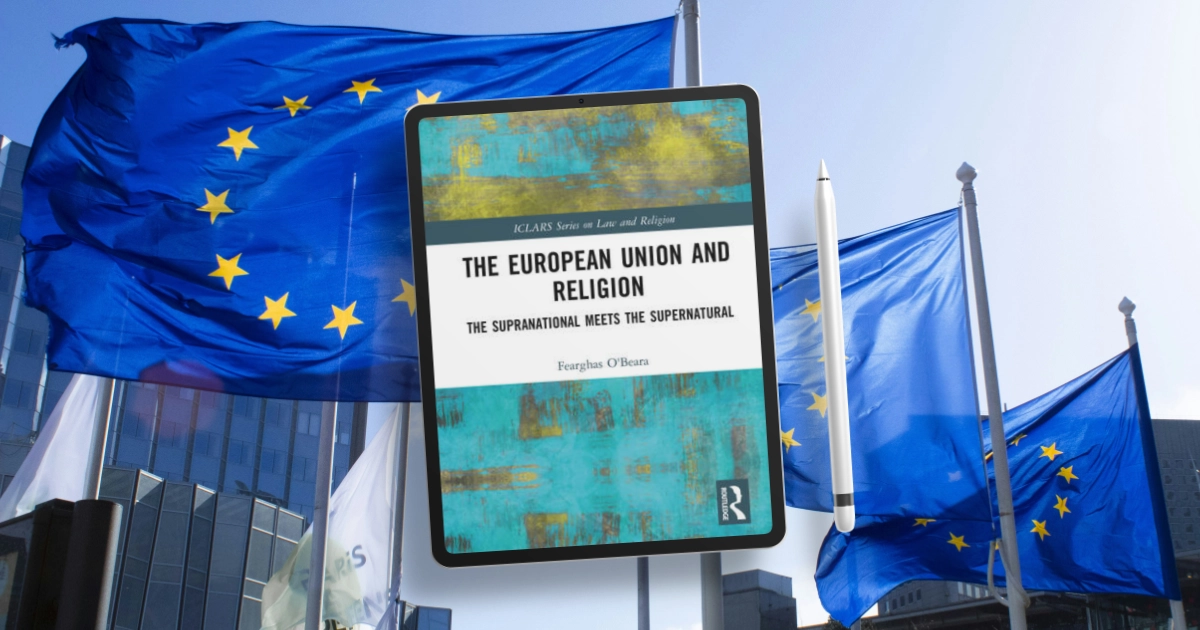
The European Union and Religion: The Supranational Meets the Supernatural.
Fearghas O’Beara,
London: Routledge, 2026.
ISBN 9781041084051. 214 pp.
As Head of the European Parliament Office in Ireland, and having acquired decades of experience in European Union affairs, Fearghas O’Beara is one of Ireland’s most distinguished Eurocrats. The fact that O’Beara holds a doctorate from the Pontifical Gregorian University belies the notion that the EU institutions are solely populated by secularists. His new book, “The European Union and Religion: The Supranational Meets the Supernatural” emanates from his doctoral dissertation and provides readers with an overview of the EU’s relationship with religion, particularly since the Lisbon Treaty entered into force in 2009. Readers may recall the controversy over the failure to include a reference to God and Europe’s Christian heritage within the doomed draft EU Constitution. Close observers might remember that the repackaged Lisbon Treaty includes a deliberately vague reference to the EU taking “inspiration from the cultural, religious and humanist inheritance of Europe”, as well as the fact the treaty included a commitment not to “prejudice the status under national law of churches”. Most importantly of all, the Lisbon Treaty requires the EU to “maintain an open, transparent and regular dialogue with these churches and organisations”. This structured process of dialogue is a key focus of O’Beara in this work, and he points out that Europe’s Christian churches initially had high hopes about its introduction. Drawing upon a detailed study of EU practices and religious developments, as well as dozens of interviews with experts from across the EU institutions, the author lays out a comprehensive overview. In the area of engagement with the Catholic Church, there is a great deal of material to analyse, and O’Beara is clearly deeply knowledgeable about this.
Aside from the fact that several of the key founders of the European project were devout Catholics, the Church is relevant to this conversation in a way that other religious bodies are not. Given its history, the Church is naturally comfortable with the idea of European unity. O’Beara cites another writer who distinguished between the national attachments of various Protestant churches and the Catholic approach in which the “guiding normative principle to assess European integration” was its possible contribution to “public justice”. When assessing the EU’s response to contemporary challenges, the Church can draw upon a deep body of wisdom and understanding in the form of Catholic Social Teaching. O’Beara further points out that almost half of the EU’s members have concordats with the Holy See, and the Church’s global spread and coherent structure makes it a sought-after partner for the EU’s diplomatic service, the EEAS. Even when considering matters on a purely functional basis, the truth is that secular European politicians have long taken Catholicism for granted. When civil leaders wish to engage, there are bishops and episcopal conferences available. This is not always the case, and O’Beara notes the difficulties which both the EU and some of its Member States have had in working with—or developing from scratch—representative bodies for Muslims. The more fissile nature of Islam should give Europe’s anti-clerical forces pause for thought, but generally it does not. After all, it was their hostility to Christianity which prevented a clearer reference to Europe’s ancestral religion being included in the treaty which provides the EU’s constitutional basis.
The author includes a number of case studies in which he examines how the EU’s religious engagement strategy works in practice. One of these is the development of the “EU Strategy on combating antisemitism and fostering Jewish life (2021–2030)” which was adopted by the Commission in 2021. In fact, this strategy was complemented by a statement from the Council of the European Union which stated that Jews were “an integral part of Europe’s identity and societies”, and had “enriched Europe’s cultural, intellectual and religious heritage, and contribute considerably to its social, political, economic, scientific and cultural development”. All of that is unquestionably true, and yet as O’Beara subtly points out, the language used contrasted “with the battles that took place a decade earlier over references in the Lisbon Treaty to Christianity as part of European identity”. It would be unreasonable to expect a representative of an EU institution to develop this thought further, but a critical reader will, and should. Recent secularisation aside, why are EU leaders comfortable with recognising the role of a tiny minority in shaping European history, while being deeply uncomfortable with honouring the religion which has been within living memory the dominant religion in every Member State?
O’Beara writes that a perception exists that the European institutions share the secularist administrative culture of French government institutions. Here again, more can be said about this, for it is a key part of the problem. Laïcité has failed to guarantee domestic peace in France and is gradually being undone as the societal shift brought about by large-scale immigration. A spirit of laïcité existing within the corridors of power in Brussels is a lamentable aspect of the EU’s workings, for it surely limits the possibility for the type of engagement that O’Beara is highlighting within this book. More importantly though, in France and in Europe writ large, the denial of Christian heritage weakens the body politic by robbing it of a clear sense of its own identity in this fast-changing world. Europe’s military feebleness and its economic lethargy—now accepted as problems by virtually everyone—are linked to the cultural decline, which is to an even greater degree a self-inflicted wound.
Looking towards the future, O’Beara summarises the perceptions of the EU model of church-state relations by writing that the “post-secular approach, reflective of wider trends, will continue”, while also adding this could involve the EU doing much more of this kind of work than some of the national governments within the Union. This is encouraging. It is probably not a coincidence that the period of greatest European integration coincided with a cultural moment in which religion—particularly Christianity—was under sustained assault by “new atheism”. The intellectual and moral shallowness of that era is all the more remarkable with hindsight. European secularism is here to stay, but aside from the clear signs that a religious revival is beginning, it cannot be pointed out often enough (as O’Beara does gently here) that the Western world is an aberration when it comes to religious practice. This is generally not understood by the people who are charged with representing Europe’s citizens on the global stage. Right across the unchurched West, too many functionaries and diplomats fail to engage with religion on an intellectual level, and the results are sometimes catastrophic. Consider the manner in which America lost its key Middle Eastern ally when the Shah was replaced by Islamic fundamentalists, or think of the speed at which post-Saddam Iraq descended into a Sunni-Shia civil war, and the degree to which American policymakers were stunned by these developments. There is no sounder political advice than this: take religion seriously.
The EU has been doing that to some extent, and O’Beara’s scholarly book proves this. It could do much more, particularly if it wants to convince believing Christians—who often tend to be Eurosceptic—to support the European project. On a moral and political level, this would be worth doing. For example, the EU could form closer connections with Christian churches when it comes to international development aid projects in the developing world. A concerted strategy to help protect persecuted Christians in Africa and elsewhere would also be most welcome, and would honour the contribution of Europe’s missionaries, past and present, who have redeemed their countries’ reputations through lifetimes of service to the poorest people in the world. Doing such things would require political courage, in particular the courage to face down the secularist critics. It is not just EU leaders who should ask themselves hard questions in this area. Many Catholics have a simplistic view of the European Union, seeing it as an alien and authoritarian force motivated by a dislike of Christianity and tradition. Yet what is now the EU was largely founded by Christians to pursue Christian goals: to prevent European nations from waging war against one another and to establish a spirit of harmony between them. This has been accomplished, and the process of dialogue and limited cooperation which exists now could lead to something greater happening in the coming decades.
James Bradshaw
James Bradshaw writes on topics including history, culture, film and literature.