
Richard John Neuhaus, founder and editor of First Things magazine, once wrote that there are writers whom you read because you have been told you must read them. Having done so, he said that they then become part of your history, along with foreign countries you have visited or great music you have heard. It was all part of the never-ending process called learning, “and a very good thing it is.” But then, he added, there are writers who catch you up short. “They are personally disruptive; intellectually and spiritually disruptive. They cannot be fitted into anything so smoothly incremental as a ‘process’. Their claims demand a decision, and contingent upon that decision is a change of disposition toward a host of questions. The thought cannot be resisted: ‘If he’s right about this, then I have to rethink an awful lot that follows from this’.”
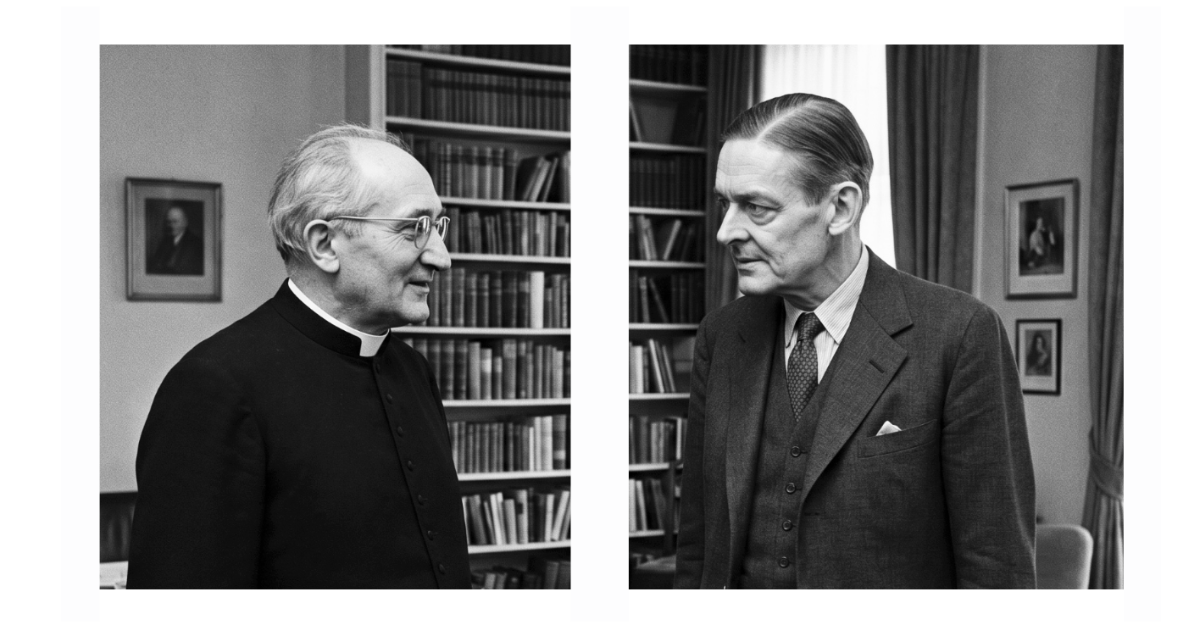
Romano Guardini (1885–1968) is such a writer, he said. He did not mention Guardini’s nearly exact contemporary, Thomas Stearns Eliot (1888–1965). He was another such. Guardini wrote toward the end of what was probably his most startling work, The End of the Modern World, that his purpose was “to declare a truth when its ‘hour’ has come.” Nearly thirty years earlier T. S. Eliot very controversially began to engage with the same purpose in a process which led him from the apparently very dark place which some find in The Waste Land to his conversion to Christianity and beyond.
Both these great figures of the twentieth century are frequently depicted as conservative opponents of modernity who invoke a curse on all its ways and all its pomps. Conservatives they certainly were because their great cause was Truth and the truth embodied in the essence and traditions of Christianity. Ironically, Eliot, with the publication of The Waste Land, which his earlier poems, The Lovesong of J. Alfred Prufrock and Portrait of a Lady, were harbingers, is identified as one of the fathers of modernist literature. He was radical, but it is a misreading of his work to interpret it as a destruction of the cultural heritage of the past.
Some readers find Guardini’s The End of the Modern World polemical. Neuhaus says that “polemics are sometimes necessary to catch attention and clear the air of cant, but Guardini is up to much more than polemics. He is proposing a different way of discovering one’s ‘location’ in the world, a different way of standing before history and finally before God.” Eliot was not polemical, but in many ways he was on the same journey as Guardini: devoutly Christian and fastidious and fearless in seeking a restoration in the Western world of its Christian heritage. Indeed, like Guardini, he saw such a restoration—particularly in the face of the horrors unleashed in World War II—as the only hope for our civilisation.
In 1943 Eliot had written in a Portuguese journal that “no European literature, I am convinced, can long flourish in isolation from the others”; instead, “the ultimate unity of Europe cannot come through identity of political organisation, but from the unity of the Christian Faith.” Lecturing and reading for the British Council in Germany in late 1949, he toured Hamburg, Berlin, Hanover, Göttingen, Münster, Bonn, Cologne, Heidelberg, and Munich. He spoke about the unity of European culture. Throughout, he emphasised that “the culture of every people arises from their religion”, and stressed the cultural bonds forming “the organism of Europe”.
Guardini’s reflections on ‘Power and Responsibility’ are strangely prescient for our own age. That is the title of part two of The End of the Modern World, written in the 1950s, as the Cold War burgeoned. He wrote: “Aside from a few constitutional optimists and those reassured by a fixed ideology, the people we meet everywhere today are marked by a profound anxiety. This is directed primarily at concrete political-historical possibilities, but reaches beyond them to the fundamental question: Is man still a match for his own works? During the course of the last century (as in the last 100 years), man has developed a measure of power far exceeding any previous dreams. This power has largely objectified itself in scientific insights and forms of work that give rise to constant new problems; in political structures that look toward the future; in technical patterns which seem to press ahead, propelled by their own dynamism; finally, and above all, in the spiritual-intellectual attitudes of man himself, attitudes with a logic of their own. The anxiety we mentioned questions whether man is capable of handling all this in such a way that he can endure with honour in fruitfulness and joy; and it tends to answer, no. Man as he is today no longer can meet such demands. His works and their effects have outstripped him, making themselves independent. They have acquired meta-human, cosmic, not to say demonic, characteristics which man can no longer assimilate or direct.”
Did Guardini see any way of avoiding this deep malaise and its catastrophic consequences? He offered this: One of the main decisions which future man will have to make, he said, will have to be based on the realisation that man is determined by the spirit—and not confuse the spirit with “nature”, in either its romantic or scientific senses. He held that the spirit lives and acts neither by historical nor by metaphysical necessity, but of its own impulse. It is free. It draws its ultimate life and health from its right relation to the true and the good, a relation which it is also free to deny or destroy. “Man does not belong exclusively to the world; rather he stands on its borders, at once in the world yet outside it, integrated into it yet simultaneously dealing with it because he is related directly to God. Not to the ‘Spirit of the Age’, not to the ‘All-Mysterious One’, not to any First Cause—but to the sovereign Lord, Creator of all being, who called man into existence and sustains him in that vocation, who gave the world into his keeping, and who will demand an account of what he has done with it.”
T. S. Eliot’s position, not long after he published The Waste Land (1922), was much the same. Cleanth Brooks, American literary scholar and critic, in his analysis of The Waste Land offers a reading of the poem which is more optimistic than that of some other critics, including that of the great, if sometimes controversial, Cambridge literary scholar, F. R. Leavis. Brooks cites the last line of Canto 26 of Dante’s Purgatorio, in which Dante meets the poet Arnaut Daniel, who warns him in his own language, Sovegna vos a temps de ma dolor (In due time be heedful of my pain). The passage from which Eliot took this quotation was of extraordinary importance to the poet.
Before Arnaut leaps back into the refining fire of Purgatory with joy he says: “I am Arnaut who weep and singing; contrite I see my past folly, and joyful I see before me the way I hope for. Now I pray you by that virtue which guides you to the summit of the stair, at times be mindful of my pain.” The protagonist of The Waste Land is the gloomy mythological figure, Tiresias, and he is bemoaning his disinheritance, being robbed of tradition in this modern world, now in decay. But the protagonist of the poem is not its author, and its author reveals a more hopeful view of the future.
Brooks says he cannot accept Mr Leavis’ interpretation of the passage, “I sat upon the shore / Fishing, with the arid plain behind me,” as meaning that the poem “exhibits no progression.” If secularisation has destroyed, or is likely to destroy, modern civilization—“London Bridge is falling down falling down falling down”—the poet suggests a resolution in his question, “Shall I at least set my lands in order?” The Scriptural allusions in The Waste Land are remarkable. Notably one which is interpreted as referring to Christ’s accompaniment of the two disciples on the road to Emmaus, with all the hope embodied in that passage of the New Testament—regardless of Eliot’s note which connects it to an account of Shackleton’s Antarctic expedition:
Who is the third who walks always beside you?
When I count, there are only you and I together
But when I look ahead up the white road
There is always another one walking beside you
Gliding wrapt in a brown mantle, hooded
I do not know whether a man or a woman
—But who is that on the other side of you?
There is hope for our civilisation. Perhaps distant, but still there is hope. Guardini offers us the same—if we can but correct our ways. Brooks asks us to consider, in this context, the last sentences of Eliot’s ‘Thoughts After Lambeth’ (1930): “The World is trying the experiment of attempting to form a non-Christian mentality. The experiment will fail. But we must be very patient awaiting its collapse; meanwhile redeeming the time: so that the Faith may be preserved alive through the darkness before us; to renew and rebuild civilization, and save the World from suicide.” By this time Eliot had converted to Christianity and had attached himself to a very devout Anglo-Catholic tradition within the Church of England.
By 1948 Eliot had come a long way. At the presentation of the Nobel Prize in Stockholm on 10 December of that year, Anders Österling, permanent secretary of the Swedish Academy, spoke of him as a poet who “from an extremely exclusive and consciously isolated position” had “gradually come to exercise a very far-reaching influence”. His verse and prose had “a capacity to cut into the consciousness of our generation with the sharpness of a diamond”. Österling ended by pointing out that “Exactly twenty-five years ago, there stood where you are now standing another famous poet who wrote in the English tongue, William Butler Yeats.”
Undoubtedly, Romano Guardini and T. S. Eliot are two towering figures in twentieth-century religious culture, Eliot the more publicly known of the two. Their struggles to restore the Christian values of our civilisation still resonate in our new century. We can only hope that their prophetic and ultimately optimistic visions of our future world will still be realised.
Michael Kirke
Michael Kirke is a freelance writer, a regular contributor to Position Papers, and a widely read blogger at Garvan Hill (garvan.wordpress.com). His views can be responded to at mjgkirke@gmail.com.