Bugonia, Yorgos Lanthimos’s (moviegoer beware) deeply disturbing film, is difficult to place; you might see it categorized as a “comedy” given its satirical bent, but it’s really more of a drama, thriller, or even horror film. And there was also no love lost for it on Oscar night; nominated for four awards, it took home none.
Yet from the opening scenes, it draws us as if by a cinematic tractor beam—grippingly, steadily, unnervingly—into its own dark world, raising fundamental questions about human existence along the way.
The film—a remake of the 2003 Save the Green Planet! from South Korea—centers on two unforgettable characters. The first is Teddy Gatz (Jesse Plemons), an unkempt warehouse worker for the pharmaceutical company Auxolith. Gatz spends his days in a run-down rural house with his autistic cousin Don (played by autistic actor Aidan Delbis), managing their backyard beehive and theorizing about a hostile takeover of Earth by alien “Andromedans” who are killing off the bees—with their sights set, ultimately, on humans. He lovingly trains the loyal Don, the Lenny to his George, on the “signs” of an Andromedan in anthropic disguise and how to resist them. Don asks, What about those people over there? “They’re fine,” Teddy responds. “I mean, not ‘fine,’ but—hollowed. You know, like the rest of us. Harmless. Hopeless.”
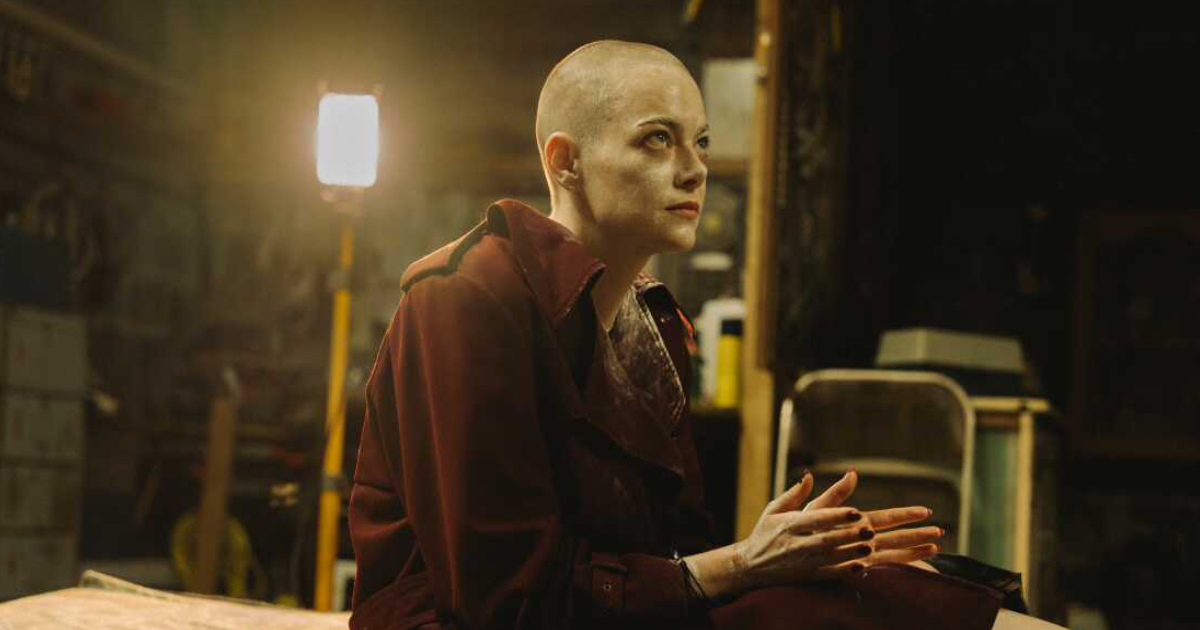
The second is Michelle Fuller (Emma Stone), the CEO of Auxolith—a sharp contrast to Teddy in almost every way. This is no worker bee but the queen of the hive: she is perfectly put together and wields great cultural influence; she lives alone in a sleek, modern mansion, beginning her days with yoga and “a very strict reverse-aging diet and therapy program”; and she spends her days high-heel-marching through the corporate halls of Auxolith and recording diversity training messages for the company. Teddy’s “human resistance” movement isn’t on her radar, but she is absolutely on his.
As G. K. Chesterton put it, we are—whatever else we might be—an exception on Earth’s surface, and one that typically takes a turn for the worse . . .
Teddy and Don, having chemically castrated their bodies and cleansed their minds to resist Andromedan maneuvering, kidnap Michelle, shave her hair (her mode of communication with the mothership; Teddy’s done his research), and hold her hostage in their basement, demanding that she contact her royal superiors. Then, in the manner of a stage play, the interrogations and negotiations begin. Michelle looks to secure her release however she can, first by trying to shake Teddy out of his worldview and then by feeding right into it; Teddy, for his part, tries to steel his resolve and manage the increasingly precarious situation.
We see in these two characters two very different sides of white America—and while it would be tempting (and typical) for a Hollywood movie to treat Teddy as the paranoid rural villain and Michelle as the clear-eyed coastal heroine, there’s no such facile division here. In Bugonia, monsters and aliens abound. Teddy is deranged and dangerous, but also the forgotten off-sloughing of a broken home, capitalist greed, and a throwaway culture; Michelle seems heartless and even inhuman—“I’m supposed to believe you’re a 45-year-old woman?” Teddy asks her, and not without good reason—but also sharp and enterprising. Both are endearing in their own ways, yet both act with deep cruelty. The line between good and evil, as Solzhenitsyn said, runs not between identity groups but through the heart.
As things intensify, Michelle—apparently still putting him on to save herself—gives Teddy an alternative history: Yes, the Andromedans have come to Earth, but the situation is more complicated. They didn’t come to destroy humanity but to try to save it from itself. Yet the humans won’t be saved. “Even when presented with irrefutable evidence of their own self-destruction,” she explains, “the humans continued unabated. Even I myself became more human, more selfish and cruel, the longer I stayed here amongst your kind. But humans can’t help the way they are. It’s in your genes . . . We Andromedans are here to eliminate that suicidal gene. To save humanity.” Teddy, she concludes, is just a “sick ape.”
All this tension hurtles, inevitably, toward a gruesome and graphic climax not for the faint of heart. It’s then capped with a satirical coda less concerned with explanations than with the plain fact of the matter: unlike those honey beings, human beings are doing a bang-up job destroying both themselves and the planet. In fact, the film’s title refers to the ancient Greek belief that bees can spontaneously generate out of the carcasses of dead animals—humanity, in this case, being all too willing to provide the service. Bugonia is thus a stark reminder that, as G. K. Chesterton put it, we are—whatever else we might be—an exception on Earth’s surface, and one that typically takes a turn for the worse: “If it is not true that a divine being fell, then we can only say that one of the animals went entirely off its head.”
But the cerebral ending, however clever and satisfied with itself, is utterly nihilistic, even antinatalistic. Bugonia is a provocative and thought-provoking parable of dysfunctions both old and new, but it leaves us, as Teddy himself put it, hopeless. What Teddy’s mother said of Auxolith is true of the movie too: It sells us our sickness—but in this case, without the cure.
In the modern world, utopians began to dream about the perfectibility of the human race, theorizing that, with enough time and willpower, we could rid ourselves of our own afflictions. And despite the disasters of the past century, we still encounter the same mentality today: techno-optimists dream of a post-work society, wherein AI does all our jobs, solves all our problems, and frees us to frolic together in open fields.
Bugonia meets this reverie with a cold, hard slap to the face. Look at history; in fact, just look around you: if we’re not fallen from the light and addicted to works of darkness, we’re very, very sick apes. No amount of creaturely ingenuity, human or alien, can save us—only the unfathomable grace of God himself, emptied out upon our heads.
Matthew Becklo
Matthew Becklo is a husband and father, writer and editor, and the Publishing Director for Word on Fire Catholic Ministries. His first book, The Way of Heaven and Earth: From Either/Or to the Catholic Both/And, was released in 2025. This article first appeared on www.wordonfire.org