
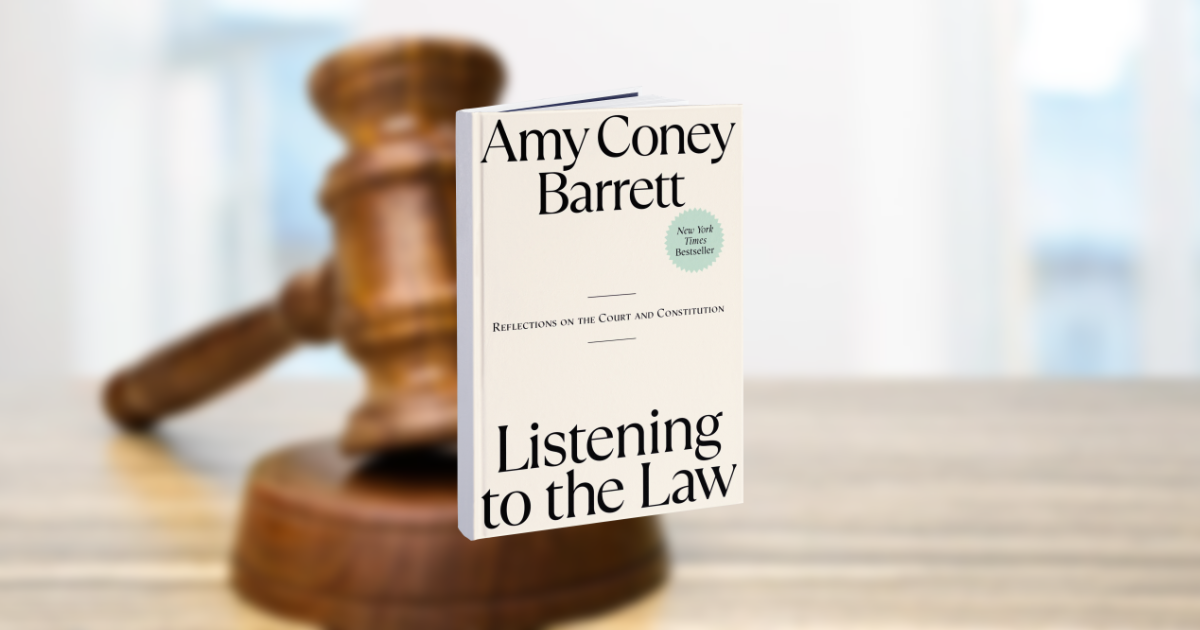
Listening to the Law: Reflections on the Court and Constitution
Amy Coney Barrett
Sentinel
September 9, 2025
336 pages
ISBN: 978-0-593-42186-4 (hardcover)
When I qualified as a solicitor a few months ago, I eagerly awaited my grand courtroom debut – something in the spirit of A Few Good Men, perhaps. That moment finally arrived in October 2025, when I was dispatched to Antrim County Court to cover a review for Counsel who, very wisely in hindsight, could not attend. The case? A boundary dispute. So, less high-octane legal drama, more “whose fence is it anyway?”
Naturally, I arrived a full hour early – partly out of professionalism, partly out of sheer terror – which gave me ample time to rehearse my lines like a rookie actor on opening night. When my moment finally came, however, those ten minutes in court felt less like a debut and more like an endurance test.
My learned friend on the other side was impressively fluent and vastly more experienced, while I, determined to observe courtroom etiquette to the letter, found myself springing up and down from my seat with the enthusiasm of a malfunctioning yo-yo. Eventually, the battle-hardened County Court Judge intervened:
“Mr Scullion, whilst one respects the courtesy, you are making me dizzy – please just remain standing.”
It was, I think it’s fair to say, a memorable debut – for all the right and wrong reasons.
At the outset of one’s legal career, the question arrives quickly and uncomfortably: what kind of lawyer will you be? The choices – your motivations, your priorities, your goals, and your balance between work and life – can feel daunting. But more than anything, it is how you treat colleagues, especially those you disagree with, that will define you.
A version of St Thomas More’s prayer for lawyers captures the ideal: to be trustworthy, righteous, diligent, precise, honest, courteous to adversaries, and loyal to clients – “their good servant, and God’s first.”
Reading Listening to the Law by Justice Amy Coney Barrett, I was struck by how closely she reflects that vision. Agree with her or not, she stands as a model of what a lawyer – and a judge – can be.
Justice Amy Coney Barrett’s Listening to the Law is, in many respects, a strikingly unusual book. It does not disclose gossip – there are no revealing anecdotes about her fellow justices. It does not advance a novel theory of jurisprudence, remaining instead firmly within the bounds of modern originalism. Nor does it offer much in the way of personal disclosure. At first glance, these absences might suggest a work of limited appeal. Yet, properly understood, they reveal something more significant: a book that reflects its author’s conception of how a judge ought to think, write, and live.
Justice Barrett emerges as upright, prudent, and composed – qualities that increasingly feel rare in public life. As the book progresses, her intellectual discipline, experience, and quiet resolve come into sharper focus. By its conclusion, one is left with the impression not merely of a capable jurist, but of a model one. For me, that became abundantly clear during her grilling confirmation hearing before the U.S. Senate in October 2020. Who could forget the iconic image of Justice Barrett showing her empty notepad when asked by Senator John Cornyn what she was using to answer the questions put to her?
Throughout the book, Justice Barrett employs brief anecdotes to introduce broader reflections. Two, in particular, are revealing. The first concerns her early academic ambitions. As a college student with a fondness for literature, she considered becoming an English professor. Not a novelist or playwright, but a professor – a detail that neatly anticipates the tone and method of Listening to the Law. Justice Barrett is not inclined toward self-expression in the literary sense. She does not write to dramatise or emote but to analyse. The book contains no flourish of confession or imaginative excess. Instead, it offers careful observation and disciplined reasoning. Unlike the protagonists of fiction, Justice Barrett does not cast herself as the main character.
This restraint sets her apart from many contemporary public figures, who often treat public life as performance. Justice Barrett’s reserve is evident even in passing remarks. She notes, almost incidentally, that she married Jesse Barrett in 1999, offering no account of courtship or ceremony. Her childhood is similarly understated. Episodes that might invite narrative colour – rebellion, conflict, or formative tension – are omitted. Even her time clerking for Justice Scalia is recounted with remarkable modesty, the most “scandalous” anecdote involving a humorous gift of a mousepad.
This is not accidental. It reflects a deeper disposition – what might be called judicial restraint. Justice Barrett’s book reads as though shaped by the same discipline she brings to the bench. She avoids speculation, resists embellishment, and declines to indulge curiosity where it would detract from principle. Asking her for a confessional memoir would feel almost a category error.
That same restraint extends to her discussion of judicial life. Her elevation through the federal judiciary is described in passing, her Supreme Court confirmation reduced to a few sentences, followed only by the understated admission that “the confirmation process was hard.” Even when recounting professional moments of pride, she withholds specifics. The result is a text that is consistently controlled.
Yet, this discipline is not merely stylistic: it is rooted in habit and conviction. Justice Barrett describes an almost obsessive commitment to efficiency, filling spare moments with work, even listening to oral arguments while completing household tasks. She recalls her father’s advice to master one’s emotions and credits an early mentor with teaching her that professional relationships are integral to work, not incidental to it. Where such relationships prove difficult, her solution is characteristically austere: greater effort. “Collegiality,” she writes, “is sometimes an act of the will.”
If Justice Barrett suppresses personal inclination, the natural question is what, in turn, animates her. The answer is clear: the law itself – specifically, the Constitution and statutes enacted by the American people. Here the book takes on greater energy. Justice Barrett is at her most engaged when discussing the structure of American government and the principle of popular sovereignty. Her jurisprudence aligns seamlessly with her temperament. Judges, she insists, are not policymakers but custodians of decisions already made: “Our job is to protect the choices that citizens have made, even when we disagree with them.”
This commitment to democratic self-government is central to her outlook. She is wary of judicial approaches that elevate abstract principles – whether dignity, pragmatism, or evolving norms—above the enacted will of the people. In this respect, her views place her firmly within the mainstream of conservative legal thought, drawing on the influence of Justice Scalia and earlier originalist thinkers. For Justice Barrett, fidelity is not owed to text in isolation, but to text as an expression of democratic choice. Interpretation must therefore account for purpose and context, not merely literal wording.
The book is strongest when Justice Barrett turns to legal process and constitutional structure. Her explanations of oral argument preparation, opinion writing, and the Court’s internal dynamics are clear and instructive. Particularly effective is her discussion of what it means to operate under a written constitution, with its implications for transparency, amendment, and the recognition of rights. Even complex doctrines – such as the “history and tradition” test for unenumerated rights – are presented with clarity and restraint.
At the same time, the book’s accessibility comes at a cost. Much of the legal material is introductory, and readers with prior knowledge may find sections on foundational cases and constitutional development somewhat elementary. More significantly, the same reserve that defines Justice Barrett’s voice also limits the book’s depth. Controversial issues are acknowledged but not explored in detail; personal experiences are alluded to but rarely examined. For some, this will reinforce the impression that the book is less an inquiry than a carefully managed presentation.
And yet, to criticise the book on these grounds is, in part, to miss its point. Listening to the Law is not intended as memoir or polemic. It is, rather, an exercise in modelling a judicial ideal: disciplined, restrained, and grounded in institutional humility. Justice Barrett does not seek to persuade through personality or narrative. Instead, she demonstrates – through both content and style – a particular vision of judging.
There are, nonetheless, moments of warmth. She writes with affection for her family, her upbringing in New Orleans, and her time at Notre Dame. She expresses gratitude to mentors and emphasises the importance of kindness in professional relationships.
In an era defined by self-promotion and performative politics, Justice Barrett’s restraint feels almost countercultural. Where many public figures seek attention, she avoids it; where others foreground personality, she effaces it. Whether one views this as admirable or limiting will depend on one’s expectations of public life – and of judges in particular.
By the end of Listening to the Law, the initial impression of detachment gives way to something more considered. This is not a book designed to captivate in the usual sense. It is deliberate, controlled, and, at times, impassive. But it is also serious, principled, and quietly confident in its vision of the judicial role.
For supporters, it will stand as a lucid articulation of constitutional method and judicial restraint. For critics, it may appear overly cautious and insufficiently probing. For all readers, however, it offers a clear window into the mind of one of the most influential members of the United States Supreme Court and into an enduring debate about the proper limits of judicial power.
Gerard Scullion
Gerard Scullion studied law at Queen’s University Belfast and Trinity College Dublin and is a solicitor based in Belfast. He writes periodically on the role of religion within law and diplomacy.