
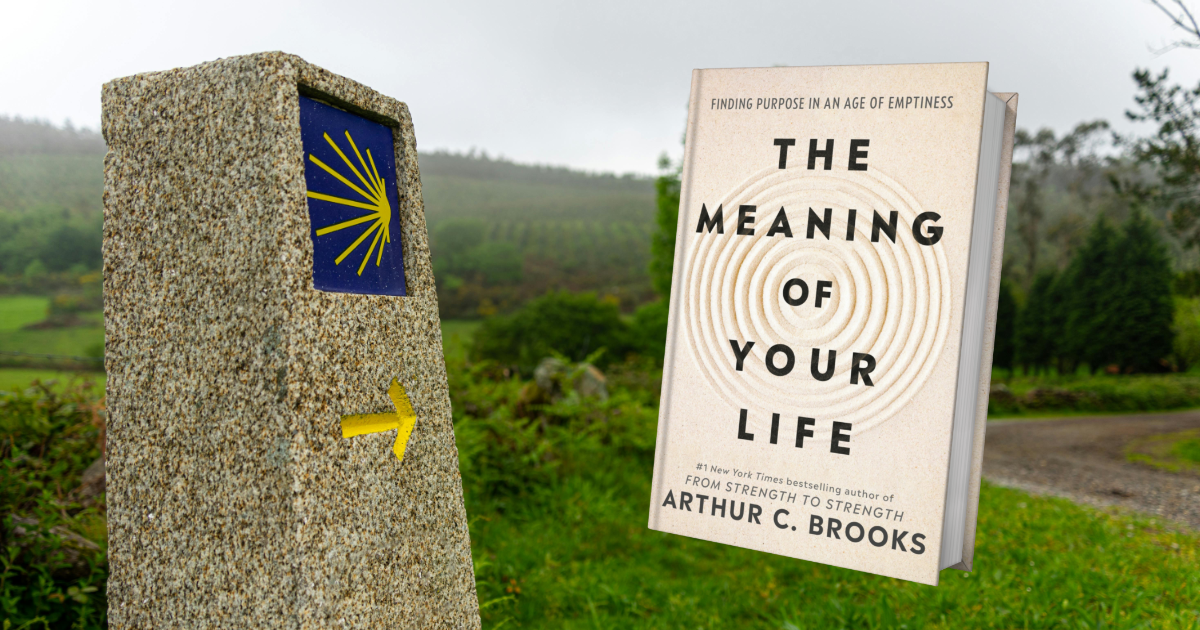
The Meaning of Your Life: Finding Purpose in an Age of Emptiness
Arthur C. Brooks
Ebury Publishing, imprint Vermilion
31 March 2026
224 pages
ISBN 978–1785046803
The Meaning of Your Life: Finding Purpose in an Age of Emptiness builds upon recent work by Arthur Brooks, including last year’s collection of essays, which was titled The Happiness Files. Brooks has achieved a great deal in his life and career. A professional musician until his thirties, his subsequent success in the academic world led to him becoming head of the American Enterprise Institute, America’s most important right–of–centre think tank. The question of why he voluntarily left such a prestigious role while still in his mid–fifties is answered over the course of this book, in which the Harvard lecturer explains how he decided during a Camino pilgrimage that he would work to “lift people up and bring them together in bonds of happiness and love, using science and ideas.”
That pilgrimage to the Camino de Santiago came at around the same time Professor Brooks went back to campus after a decade away, and the mood he encountered upon his return disturbed him. At Harvard, Brooks found that his “office hours were more like counselling sessions than tutoring.” Problems elsewhere were even more severe: as Brooks writes, more than half of the students at some colleges were receiving mental health treatment. But happiness is not the focus of this new book. Based on the empirical evidence, Brooks asserts that happiness is a combination of enjoyment, satisfaction, and meaning.
The miserable youth on America’s elite campuses and those in older age brackets struggling with the same mental health challenges are not lacking enjoyment and they are not short of satisfying accomplishments (like receiving degrees or large salaries). Brooks locates the source of the declining happiness in the decline of meaning. Not only do many people not have a strong sense of meaning, many have stopped looking: a study showed that less than half of American undergraduates say they want to develop “a meaningful philosophy of life,” which is a massive decrease compared with the stated preferences of college students in the 1960s. Based on his experiences, Brooks detected a subtle difference between the students he has recently taught and his own contemporaries. Long philosophical conversations about the meaning of life were a standard part of student life in the past, but have grown less common in a world where the constant presence of smartphones saps the desire to ponder things deeply.
This is not a book about college students, nor is it even about young adults. In his profiles of successful people struggling with a lack of meaning, Brooks highlights the problems of accomplished strivers of various age brackets. Many of them have fallen into the trap of trying to establish an identity focused on career, at the cost of nurturing relationships with those around them. It is easy for such people to become too goal–oriented. “Strivers are, by nature, doers. They most value points on the board and forward progress. What kind of points, and progress toward what, you ask? It hardly matters, because the dopamine hits are all from the forward motion per se. The result is that they are always thinking about the future and never truly alive in the present,” Brooks writes.
One of the admirable features of Brooks as a writer is his clarity. Referencing the work of the psychologists Frank Martela and Michael Steger, he defines meaning early on as being a combination of coherence, purpose, and significance. Though he uses portraits of individuals in a manner similar to what one finds in Jordan Peterson’s work, Brooks’s books are more focused. One brief case study which does stand out is that of Leo Tolstoy, who struggled badly with a sense of meaninglessness in spite of his widespread fame as a great writer. Finding no answers within the urban intelligentsia, Tolstoy fled to the countryside and looked to the example of the Russian peasantry, who “lived at peace with the universe in the simplicity of their love for God and each other.”
Similarly, Brooks urges his readers to consciously work towards rediscovering the wisdom of their ancestors, but is fully aware that the ubiquity of modern technology makes this task difficult. The statistics which he lays out are shocking and yet not at all surprising. The average American looks at their phone 205 times each day. The natural human aversion to boredom encourages us to distract ourselves with some form of stimulation (videos, news updates, social media content, etc.), but this traps people in a cycle which only feeds the left side of the brain (which deals with practical questions) to the detriment of the right side (which is where the deeper ‘why’ questions are dealt with). Depression and anxiety lead people to avail of more technological fixes, which only intensifies the destructive ‘doom loop.’
In this environment, even the most ostensibly successful people are left feeling like they are part of a fake world, akin to that presented in The Matrix movies. Without promoting the unrealistic attitude of the Luddite, Brooks encourages readers in this increasingly indoor society to familiarise themselves with the beauty of boredom, the sort of boredom that helps people to think. That could involve digital fasting or even – as the Catholic author himself does – participating in silent religious retreats.
Creating more time to think is more than just a question of how we use technology. To establish a greater sense of meaning, Brooks argues that people need to consider key questions about their own lives and values, while also suggesting that they find jobs which serve those values. It was on the aforementioned Camino pilgrimage – accompanied by his Spanish wife, Ester – that Brooks discovered what he was looking for. This book is another worthy chapter in what has clearly been an incredibly meaningful career.