
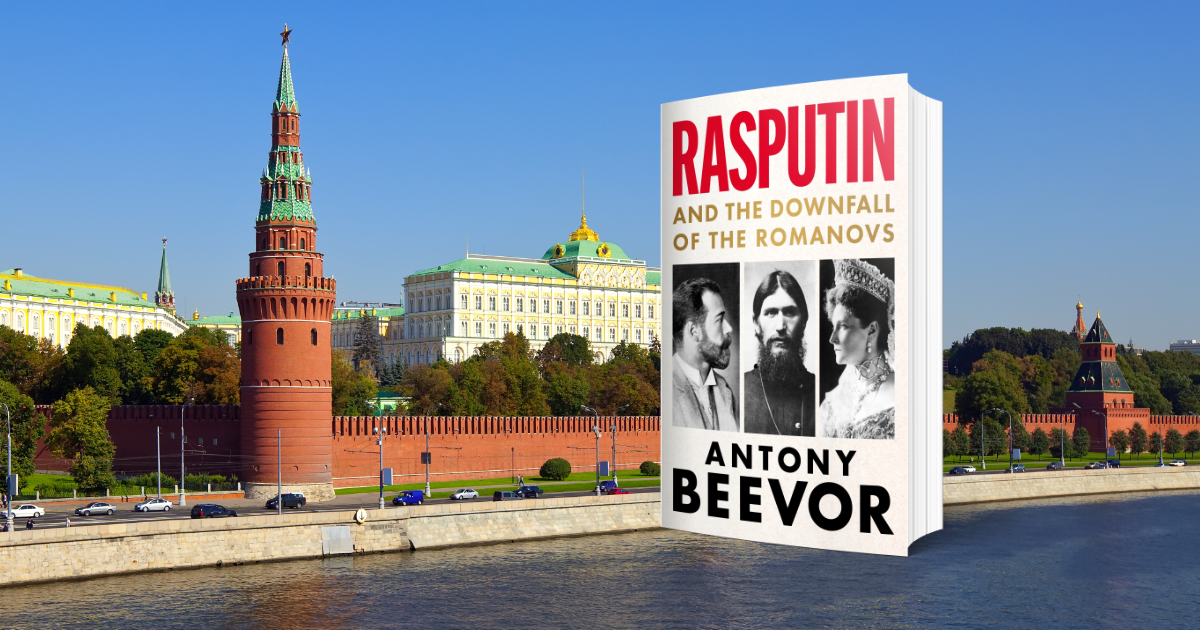
Rasputin: The Downfall of the Romanovs
Antony Beevor
Weidenfeld & Nicolson
2026
384 pages
ISBN: 978-1399642774
The death of Grigory Rasputin in December 1916 at the hands of Grand Duke Felix Yusupov and others was hailed with great joy in Russia. The killers were national heroes, toasted in the salons of St. Petersburg and sent letters of adulation from members of the royal family. Finally, this semi-literate peasant, who seemed to dominate the Tsar and the Empress, dictating matters of state to them in disastrous ways, was gone. The situation had been grave, and no one in court, in government, or in the Orthodox Church, which the Tsar had so alienated, seemed to be able to stop the disaster which was unfolding. Lev Tikhomirov, a contemporary author, commented: “This sinister Rasputin means absolute doom for the dynasty. What incomprehensible wizardry has charmed every more or less sensible person at the very top?” (p. 216). Perhaps the fortunes of the Tsar would change.
But the damage had already been done, and the revolution and bloodshed which had so marked Russia’s history before the Romanov rule were coming. The Imperial family were swept aside weeks later in the February Revolution of 1917, the Tsar would be shot the following year, and the Bolshevik Revolution and the horrors of the communist USSR under Lenin and Stalin would follow. This is a compelling read that skilfully portrays the characters at the heart of this incredible story, framed around Rasputin’s particular influence, and attempts to unravel the means to his power within the atmosphere of fragility and credulity in the royal family.
His achievement, which is what makes the book highly interesting, was to bring about not only a political but also a Christian collapse for the world’s greatest land empire. It isn’t too much to say that these explosive events, and the “errors of Russia” (in the words used by Our Lady at Fatima in 1917), have haunted the world in the past century and proceed from them. What the story covers, then, is the beginning of the atheistic and cynical modern age in which we are struggling today. No wonder every school child in the world has heard of this man, the “holy elder” or starets, and why he is treated with a peculiar mix of fascination and disgust—as he was in his day.
The narrative takes us in detail from the institution of the Tsar to the February Revolution, a story spanning roughly twenty years, and draws upon varied sources. The portrait of Rasputin is fascinating; he seems to have been a man seeking God keenly after the unexpected loss of a child, deciding to become a pilgrim from his Siberian hometown of Pokrovskoye and journeying to monasteries hundreds of miles away. Such long pilgrimages were not uncommon among the poor in Russia’s vast territories, with the book pointing out that even revolutionaries such as Leon Trotsky, who the author is fond of quoting, took part in one to investigate the phenomenon. Rasputin gains a reputation, then, convincing figures in the Orthodox Church to promote him. But he is a terrible person who takes advantage of the establishment around him to win admirers, mainly women, whom he abuses if he can, while attempting to play the role of a popular religious figure and darling to the aristocracy. He began influencing the Romanovs from around 1905 and wielded, in the end, a terrifying power, pushing the Tsar to make mistakes that led to disaster.
St. Petersburg, the seat of the Emperor and the city of Peter the Great, was full of disinterested aristocracy sailing along the fine avenues to schools and salons, while hundreds of thousands of poor workers, whose life expectancy was at the same level as those in the poorest villages, worked endlessly in horrible factories. Tsar Nicholas is a fatalistic figure according to the book, and his genuine Christian faith is portrayed as the reason for his ultimately passive attitude to his fate (seeing God’s hand in everything), while his unwillingness to reform anything is, predictably and correctly, blamed for the speed of his demise. He is propelled to the throne early, when Alexander III dies and, as the book skilfully reminds us, he is committed to maintaining the autocracy of the lineage. The Emperor and his wife (the Tsaritsa) are young and begin trusting their private friends and personal instincts as the world around them disintegrates. The stage is set for a “Holy Man” to take advantage of their fears and instability. Rasputin could make use of the Tsar’s autocratic position while manipulating his personal weaknesses.
But it is the atmosphere of the aristocracy of this age and the instability of the empress, Alexandra Feodorovna, which are the true source of Rasputin’s power. Interestingly, the Tsaritsa starts life being raised (as so many of the royalty of the age) by Queen Victoria, and is of German origin. She refuses the future Tsar on account of the difference in their religions: she is Lutheran. Queen Victoria is credited with convincing her that Lutheranism and Orthodoxy were really similar enough. It is her religious confusion which leads to a life of misery: a deranged devotion to newfound Russian Orthodoxy—or an occult version of it—that is mixed up in a confused self-righteousness and sense of position. Her distress at the haemophilia (the royal disease of that time) she passes to their only son Alexei, who suffers badly with swelling and pain, along with her misplaced moral superiority, paves the way for her terrifying attitudes and insistence on devoting herself to Rasputin. The latter seems to be able to calm Alexei in his agony on occasion, which convinces her of his holiness, and thus places him at the heart of the royal family. He became “our friend” to the imperial couple, and would only become more important in their minds as others attacked him and challenged the Tsar.
It is abundantly clear that Rasputin’s real influence, as one would anticipate, was disastrous, and foreseen by every sensible person at the time, who are quoted in detail as the tragedy unfolds. The book does its best to be fair to him, but also introduces, sheepishly but entirely correctly, the vision of the Dowager Empress, Tsar Nicholas’ mother, who has a terrifying dream in which her son is killed by a peasant (a moujik). She is so moved that she warns the Tsar years later of the dangers of being close to Rasputin, eventually fleeing to Kiev in protest at his influence (a move which saves her life when the revolution begins). She is one of many who predict disaster. The Tsar fires ministers, loyal family members, and elevates terrifyingly incompetent figures at Rasputin’s advice, all based on whether or not the individuals like “Father Grigory,” and in order to placate the hysteria of the Empress. One author wrote of those times: “[Rasputin] rules Russia in the hours that are spare from fornication and drinking; he replaces ministers and indicates policy lines. ‘Devilgrad’ is frozen…only the devil knows who is protecting whom.” (p. 223).
Beevor skilfully conveys the sad interplay of the Tsar’s dogged and indignant autocracy, the empress’ superstitious hysteria, and the growing unrest in Russia, particularly after the outbreak of the Great War, as the peasantry were sent to slaughter. Rasputin advises the Tsar to take command of the army, to disastrous effect, while the Empress begins, with Rasputin, to run roughshod over local government and the Orthodox Church in appointments and dismissals. The Tsar’s bungling efforts to comprehend the world around him are summed up in ample correspondence. On the eve of war with Germany, he remarks of his cousin, Kaiser Wilhelm: “Willy is an exhibitionist, but he would never start a war.”
It is tempting to conclude that the story is merely one of gross incompetence and, as the author posits, a testament to a regime which has ceased to believe in itself, led by a fatalistic and sad religious believer in the Tsar. But it is also a credit that the narrative draws deeply on sources to explore the nature of Rasputin’s power. The book struggles to explain his “clairvoyance” and powers of persuasion, but does not shy away from relaying the stories about him. The Tsar, according to some accounts, avoids him as he “can’t refuse his demands.” Rasputin is recorded by confused witnesses as manifesting demonically (these are the reviewer’s words) when making predictions (“his eyes rolled into his head, his skin became like wax”). He has violent changes in mood and character. Even secular writers of the time who met him wondered if there were “a black beast howling inside him.” The book searches for a reasonable logic to his healing powers, at one stage wondering if he had some skills of healing “akin to the Japanese masters.”
Naturally, no history book should attempt to draw theological conclusions. But all of us are aware, no matter how secular our outlook, that if ever there were a demonic character, it was Rasputin. He was instrumental in bringing about or paving the way for the calamitous end to the 300-year rule of the Romanovs. Beevor concludes that “[I]t was the demoralisation of the ruling class, not the fervour of revolutionary dogma, which accelerated the collapse [of the regime]” (p. 263). But although it is not discussed, it is clear that the scandalous figure of Rasputin, whom most of Russia seemed to think was cuckolding the Tsar, and the presence of someone so divisive at the heart of the royal family, was what really led the Imperial Guard and the establishment not to lift a finger in protecting the Romanovs when the time came. The stage that Rasputin set, therefore, was of disarming any of the loyalties that moderately conservative Russians could have had in the leaders of Holy Russia. We know now that this ushered in the revolutionary values that were murderous, utopian, and completely atheistic. It is from this moment, more than any other in the last century, that the world we now know gains its identity and struggles with the horrors of cultural revolution that began in Russia.