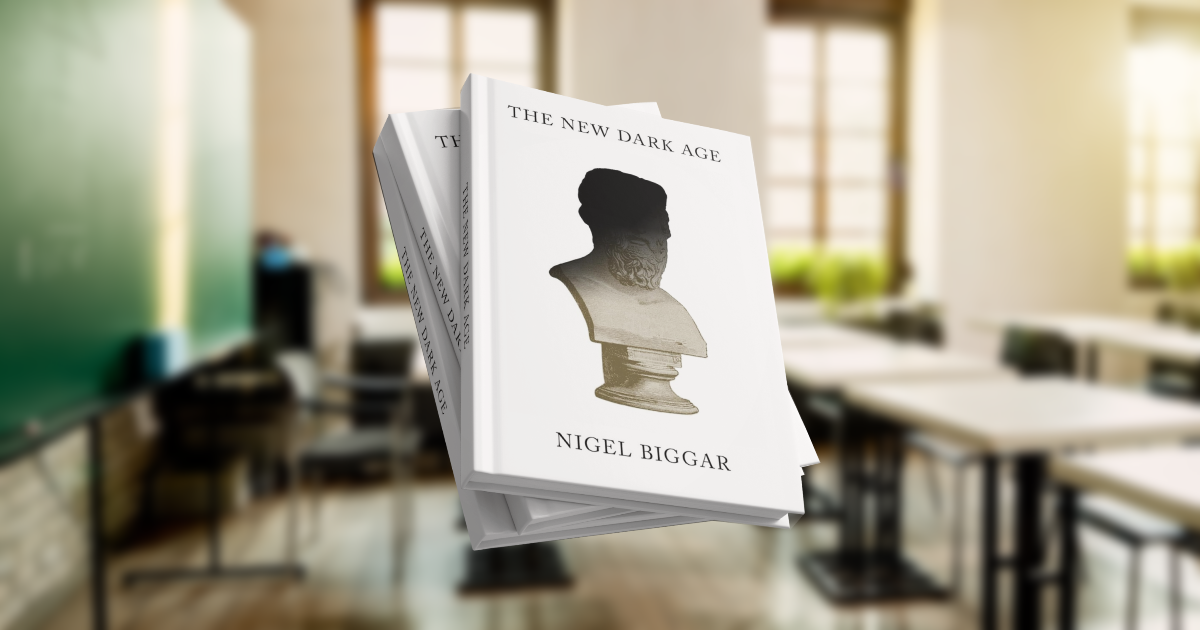
The New Dark Age: Why Liberals Must Win the Culture Wars
Nigel Biggar
Cambridge: Polity Press
February 2026
192 pages
ISBN: 978-1509568321
It seems that undergraduates are voting with their feet. A growing number of humanities courses around the world are struggling to enrol students, with some faculties and programmes being amalgamated or even shut down entirely. As recently as February of this year, news emerged that the University of Galway is planning to discontinue its general Arts course amid a “sustained decline” in student numbers, according to a leaked internal report. The humanities are essential to the intellectual and moral formation of the next generation, to the transmission of knowledge and skills both age-old and brand new. Unfortunately, the ideological capture of many humanities faculties in the West has led to a narrowing of their intellectual vision.
Undergraduates themselves have sensed something’s up. Why pay extortionate fees to be fed a meagre diet of indigestible lefty theory and then browbeaten by an activist professor? Surely more exciting avenues abound for someone in their early twenties. Enter The New Dark Age by Nigel Biggar. Published earlier this year, the book offers a timely and penetrating insight into the intellectual, administrative, and moral decay that has set in at many third-level institutions, and how they can recover their purpose.
Nigel Biggar is Regius Professor Emeritus of Moral and Pastoral Theology at the University of Oxford. He was ordained a priest in the Church of England in the 1990s and was appointed to the House of Lords last year. Between 2004 and 2007, he held the Chair of Theology and Ethics at Trinity College, Dublin, before taking up his professorship at Oxford. As he explains in his book, he found himself thrust into the culture wars when he decided to organise a research project on “Ethics and Empire” at Oxford in 2017. The purpose of the project was to inquire into ways in which imperial rule was beneficial to both parties—coloniser and colonised—and to critique historical biases against empire in the academy.
Biggar was busy with his project when an English literature professor at Cambridge stumbled upon it. As any professor from a well-regarded institution would have done in 2017, she took to Twitter. Remember that, back then, Twitter leaned very “woke” and was heavily regulated by a censorious moderation team. “OMG. This is serious shit”, she wrote, “We need to SHUT THIS DOWN”. Hardly academic idiom. Things snowballed from there. Campaigns were started, both within Oxford and from academics worldwide, calling on the university to distance itself from the project and to cease its funding to Biggar.
To its credit, Oxford did not budge. Biggar acknowledges this in his book. Under the leadership of its then Vice-Chancellor, Louise Richardson—an Irishwoman and Trinity graduate—the administration “was sufficiently liberal in principle to assure me early on of their support and to deter demands that the ‘Ethics and Empire’ project be taken out of my control”. Now retired and the project complete, The New Dark Age reflects on Biggar’s brush with the “woke” mob and the damage it has inflicted on learning. “My focus is mostly on universities”, Biggar writes, because “they are culturally and politically strategic.” What starts at the top soon trickles down into other educational environments, NGOs, and government agencies.
The book’s subtitle is “why liberals must win the culture wars”. But what is meant by “liberal”, and why must they win the culture wars? “The liberal culture I seek to defend in this book is certainly not radically individualist or utopian”, Biggar writes early on. He finds himself inspired by John Stuart Mill’s “idea that a free marketplace of ideas is the best way of testing and correcting prevailing orthodoxies”. A university, in other words, should allow ample room for jostling viewpoints and approaches to things, knowing that academics and students are going to encounter disagreement and challenge on positions they are taking or arguments they are advancing.
Such is the ideal. The present-day reality at many third-level institutions is “the threat posed to liberal society by authoritarian, left-wing ‘progressives’”. “Progressive”, Biggar acerbically notes, “is a more respectable term for ‘woke’”. For “while [they] identify themselves as the champions of progress, genuine progress is a controversial matter and ‘progressives’ often fail to champion it”. Biggar makes an important distinction here—the term “progress” is often used quite carelessly as a synonym for left-wing causes, rather than to refer to matters that represent genuine social or scientific progress.
While much of the story is Biggar’s own, he also brings in other academics who have suffered at the hands of their students or their own colleagues and employers. Kathleen Stock, a former professor of philosophy at the University of Sussex, was compelled to resign from her position for questioning prevailing orthodoxies about transgender self-identification, thus, Biggar notes, “perhaps ending her career in her early forties”. Left-wing, lesbian, and married to a woman—on paper Stock’s credentials seemed impeccable. But it is all or nothing in some university faculties these days. And so she found herself without institutional support, and soon without a job, for questioning certain modern verities.
This book offers much food for thought on the state of affairs at third-level institutions. The early chapters trace the intellectual beginnings of the move towards anti-rational thinking at universities since the second half of the twentieth century. Later chapters highlight examples of academic cowardice, and the institutional authoritarianism of university administrations. The final chapters explore ways forward by trying to cultivate intellectual virtues in order to recover the university as a “liberal” institution, properly understood.
Biggar attributes the present intellectual decay of our third-level institutions to “the corrupting influence of post-modernist thought”. The ravages of two World Wars, and the rise of communism, Stalinism, and Nazism across the twentieth century meant that “reason’s reputation as the guarantor of constant human improvement was shredded”. “Thus arose postmodernist thought”, Biggar writes, “thought that has lost faith in the modern narratives of secular salvation through liberal democratic or communist reason”. Postmodernism rejects grand narratives or metanarratives. Instead, “there are only multiple, diverse narratives”. Thus the Christian creation story or the Christian worldview on something, for instance, finds itself jostling for institutional validity against other rival narratives. Postmodernism rejects attempts at establishing an overarching discourse.
Of course, this does not mean that overarching discourses do not exist in academia. But if no one argument or worldview can claim precedence on the basis of sound reasoning, then on what basis do some of them become dominant while others decline? According to Biggar, power fills the vacuum left by reason. “Postmodernism […] is a logically inconsistent overreaction that encourages the resort to power rather than reason in handling conflicts between different points of view. Instead of arguing with one’s political opponents, the postmodernist moves to shut them down”. Power does not require reason. And unchecked power can lead to authoritarianism. Numerous examples throughout The New Dark Age make this clear, including the pressure and ostracisation Biggar himself experienced during his “Ethics and Empire” project.
So how are universities to rekindle their liberal spirit? After decades of backsliding, and with numerous academics and administrators now embedded for life in secure and pensionable positions, improvement will not come immediately. Worse still, writes Biggar, “the consequences are not confined to campuses: through university graduates, they spread their damage throughout society”. Biggar criticises “the moral inarticulacy of universities”. He criticises “diversity, equity and inclusion” (DEI) initiatives in faculty recruitment and programme intakes as an “unquestioning deference to a dogmatic programme” that, in the UK at least, “does not map onto the complex racial reality”.
Conversely, he also considers the presence of DEI as evidence that universities are aware of the need for a moral purpose. It’s just that they are blindly backing the wrong ones: “It cannot be claimed, therefore, that universities currently disown an explicit moral purpose”. Biggar outlines a series of moral virtues that he believes need cultivation in contemporary universities in order to restore a lively and engaging liberal culture—temperance, respect, carefulness, patience, charity, humility, docility, thoughtfulness, and courage. On such existential matters “there is no neutral position available”, he writes. How should professors teach the virtues? Through the writings of others, yes, “but most of all by modelling them in their own conduct. The best way to teach virtue is to be virtuous”.
It is only in the closing pages that Biggar dons his theologian’s hat and makes a case for a monotheistic, and specifically Christian, approach to virtue in academe. “In the recovery of a broader set of liberal convictions, the adoption of monotheism, especially its Christian form, would certainly help”, Biggar writes, “since those who really believe in a God are less inclined to mistake themselves for one”.
The New Dark Age is a fruitful analysis of some of the intellectual, administrative, and ultimately moral problems that are causing a kind of decay to fester in the faculties of many universities. Biggar’s prose is crisp and, while his tone is sometimes strident, the book’s argument remains focused and well paced throughout. Educators and administrators will find valuable insights into where the university has veered off course, and how it can be recovered, from a man who has spent his life in the field. Moreover, for those interested in hearing from Biggar himself, he will be speaking on the topic of his book in the Newman Building at UCD on Wednesday evening, 6 May. Tickets are available online.
Lest one accuse Biggar of being a square old bore, he points out that he “voted for New Labour for thirteen years […] and was until quite recently a long-time subscriber to the Guardian newspaper”. There is an interesting subplot here, of how the paraphernalia of “liberalism” has produced a kind of “conservatism” in Biggar. For him, of course, these terms probably do not really inhabit either end of a spectrum. “Liberals must win the culture wars” is the urgent message of the book’s subtitle—a liberalism that is free to think and speak without fear, a conservatism that safeguards established truths.