
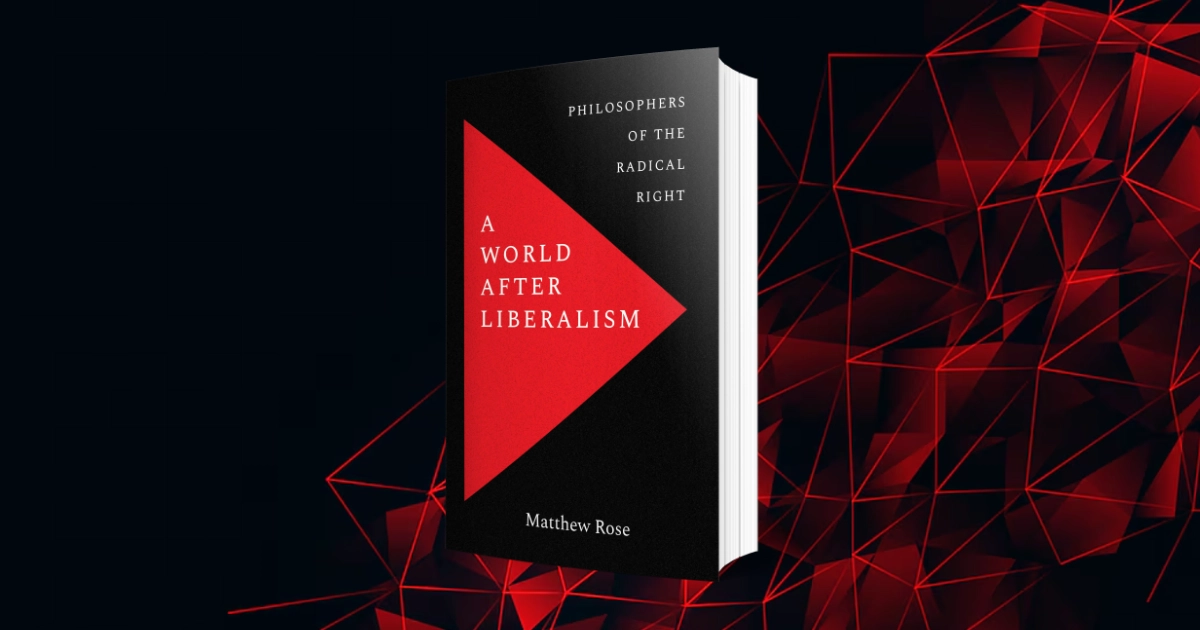
A World After Liberalism: Five Thinkers Who Inspired the Radical Right
Matthew Rose
Yale University Press,
August 3, 202
208 pages
ISBN: 978-0300243116
As American politics descends into permanent chaos, many observers have been left wondering how the “Land of the Free” has got to this point. In Trump’s second administration, the distance between the beliefs held by his inner circle and the conventional wisdom espoused by opposing elites on both sides of the Atlantic is stark. What change in thinking has occurred? Why is the world’s geopolitical structure in such a state of upheaval? Forget the consequences for a moment and consider the genesis. There is no one person or book that can explain why Trump and like-minded figures think the way they do. There is no grand unifying theory for nationalists or populists, no equivalent of The Communist Manifesto to rally around and draw wisdom from. Those who have worked closely with America’s forty-fifth and forty-seventh president maintain that what he says at any given moment closely reflects the last sycophantic words to enter his ears. Bearing all this in mind, there is a brilliant and little-known work, not new but still very fresh, which offers startling insights—Matthew Rose’s A World After Liberalism: Five Thinkers Who Inspired the Radical Right.
The author is a scholar of modern religious thought who serves as director of the Barry Center on the University and Intellectual Life at the Morningside Institute in New York. As he told Andrew Sullivan in a fascinating podcast discussion in 2022, he comes from a small-town background on the American Plains, one of the most reliably conservative parts of the United States. Here, this convert to Catholicism analyses the views of five thinkers whose work—though often known only to a small group of dedicated readers—has come to have a disproportionate impact on the development of the radical right which has emerged across the West. Central to his argument is the claim that Christianity figured heavily in the minds of these figures, not as a core belief they wished to defend from a secular and internationalist elite, but as an oppositional force which the radicals viewed as either an insignificant cultural marker or something alien to their own pre-Christian values.
None of the five men in question are household figures. The life stories of the German Oswald Spengler, Italy’s Julius Evola, France’s Alain de Benoist, and the Americans Francis Parker Yockey and Sam Francis are not very similar, yet all of them possessed an enormous sense of the allure of the tribe. After a long decline, tribalism is back in vogue. Politics today is increasingly dominated by discussions about immigration, which often boil down to identity: whose country is this, what customs should prevail, and which resources belong to which people. This marks a sharp contrast with the political liberalism which has prevailed until now, with its underlying assumptions about the primacy of the individual: the right to live as one pleases, the right to trade across borders, and the right to move from one country into another. Tribalism subverts this.
As Rose states early on, in the post-liberal era we now live in, this new right-wing politics will be dominated by considerations relating to “national solidarity and cultural identity, not individual liberty”, adding that this will be “a conservatism focused on public goods, not private interests”. While Huntington’s Clash of Civilisations thesis placed the Western world together, the inability of European far-right parties to work together effectively in Brussels indicates that no strong sense of Western cultural solidarity exists among them, and recent developments in Washington, DC, certainly suggest that this concept is diminishing in importance there also.
Rose draws attention to the neo-Nazi Yockey’s affection for Communist Russia, which he felt precisely because Russia was not Western. Russia’s cultural soul, Rose describes, was “innately opposed to individualism, rationalism and materialism . . . Russia preserved everything the liberal West had squandered. Where the West had grown tired, divided, effeminate and self-critical, Russia had remained vigorous, tribal, masculine and self-protective”. Today’s equivalents of Yockey, who committed suicide while in the custody of the FBI in 1960, see something similar when they look at Putin’s Russia, and they are perfectly right to see it. A country whose dictator can on a whim send millions of slave conscripts to be killed or maimed in a needless war is a country which has not been impacted by liberalism or modernity. The alleged Christian state church which exists in Russia is nothing more than an adjunct to Russian nationalism.
More interesting than references to that or any other country is the emphasis which the author places on the Christian religion. All five of his chosen subjects rejected it, and at least one of them detested it. Far from being at the heart of the worlds they knew, the radical thinkers saw Christianity as an alien force which their ancestors had adopted. “It was not Christianity that transformed Faustian man,” Spengler wrote, “but Faustian man who transformed Christianity.” As Rose notes, this atheist “transformed Western Christianity from a universal creed into a tribal signifier”, and like-minded thinkers continue to engage in this blasphemy to this very day.
Alain de Benoist, the only one of the five thinkers who is still alive, went further by entirely abandoning the Catholic faith of his family and adopting paganism, even writing a book titled On Being a Pagan. To Benoist, the paganism of pre-Christian Europe was better at grounding people in the world around them, and Christianity had subverted this more natural pagan order due to its universalist nature. “Benoist alleged that Christianity thereby deforms our natural impulses and weakens our social relationship. We naturally respect and trust those like us, and avoid and distrust those who seem alien. We naturally admire beauty, health and excellence, and pity the weak and ugly. But where paganism consecrates our vital instincts, seeing them as the healthy basis of social life, Christianity aims to reform them. It demands that we recognise the shared humanity and will the common good of all people, regardless of their condition or background,” Rose explains. As the identitarian American journalist Sam Francis put it when critiquing the influence of conservative Christians in America, “Christianity today is the enemy of the West and the race that created it”.
Francis deserves special attention. In Rose’s telling, this courtly but dangerous Southern intellectual is something of a precursor to Trumpism. Decades before Trump reshaped the Republican base and remoulded the Republican Party, Francis was writing of the “Middle American Radicals”, or MARs: the low- and middle-income white Americans who opposed rapid cultural change, viewed free trade with distrust, and thought they were being abandoned by a government concerned only with other minority groups. Francis dearly wished for a greater sense of white identity to develop among white Americans, seeing this as the only way for them to survive as a distinct group in a changing America. While the economically conservative Republican old guard had failed to appeal to the MARs, if their radicalism were to be properly channelled, it could truly change America.
Drawing together the work of all five thinkers, Rose makes an eye-catching claim that these philosophers of the far right opposed the social order which Christianity helped to establish precisely because of what Christianity is. Even in a secularised age, this process continues to be played out. “Christianity is no longer an assumed premise of civic life, and its doctrines are often rejected or derided. But according to the radical right’s sweeping claims, its ideological offspring fill our public life. Liberalism is a secular expression of the Christian teaching that the individual is sacred and deserving of protection. Socialism is a secular expression of Christian concern for the poor and downtrodden. Globalism is a secular expression of the Christian hope that history is leading to a kingdom of universal peace and justice.”
This is a book of exquisite perception and profound importance, and one hopes that Matthew Rose will seek to expand on it in the coming years as fresh developments occur. It is also a necessary reminder that the liberal age which is now concluding was never entirely baleful, and radically distinct electoral choices are certainly not always positive. In the poisonous two-party system in America and in many other countries as well, voters are today faced with difficult options. After all, for all Trump’s disruptiveness, Christian voters may have been right to back him in 2024, given the nature of the modern Democratic Party. Some populist or nationalist parties are certainly unpleasant, but others are radically different from the pagans whose views are dissected here. All of this requires deep reflection—the sort of deep reflection which does not occur in politics any more. If nothing else, A World After Liberalism is a necessary warning to any Christian tempted to vote for politicians or parties offering an updated tribalism divorced from the Christian sentiments which have inspired national patriotism across the West historically. The pagan landscape which the Church and the West were built upon still exists in the darkness below, and still needs to be guarded against.