
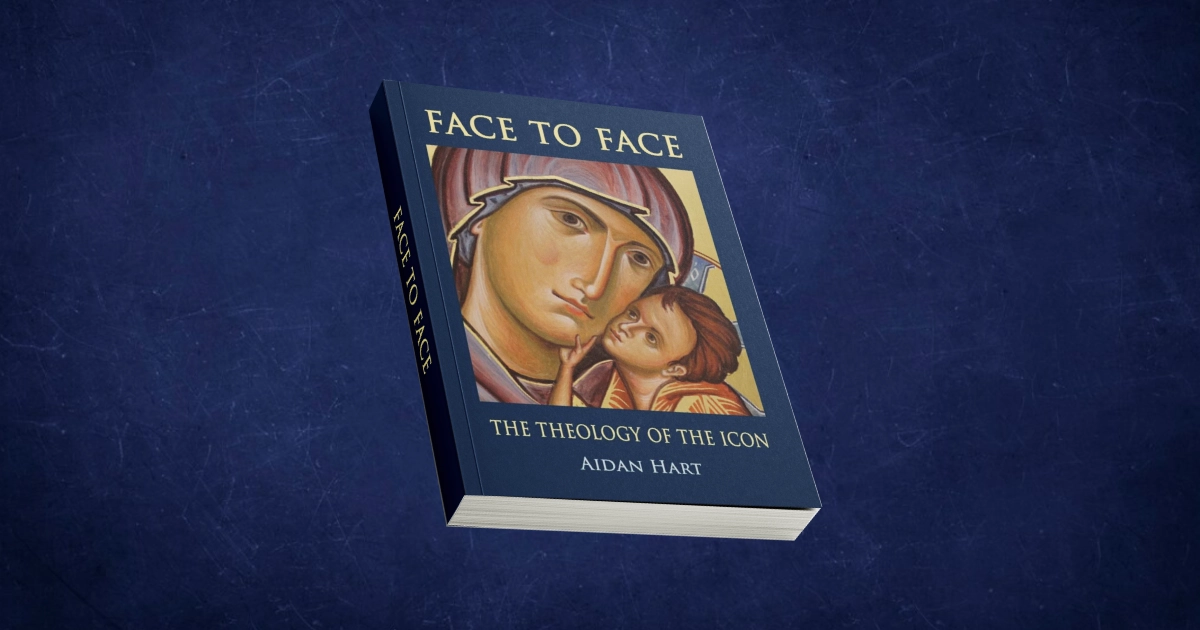
Face to Face: The Theology of the Icon
Aidan Hart
Gracewing,
July 21, 2025
108 pages
ISBN: 978-0852447109
This is, as the title states, an introduction to the theology underpinning the icon. It is very clear, very well written, and will certainly help Western Christian and non-Christian audiences to appreciate what exactly an icon is. The author is himself an iconographer and teacher of note, and he has distilled decades of skill and practice into a most accessible and instructive little book. One thing to note about this book, however, is that there are no illustrations apart from the beautiful cover image, one of the author’s own icons, so, if the reader needs to see an image of, for example, the Mandilion in order to follow what the author is saying, he will have to betake himself to Google or another book with photographs.
The book consists of eight chapters plus an Introduction, and there is not a wasted word anywhere. The Introduction is very informative and lays out the programme of the book very clearly. Chapter 1 tells us what an icon is, theologically, stressing the liturgical significance of the icon, a theme the author returns to in chapters 5 and 6. He emphasises the fundamental theology of the icon, citing the teaching of St John Damascene in the eighth century, which summarised many centuries of reflection and teaching on the use of sacred images. He highlights the teaching that, in spite of Old Testament prohibitions on the making of images, sacred images are now justified because of the Incarnation: Christ has sanctified and redeemed human flesh, and so icons are not images of corrupt nature but of divinised human beings.
Chapters 2 and 3 give us an account of the Iconoclast crisis (726–842 AD), which was felt mainly in the East, due in some respects to pressure coming from a burgeoning Islam, and the orthodox Christian response to that, valid in both East and West. Concepts such as the distinction between worship and veneration were crucial to the resolution of that dispute and are found in, for example, Western Catholic teaching on the veneration of the saints. The Eastern Empire (“Byzantium”) was far more settled at this point in history, and the emperor had far more power to impose outright bans on the use of images in the East, whereas the still unsettled West could not participate in the crisis to the same extent, largely due to recurrent spells of anarchy but also because images were just not seen in the same way in the West. The very importance given to images in the East in some respects precipitated the crisis, in that there were distinctively Eastern abuses verging on idolatry, which the emperor could claim he was setting out to remedy. The restoration of the use of icons in 842 finally established the liturgical significance of the icon in the Eastern Church, and the author emphasises that this is not simply decorative or a matter of adding to the beauty of a church.
This is crucial for non-Eastern Christian readers, since Western Christian attitudes to religious art tend to consider it as essentially decorative, important but important accidentally to the main action of the liturgy, but this is not true of the East. It is arguable that, in spite of stylistic similarities in the Western early mediaeval period, the West never really absorbed the full theology of the icon (the author deals more fully with this in chapter 7), and that this is essentially what allowed for the highly naturalistic developments of the Baroque and Rococo eras of religious art. I think the author over-emphasises the role of scholasticism: it was not a monolithic phenomenon. Aquinas and Scotus are very different thinkers, and I would argue, following Cornelio Fabro, that much of Aquinas belongs in the broad Platonic tradition formerly referred to as Neoplatonism. He recasts it, but then so does Proclus, so does pseudo-Dionysius, and so does Maximus the Confessor, all crucial authors for the East. Much Orthodox theology is very systematic and highly logical, and a thinker such as, for example, Leontius of Byzantium will make extensive use of Aristotle, who is often blamed for Western scholasticism.
Rather than looking exclusively to some manualistic “scholasticism” effecting the move towards greater naturalism in Western religious art, one has to look also to changes in devotional practice, the Franciscan school which gave us the Stations of the Cross and the Devotio Moderna, as well as the revival of classicism called the Renaissance. But all of this artistic ferment in the religious sphere was possible because the Western Church did not accept the canons of the Council of Trullo—the Sixth Session of the Second Council of Nicaea—which set very strict limits on what was possible for liturgical art and was therefore far more open to artistic innovation—and degradation.
Chapter 4, “Icons and Imageless Prayer”, handles the question of how icons are used in prayer that ultimately seeks union (theosis, deification, divine filiation) with God, who is beyond all. The tension between the reverent use of the icon and the need ultimately to surpass it is explained very well and clearly here and refers us ultimately to the paradoxes of Christianity itself, seen, for example, in the West in such phrases as “O felix culpa …” from the Exsultet of Easter, a very “Greek” feeling prayer. The use of icons as a method of purification of the imagination (which could take us all the way back to Plato) is also mentioned here.
Chapter 5, “The Use of Icons”, deals with exactly that: how icons feature in the liturgy and the spiritual lives of the faithful. He highlights some of the common practices in Orthodoxy, Catholicism, and High Anglicanism: making the Sign of the Cross before a holy image, lighting candles, or wearing blessed medals, for example, but the greater devotion given to the holy image in Eastern tradition is seen in the fact that it is kissed. In Western Catholicism, only the Cross is kissed during a liturgy, during the Veneration of the Cross on Good Friday. Otherwise, only relics are kissed. This chapter finishes with an interesting historical note about the relative importance given to painted versus relief icons: jewelled or sculpted images were considered better, more incarnational. It would be interesting to compare the thought of the Byzantine world on this point with Abbot Suger’s writings on art and architecture, which established the Gothic: there seem to be some startling similarities.
Chapter 6, the longest chapter in the book, “Icon Form and Theology”, is a wonderful theological exploration of the relationship between the purely artistic (to use an ugly contemporary term, “skills-based”) aspect of the icon and its theological significance. One striking aspect of iconography is its specialisation: iconographers do not seem to produce other forms of art, and being an iconographer seems itself to be a form of life, in which prayer, meditation, and theology are actually more important than technique, although that is important. The iconographer is not an aesthete, but he understands aesthetics. Here again lies an important difference with Western religious art: for example, the devout Bernini produced all sorts of other things besides his marvellous St Teresa. This chapter is very nuanced and very satisfying philosophically; it is rewarding to see the author deal so calmly and thoroughly with accusations of “essentialism” in regard to the theology of the icon.
Chapters 7 and 8 deal with the icon beyond the Orthodox and Eastern Christian world, both historically and in modern times. Chapter 7 outlines the historical elements mentioned above; as I say, I think the author’s remarks on “scholasticism” are oversimplified, but the account of the Carolingian emphasis on pedagogy and the failure of the West to adopt the canons of the Sixth Session of the Second Council of Nicaea are covered well. He devotes a lot of space to what one might call the Western iconoclast crisis, that is, the Reformation, and does it well. One point he notes is important: Western art historians dealing with religious art have not taken much interest in its theological significance, at least not since Émile Mâle’s nineteenth-century writings on the Gothic, either because they were non-believers or, if believers, because they were writing for a secular art establishment. This has tended to muddy the waters somewhat, giving the impression that all Western artists cared about was stylistic innovation. But a more careful study of the Gothic reveals otherwise, and I think this could be emphasised.
Chapter 8 is very interesting: the author deals with the rediscovery of the icon tradition in the West partly through movements traditionally seen as anti-traditional—the art of Cézanne, for example, or Gauguin. Many twentieth-century modern artists were Orthodox in origin—Brancusi and Kandinsky—and the parallels between their work and traditional iconography are most interesting to read about: here is where the practice of the iconographer as artist really comes into its own. He notes that the very strong Catholic interest in icons represents something of a turn back to traditional figurative art following the extreme experimentation which came in the wake of Vatican II.
In conclusion, this is a wonderful little book, very well argued, very informative, and very clear. It deserves to have a wide readership.