
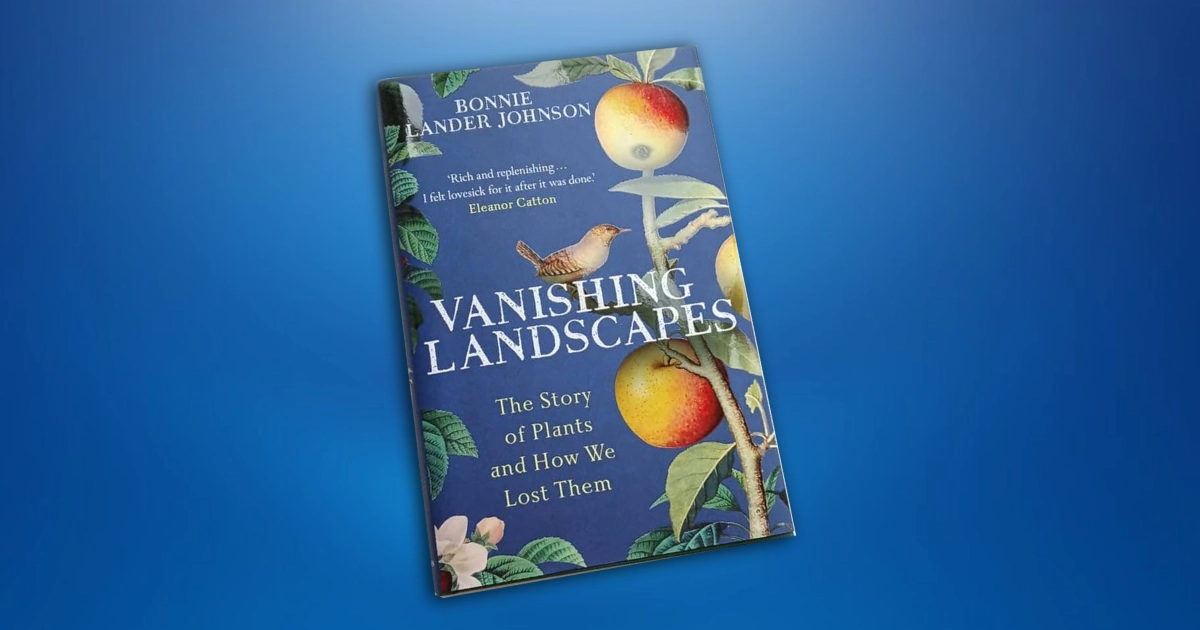
Vanishing Landscapes: The Story of Plants and How We Lost Them
Bonnie Lander Johnson
Hodder Press,
April, 2025
320 pages
ISBN: 978-1399731522
In Vanishing Landscapes, Bonnie Lander Johnson—an associate professor at Downing College, Cambridge, specialising in literature and history in the early modern period—outlines how, as a modern people, our relationship with plants has become severed. Johnson describes how in the medieval world—far from viewing plants as having a merely ornamental or commercial purpose—they taught us how to live:
“Wheat was not only food but the breath of God calling us to communion with each other. Flowers fattened bees but they also showed us how to live, their faces turned all day to heaven and inward at night. We were not authors of nature but part of its fabric.”
As part of her endeavour to unveil the medieval world’s relationship with nature, Johnson travelled around the British Isles in search of traces of this vanishing world. In Devon, Johnson enrolled in a cider-making course with a local apple farmer. We learn that if apples are left to their own devices, they will grow large seeds with little flesh to facilitate self-propagation. In order to ensure apples are good for eating, it is necessary to graft them. This involves cutting a young shoot or bud from the variety of tree you want (“the scion”) and inserting and taping it into the rootstock. The two will then grow as one, ensuring the apple tree produces fleshy apples.
Although the participants try to recreate the experience of apple farming, the world where farmers truly depended on it for their livelihood has vanished. The farmer himself was detached from the land in that his income was earned more from providing courses to city-dwellers than from cultivating apples. The gaps between the lines of trees, where farmers of old would light bonfires to ensure the apple blossoms would not wither from the late “May frost”, underline that their survival was bound up with their produce.
Johnson then travels to Norfolk, a land which was once resplendent with saffron fields. Sally—a modern-day saffron farmer—is the sole remnant of a practice which was once widespread. In August, Sally plants the “corms” (bulbs), which flower in October. At this point, helped by her family, the saffron flowers are “gathered”, which turns your hands blue. Then begins the painstaking task of “picking” the stigmata from the flowers, which have the colour of a red crocus. The stigmata are then dried in the kiln. Once dried, the saffron threads are ready to be sold to boutique buyers around the world (this saffron should not be confused with the wild look-alike which is deeply poisonous).
The practice of harvesting saffron was deeply cherished and widespread in medieval Norfolk, in a manner unthinkable today. In those times, after a harvest, the peasants would make a medieval cake of saffron which consisted of a million individual threads of saffron. The medical properties of saffron were revered by “huswives”. Its uses were as varied as curing macular degeneration, pox in the eye, or depression. Medieval manuals instructed soldiers to insert it into poultices when bandaging wounds. Rubbing it into shirts served to kill lice—but also turned the shirts yellow. Often, to the chagrin of puritans, it was used for aesthetic purposes in court in order to create golden collars or as a moisturiser.
Apart from puritan disdain, the use of saffron began to decline as the medical profession became more regulated. Urban apothecaries, jealous of the superior knowledge of “herb women” of plants, sought to bypass this by attempting to extract the hidden chemicals of plants. The following ode to William Harvey—a Fellow of the College of Physicians—reflects how he plundered nature’s secrets:
“Coy Nature (which remain’d, though aged grown, a beauteous Virgin still, injoy’d by none […]
When Harvey’s violent passion she did see began to tremble and to flee […]
But Harvey our Apollo, stopt not so, into the Bark and Root he after her did go”
Throughout, the book—whether speaking about the medieval cultivation of apples, saffron, woad, reed, oak, grapes, or wheat—Johnson laments how our close ties with nature have become sundered.
The fenlands where reed was harvested by “fen-men”, to great protestation, were drained to make way for more profitable cattle fields. Mixed woodlands, where people formerly lived in community under the foliage and used advanced coppicing techniques to extract materials while ensuring there was always sufficient supply, have been cordoned off by the Woodland Trust.
Johnson does not wish to reverse the tide of modernity—she would not exchange her office job for the hard labour of the past—yet her heart pines for it.
At a festival in Buckland Abbey in the darkest depths of winter, there is a tradition that inhabitants would go out and sprinkle cider from a “wassail” (a bowl) on the apple trees, blessing them in the hope of a good harvest. During the ritual, Johnson prays, “to feel less yearning for a life now lost to us, I ask to be reminded that what we have now is good.”
In this book, Johnson has done a great service in reminding us of the beauty of the hidden lives of our ancestors. It is a reflection on what we have lost with modernity and explores the sources of our nostalgia for the country way of living.