
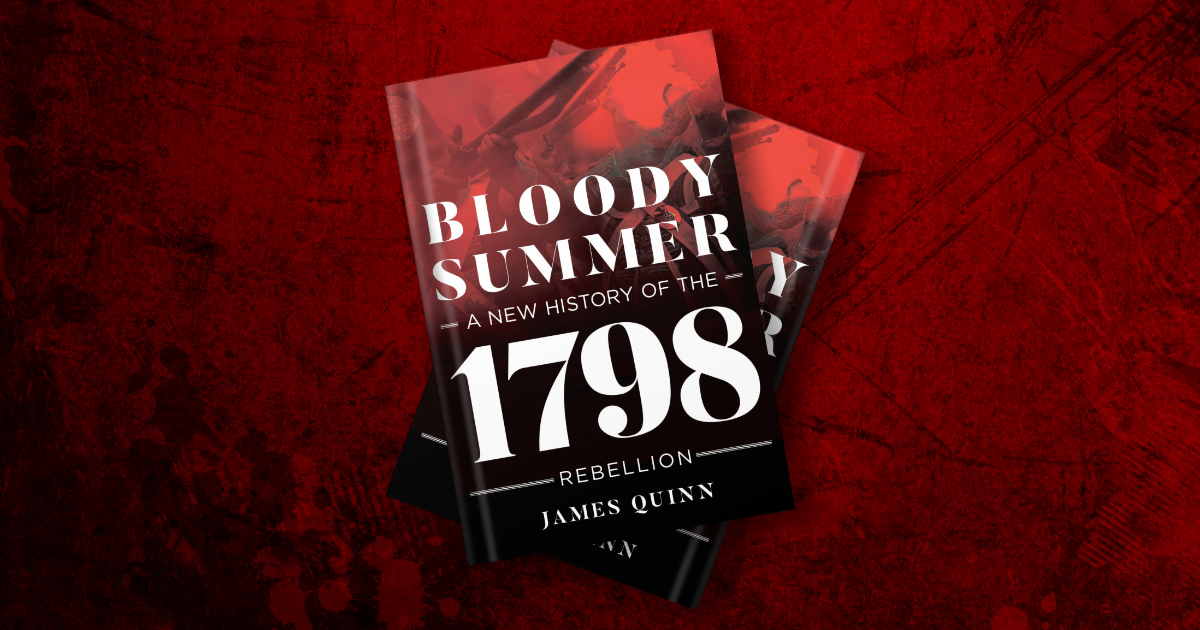
Bloody Summer: A New History of the 1798 Rebellion
James Quinn
University College Dublin Press
October 2025
175 pages
ISBN: 978-1068502347
1798 is one of the defining years in Irish history, marking the beginning of a new chapter in the Irish freedom struggle. In Bloody Summer: A New History of the 1798 Rebellion, the talented historian James Quinn looks at the rebellion afresh, and provides a concise, readable and profound overview of what happened and why the legacy of “Ninety-Eight” still lives with us.
Measured in scale, 1798 was far beyond any of the rebellions which followed, including the War of Independence. More than 100,000 Irishmen took up arms or pikes, and more than 10,000 people were killed, the great majority of them Irish. The authors of the 1916 Proclamation were misleading when they wrote that the Irish had rebelled “six times during the past three hundred years.” The first two instances were the uprisings of 1641 and 1689, which were not separatist in their intent, but instead constituted efforts by Irish Catholics to defend their Faith and right the wrongs of land confiscation and plantation. 1798 was something very different: a secular rebellion, led by Protestants seeking to import the political system introduced in the French Revolution. It came about after a period of peace and rising prosperity.
In his early chapters, Quinn describes the Ireland of the late 18th century, where steady economic growth had been recorded from the 1760s onwards. The Protestant gentry profited handsomely as Georgian Dublin grew in wealth and influence, along with our other port cities. A significant Catholic middle class had also developed. Blocked from participating in the governance of their own country, ambitious Catholics dedicated their efforts to business, and as they acquired more wealth, they slowly began to acquire a subtle but obvious political influence. Slowly but surely, anti-Catholic laws were eased, and the Irish Church gradually recovered from the disastrous 17th century.
Within Henry Grattan’s Irish Parliament on College Green, the Protestant elite demonstrated their developing national consciousness by demanding legislative independence from Westminster. The population grew by 500,000 people each decade between 1760 and 1800. Ireland was coming into its own at last. None of this negates the fact that the Ireland of the 1790s was a deeply unjust society. Only 5 per cent of the country’s land was in Catholic hands, and when Grattan introduced a Catholic relief bill in 1795, his fellow parliamentarians defeated it by 155 votes to 84. The Protestant minority continued to oppose political equality for their Catholic neighbours, and yet that vote tally indicated that changes were coming. A minority within the minority was committed to real reform, and a spirit of national unity was taking root. “By the early 1770s there were clear signs that the economy was expanding and that the government was prepared to consider relaxing the Penal Laws,” Quinn writes. “Ireland appeared to be more prosperous and law-abiding than ever before, and optimists claimed that any remaining sectarian and social tensions would soon be a thing of the past. In quieter times, they may well have been proved right, but quiet times were not what lay ahead.”
Contrary to how modern-day Irish republicans tend to think, what lay ahead cannot be examined solely by considering developments in Ireland. The 1798 Rebellion and the Society of United Irishmen who staged it cannot be understood without reference to France and the bloody and self-destructive revolution which commenced in 1789. Quinn’s description of the French influence contains many striking examples. Quinn describes how a Dublin publication of Thomas Paine’s Rights of Man (written in response to the great Irish conservative Edmund Burke’s Reflections on the Revolution in France) sold 40,000 copies: more than twice its sales in England. When the United Irishmen in Belfast launched their Northern Star newspaper, the publication openly celebrated military victories by the French revolutionaries, and when Henry Joy McCracken led his Ulster rebels towards Antrim, they sang La Marseillaise. One of the most interesting quotes of all is from Napoleon. Having shown little interest in Ireland during his time as dictator, Bonaparte later reflected on what could have been during his lonely exile on St Helena: “If, instead of the expedition of Egypt, I had made that of Ireland…what would England have been today? And the Continent? And the political world?”
The failed attempt by the French expedition to land at Bantry Bay in 1796 is described. From a young age, Irish history students are implicitly taught to regret the tragedy of bad weather and poor leadership which prevented an invasion fleet of 15,000 men from landing on Irish soil. Whatever one’s views, it is certainly one of the great “what ifs” of Irish history. On a practical level, the expedition made the same critical geographic mistake as the Spanish fleet when they landed in Kinsale in 1601, far away from the Ulster Earls’ support base. Quinn points out that the United Irishmen would grow to have 118,000 members in Ulster by spring 1797. The radical Presbyterians of Ulster were the beating heart of the United Irishmen, and unsurprisingly, they were keener on what had happened in France than Catholics in the rest of the country. Had the French landed in force there and brought sufficient firearms with them, they could have overwhelmed the colonial garrison quite easily. When a small French force did land in Ireland in August 1798, they arrived too late — the rebellion had already been crushed elsewhere, including in Ulster and Wexford. Furthermore, a potentially liberating force again arrived in the wrong place, in Mayo, where the United Irishmen were numerically weak.
What happened when General Jean Humbert arrived in Mayo was perhaps the most ironic chapter of the whole affair. Shortly before the French embarked on their Irish quest, the revolutionary government had waged a savage counter-insurgency effort against the Catholic monarchists in the Vendée region of western France. As Quinn writes, the French were confused by how they were perceived by the Catholic Irish: “Many of Humbert’s troops had fought against Catholic counter-revolutionaries in the Vendée and Italy and were somewhat bewildered to see Irish recruits coming forward to ‘take arms for France and the Blessed Virgin’.” Not only did many within Humbert’s force have experience of the Vendée, the French revolutionary commander in that campaign, Lazare Hoche, would go on to be the key advocate of a French invasion of Ireland, and would travel with the French forces to Bantry Bay in 1796. Quinn goes further than most in suggesting that a French conquest of Ireland in this period could have led to another Vendée, where “bands of Catholic peasants led by priests resisting republican secularism were savagely crushed by French armies.” More to the point, even if France prevailed initially, British naval dominance made it unlikely that the French could have held on, and British policy towards a recaptured Ireland would likely have been punitive. “Had a French army successfully conquered Ireland in 1798, ‘The Year of the French’ might well have been bloodier and even more tragic,” Quinn contends.
The most depressing part of this book deals with the aftermath and the rebellion’s consequences. The obvious of these is the most long-lasting: the Act of Union. As Quinn makes clear, this was a more complicated legislative development than is sometimes assumed. Some prominent Catholics including the Archbishop of Dublin, John Troy, supported the Act in the hope that Britain’s House of Commons would grant Catholic Emancipation sooner than its Irish equivalent would; on the other hand, the Orange Order remained officially neutral on the question. Bribery and chicanery delivered London’s desired result in the end. The demise of legislative independence — coupled with the growth in sectarianism after a rebellion marked by atrocities against all communities — helped to stymie the blossoming Protestant Irish nationalism of the 18th century, the existence of which had arguably made the development of the United Irishmen a possibility.
1798 was meant to achieve full independence. Instead, it led to complete control by Westminster, and an Act of Union which still binds part of the country to Britain. 1798 was meant to unite all Catholics, Protestants and Dissenters. Instead, it helped to harden the divisions between communities. Never again would large numbers of Irish Protestants take up arms against the Union Jack. In the revisionist republican narrative, 1798 was meant to end foreign involvement in Irish affairs. In truth, it was an attempt to impose a radical and anti-Christian political ideology which had brought ruin to France’s people and France’s Church. The anti-Catholic strain of Irish Republicanism developed from here onwards, and in recent times has fuelled the Provisional IRA’s pointless campaign, its movement to the far left and its political wing’s ongoing descent into moral degeneracy. It was a “Bloody Summer” indeed. The tragedy of “Ninety-Eight” lives on with us, but we were bloody lucky that the French never made it ashore at full strength.