
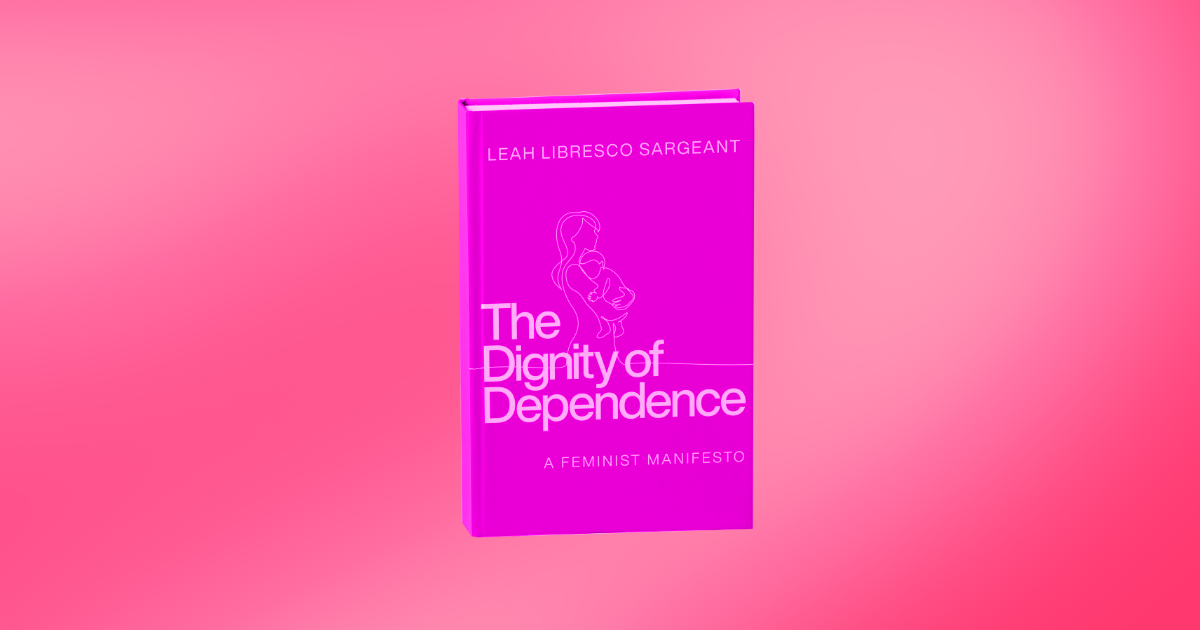
The Dignity of Dependence: A Feminist Manifesto
Leah Libresco Sargeant
University of Notre Dame Press
October 2025
232 pages
ISBN: 978 0268210335
In this book, Leah Libresco Sargeant takes on the feminist (ultimately the Enlightenment) notion that justice for women requires that they (a) be fully autonomous and (b) be treated exactly the same as men in every respect. She rightly notes that women’s experience is of necessity different from that of men, and points out that legislation intended to promote equality has all too often led to the serious disadvantage of women, and to the devaluing of their essential nature.
In some respects, this book is very similar to Kathleen Stock’s Material Girls, insofar as the fundamental point of both books is that we cannot simply create reality by wishful thinking, and that the attempt to do so has resulted in seriously damaging consequences for women and girls, above all those who are most vulnerable. Stock’s book is more scholarly, more focused, and better written; her fundamental thesis emerges very clearly early on in the work’s tight construction. Libresco Sargeant’s book is more diffuse, more impressionistic, and in some respects more self-indulgent: she uses herself, her experiences, and her tastes as an example far more often than Stock does. Yet her thesis is more general: human beings are inherently mutually interdependent, something which is particularly obvious in the relationship between mother and child. Society has rejected this mutual dependence in favour of a false interpretation of Kant’s idea of “autonomy,” according to which every human being is essentially alone, atomic, and self-sufficient. Libresco Sargeant notes that this is damaging to all human beings, in that it is simply not true, not conformed to reality, and the focus of her interest is how this plays out for women in particular.
The book consists of nine chapters, each of which examines a particular aspect of the post-feminist world women now have to negotiate. Chapter 1 deals with the fact that public spaces are calibrated to men, and asks if this is symbolic of the world in general—at least, the man-made part of it. When she is fussing about basketball courts, the non-American reader feels a slight impatience, but when she moves on to car safety, it becomes compelling. Chapter 2 deals with the whole notion of “autonomy” as the human ideal, and the attempt to force women to fit in with that. Some reference to the literature in medical ethics would have been appropriate here. Childress and Beauchamp based their all too influential work in medical ethics on precisely the kind of autonomy that Libresco Sargeant attacks here. “Autonomy” as currently understood is in fact a gross misrepresentation of Kant’s thought on conscience, and, as the author rightly notes, it is taken for granted everywhere. Some historical background would have been useful here, but it is good to see the subject tackled like this. Chapter 3 deals with the claim that (a) equality for women means being the same as men, and (b) that a good man is never vulnerable. Underlying this premiss is the contempt for vulnerability that, as Peter Hitchens has noted, characterised the ancient world and is back with us again. Nietzsche started it, but he has had many willing accomplices.
Chapter 4 deals with the attack on femininity represented by wildly unrealistic expectations of what the female body should look like and be capable of doing, and the damage that this has done to young girls, indeed to mere children. What is striking here is the fact that these damaging ideas underpin much of our law, which I had not realised before. Chapter 5, “The Limits of Labour Language,” deals with the attempt at a push-back by way of calculating the value to the economy of traditional women’s work in the home. L. Sargeant is sympathetic to this, but also uncomfortable with it. She has an interesting discussion here on the meaning of “economic,” noting that it originally referred to the domestic sphere. There is a real problem: to refuse to put a price on women’s work erases it from the consciousness of a rabidly materialistic society—and leaves those women very vulnerable—but to put a price on it is to tacitly acknowledge that all value is ultimately economic, i.e., material.
Chapter 6, “Illegal to Care,” is the real eye-opener in the book, at least from a non-American perspective. L. Sargeant goes through the extraordinarily mean-spirited laws in several cities and states in America that literally prevent people from helping each other. I knew that European laws were better for the vulnerable in many respects, but I had no idea how bad things had got, at least in some places in America. From the removal of all public seating lest the homeless use it (how about housing the homeless instead?) to laws forbidding ordinary citizens to feed the poor (St Vincent de Paul never had to cope with that), to the inordinate right to interfere with whom a family may have living with them, the catalogue of casual cruelty and bureaucratic indifference to need is quite shocking. The story of Inez Moore, who fought for several years for the right to have her grandson living with her, is very striking, but so too is the account of the sheer meanness involved in disability benefits. The underlying mentality is that of treating vulnerable people as defective machines, which, for some reason or another, we are not allowed simply to dispose of.
The fundamental problem is that love is simply not recognised as a value or even as a reality, and the final three chapters deal with that issue, and make a case for restoring love as a value. Libresco Sargeant notes that this will be difficult, since Western law is now so skewed in favour of materialism—although her follow-up sentence will shock some people: “Good things have been built on that mound of tiny corpses.” What good things? She does not tell us. If one were to say that good things emerged from the Nazi research at Dachau, would that be acceptable? The taste for performance art which emerges in chapter 7 will not be shared by everybody, although her evaluation of the value of inconvenience and suffering is good. Chapter 8, “Men into the Breach,” is very interesting for its analysis of where men find themselves in all this, her analysis of the Cistercian monks who were martyred in Tibhirine being particularly striking.
So far so good, but there are a few caveats. First, as noted above, Libresco Sargeant refers back to her own experience very often, and it is always something that shows her in a good light. Personal experience is valuable, of course, but I think this needed a little tightening up to avoid an impression, possibly unfair, of self-indulgence. The book improves as she works through her chapters, precisely because she moves into a reflection on wider issues, which specific cases clearly exemplify. Secondly, the focus of the book would have been helped by a historical chapter of the “How did we get here?” type. In 1960, the year Kennedy was elected, the average industrial wage was enough to support a family in reasonable comfort: it was called the “family wage.” It was presumed that people, usually men, worked to support a family: the family was the important thing, not “the economy.” This allowed mothers to stay at home with their children—something which, as even Simone de Beauvoir noted, most of them want. Something called the “social contract” prevailed, an understanding that for every 1 per cent increase in productivity, workers’ remuneration would also rise by 1 per cent. This was perceived as equitable and fair, much better and more productive than the Soviet aspiration to absolute equality. The United Auto Workers’ agreement with Henry Ford II (“The Douce/Duce”) set standards for salaries all over America, which was perceived globally as having fixed industrialism. Kennedy’s White House is actually nicknamed “Camelot.” Globalism and second-wave feminism destroyed this. Tracking that, and asking what do we do now, would have given this book more focus.
Thirdly, clearly these issues have potentially volatile political implications, especially in the American context. Libresco Sargeant notes some of these in the best—and most shocking—chapter of the book, “Illegal to Care,” when she discusses disability benefits, maternity leave, and pension entitlements for stay-at-home mothers in France, but a fuller treatment would be more satisfying. This relates to the question of the historical status of the question mentioned above: there is a tendency to assume the American economic system is the way God made the world, as though Eve had worried about her 401(k) plan. It is in fact very recent and inherently unstable, especially following globalisation and the debt crisis. She says nothing about crushing debt due to student loans or mortgages, which is the main reason many women are forced into the public workplace, and that adds to the impression of somebody who has never had to worry about it, who can afford to indulge in purely speculative considerations and performance art. This impression, incidentally, is reinforced by her casual reference to “gig workers” on p. 91, where she fails to raise the question as to whether this development, convenient as it may be, involves injustice of any kind.
The main strength of the book lies in its sharp, almost random insights. Libresco Sargeant has a gift for the telling sentence: “My co-worker was echoing the idea that the external world was a threat to the self” … the external world is a threat to the self. What better encapsulates the reasons for the extraordinary, unbalanced manifestations of anger or triumph in Washington, DC, and Dublin on the part of the pro-abortion side in the abortion wars? This is a valuable exploration of an idea that has been attracting a lot of attention recently on both sides of the Atlantic, namely, that feminism has failed to keep its promises to women, that things have not worked out as expected. Of course, as Ed West implied a few years ago in an essay for the Catholic Herald, the Catholic Church foresaw this, Humanae Vitae being particularly prescient, and now the world is catching up. The defeat of the Irish constitutional referendum which sought to change the nature of the family as defined in the Constitution was an important straw in the wind: the “No” campaign was fought largely on the claim that the proposed change sought to erase mothers from the Constitution, and although the defeat was attributed later to concerns about immigration, concern about the status of mothers did play an important part. The book itself is rooted largely in the feminist literature of the last fifty years and in a response to that. Her attack on the false autonomy of the Enlightenment goes deep, and is valuable and timely. As noted above, it opens very wide horizons in history, philosophy, and politics, far beyond the scope of the actual book, but we may hope that those who read it will be stimulated to explore further in these areas.