
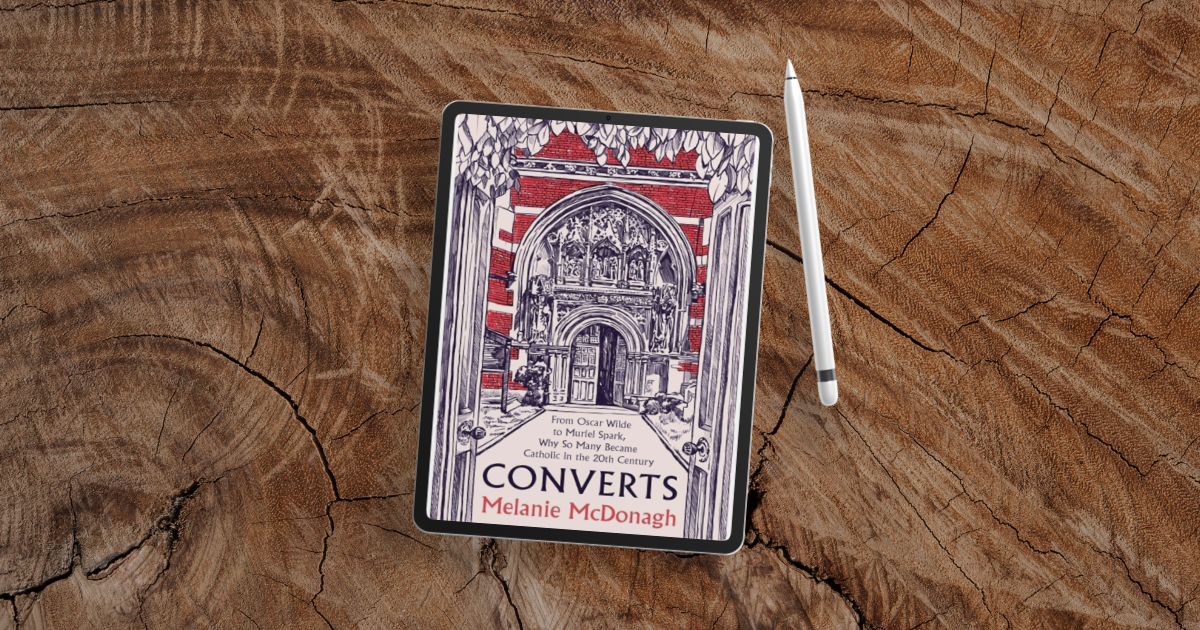
Converts: From Oscar Wilde to Muriel Spark, Why So Many Became Catholic in the 20th Century
Melanie McDonagh
Yale University Press
November 2025
ISBN 978-0-300-26607-8
Melanie McDonagh’s insightful new book, Converts, explores the conversion stories of a series of significant poets, writers, and artists from twentieth-century Britain. The growth in conversions to the Catholic Church in England across the first half of the twentieth century was remarkable—from 3,600 people in 1911 to a high of over 15,000 in 1960. In all, well over half a million people in England and Wales became Catholic during this period. This was a fertile time, when many new souls came to the faith.
McDonagh’s book sets out to explore these converts’ lives from the perspective of their conversions. Consequently, the accounts are not biographies in the strictest sense. They do not exhaustively chart the minutiae of each convert’s life. With almost twenty converts profiled, that would be impractical and unfocused. Rather, McDonagh writes, her book is “an attempt to look at one element of converts’ lives, their conversion.” Accordingly, her accounts pivot on this central event and the ripple effect it caused in the convert’s life, relationships, and work.
McDonagh is an experienced journalist at the Spectator. She has also written for The Times, Daily Telegraph, and Evening Standard, as well as columns for the Catholic Herald and the Tablet. She holds a doctorate in history from the University of Cambridge and is herself of convert stock. “My grandmother, a maid in the Curzon Hotel in Mayfair,” she recounts in the introduction, “converted when she married my grandfather, an Irish sailor.”
The book opens with perhaps the most famous convert of the early twentieth century—Oscar Wilde. While Wilde’s deathbed conversion is well known, McDonagh’s research adds fascinating colour and depth by chronicling how Wilde’s lifelong interest in Catholicism led to this pivotal moment. A letter written by a friend from his Oxford days, William “Bouncer” Ward, following his death, recalled that “his final decision to find refuge in the Roman Church was not the sudden clutch of the drowning man at the plank of the shipwreck, but the return to a first love, a love rejected, it is true, or at least rejected in the tragic progress of his self-realisation, yet one that had haunted him from early days with a persistent spell.”
Having grown up in a Church of Ireland family in Dublin, the flavour of Anglicanism in Ireland, McDonagh explains, “was in general combatively anti-Catholic.” “Not to put too fine a point on it, the defining characteristic of Irish Protestantism was antipathy to Catholicism.” Wilde’s escape to Oxford, then, allowed him to encounter Catholicism in a less antagonistic way. Nonetheless, his family in Ireland were alarmed at his flirting with the faith. McDonagh recounts how, following the death of a particularly concerned and staunchly Protestant cousin, Oscar’s brother Willie received £2,000 from the will, and Oscar only £100, “on condition,” he wrote, “of my being a Protestant!” Wilde’s interest in the faith evidently long predated his eventual conversion.
McDonagh counters the assumption that Wilde’s interest in Catholicism was primarily aesthetic. In a letter to Robbie Ross, a former lover, he observed how “it is very curious the connection between Faith and bad art; I feel it myself.” The gaudy excesses of popular Catholicism did not enamour him. Throughout his life, Wilde’s interest in the faith was intermittent but intense. He wrote to a friend of his desire to go to Birmingham to visit Newman “to burn my fingers a little more … I am awfully keen for an interview, not of course to argue, but merely to be in the presence of the divine man.” Later, while visiting Greece and Rome, he would even meet the pope. One of Wilde’s friends recalled of the trip that “he was granted a private audience by Pius X, [and] wrote him, I think, a sonnet which was graciously accepted.” Later in life, upon his release from prison, he “considered going on a religious retreat, if not entering a monastery.”
As his health worsened in Paris, it was a Passionist Father from Dublin, Fr Cuthbert Dunne, who ministered to Wilde and received him into the Church before his death. It seems that Wilde was conscious, though not fully articulate and competent, at the time of his reception, which has since led to doubts among some as to the authenticity of his conversion. Given Wilde’s lifelong fascination with the faith, and the eyewitness accounts of those present at his deathbed (Fr Dunne and Robbie Ross), McDonagh finds this scepticism “oddly dogmatic.” Wilde had once joked that “Catholicism was the only religion to die in,” and his conversion story does not end there. Many in his circle would eventually enter the faith themselves—Robbie Ross and Lord Alfred Douglas, his former lovers; the Marquess of Queensberry, the author of his downfall; and Vyvyan Holland, his son.
Conversion was not always plain sailing. Despite the many graces gained through baptism, one is not necessarily freed of one’s baggage. McDonagh’s account of Graham Greene captures his complex back-and-forth relationship with the faith following his reception into the Church. The initial twitch upon the thread came when a letter dropped into the pigeonhole at his Oxford college. He had written a film review in which he had sloppily referred to Catholics’ “worship” of the Virgin Mary. Vivien Dayrell-Browning, a publisher’s secretary, “had been irritated by the reference” and wrote to correct him. Dayrell-Browning herself had converted at fifteen or sixteen, against her mother’s wishes. The two would marry in 1927. Greene was received into the Church a year earlier. McDonagh writes of his conversion that “he was not at all elevated by any sense of the numinous, let alone any personal exhilaration, when it happened, in February 1926, on a dark afternoon, with the only witness a woman who had been dusting the chairs.” For Greene, “his initial conversion was … intellectual—he continued to read books on theology after being received into the Church.”
Greene and Dayrell-Browning went on to have two children. However, he struggled to remain faithful and, “by the time the [Second World] War broke out, Greene was already visiting prostitutes, and during the war he had a mistress, Dorothy Glover, who was later to become a Catholic.” Eventually, in 1947, he separated from Vivien. He spent the rest of his life with a series of mistresses. This moral quandary did not sit well with Greene—he knew that what he was doing was wrong. He realised that he could not receive the Eucharist in a state of grave sin, and he struggled with this difficulty for many years. “For a long time the tension between the practice of the faith and his sexual relationships, especially long-term affairs, meant that it was a tortuous business for him to go to confession and receive Communion,” McDonagh writes. Unfortunately, “it was a dilemma he never satisfactorily resolved, at least until the last years of his life.”
As might be expected, such “absence from the sacraments eventually had its effect on him: it distanced him from the Church,” and he lapsed into a doubt-filled agnosticism. Perhaps we owe some of Greene’s greatest writings to this sense of doubt and failure. The Power and the Glory caused scandal among the faithful in England when it was published, as it recounted the serious personal failings of the whisky priest, its unnamed hero. Yet it also portrayed his compassion for others, his sense of duty, and his courage as he ministered to the Catholic faithful in radically socialist and anticlerical Mexico. The End of the Affair (1951) explores the complex relationships and jealousies of its three intertwined central characters. The interplay between faith and failure in his characters’ situations made Greene one of the most celebrated novelists of the twentieth century. “Greene’s particular vocation,” in McDonagh’s terse appraisal, was “in conveying religious truths by improbably sordid means.”
One of Greene’s close friends and confidants was Fr Leopoldo Durán, a priest from Galicia who lectured in philosophy and theology in Madrid. In one letter to him, Greene explained, “I am to a certain extent an agnostic Catholic … One must distinguish between faith and belief. I have faith, but less and less belief, in the existence of God.” Whether this agnosticism persisted to the end is not clear. According to McDonagh’s research, Fr Durán “would later, at Greene’s request, come to him when he was dying, to give him absolution, forgiveness of his sins. He was with him when he died.” Perhaps Greene’s story had a happy ending.
One of the final converts explored by McDonagh is Elizabeth Anscombe, one of the most distinguished philosophers of the twentieth century and coiner of the term “consequentialism.” Born in Limerick while her father was stationed there during the War of Independence, she first encountered Catholicism “at around the age of twelve, when she read a book on the lives of the Catholics martyred during the Reformation.” According to McDonagh, young Elizabeth’s “parents were appalled by her attraction to Catholicism.” One inspiring quality of many of the converts in this book is their tenacity. The alarm and even scandal that such a decision caused to family and friends did not deter them. Anscombe was received into the Church in April 1938, shortly after turning nineteen.
Following undergraduate studies at Oxford, she obtained a series of modest scholarships at Cambridge to pursue graduate work there under the guidance of Ludwig Wittgenstein. By this time, she had married (a fellow convert) and had her first child. McDonagh writes that “one of Wittgenstein’s graduate students helped her mind the baby.” She went on to have seven children, one of whom is now a Dominican nun. Anscombe maintained a close friendship with Wittgenstein. She translated many of his writings from German, becoming an authority on them herself. Eventually, she would inherit his chair of philosophy at Cambridge following his death.
Anscombe was formidable. “She was a woman of strong character and pronounced individuality,” McDonagh writes. “She actively disdained feminine conventions. She wore trousers because she liked them, and when this conflicted with the requirements of the university for dress for women lecturers, she put the required skirt over her trousers.” Apparently, “when she first appeared at the Cambridge University payroll office, the clerk asked her if she were one of the new cleaning ladies.” She was “pugnacious and uncompromising, but she could also be gentle and forbearing. She alienated many of her peers by her antagonism to contraception and abortion.” Anscombe died on the eve of the Epiphany in 2001 and was buried next to Wittgenstein in Cambridge.
Converts displays a commendable breadth of research. The chapters are concise, and the language is crisp. If you are looking for a meticulous social and cultural analysis, or achingly granular conversion trends from parish records and diocesan archives across England and Wales, then Converts is not for you. But if you want to learn the conversion stories of some of the greats of twentieth-century English culture, and what moved their hearts and minds to the faith, then look no further than McDonagh’s attentively researched and engagingly written book.
Even though each soul comes to the faith in their own unique way, some striking patterns are evident. One of the most fascinating takeaways from the book is how, despite the individuality of each conversion story, many of the men and women chronicled were drawn by an encounter with another convert, and they themselves often created further ripples of conversion among their own friends and loved ones. How quickly a trickle can become a torrent. It only takes one “yes.”