
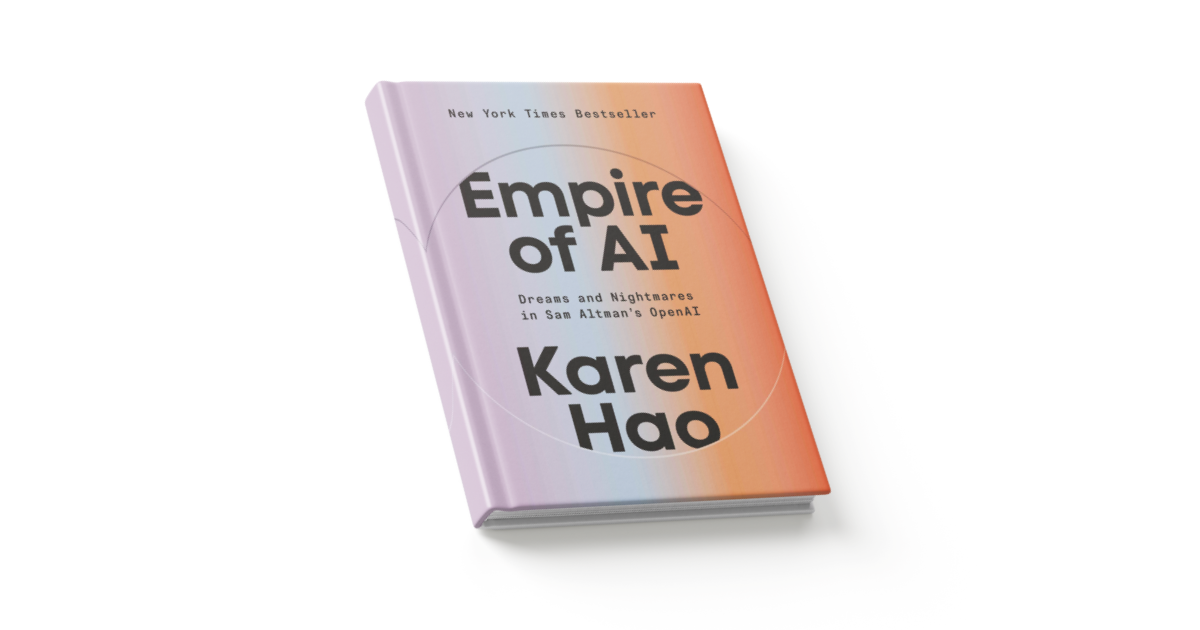
Empire of AI: Dreams and Nightmares in Sam Altman’s OpenAI
Karen Hao
Penguin Books
May 2026
496 pages
ISBN: 978-1802064650
Empire of AI was one of the most discussed books of 2025, largely because it focused on one of the most discussed topics—artificial intelligence—and on the organisation which created ChatGPT, OpenAI. The author, Karen Hao, is a journalist who has spent years reporting on AI and related issues, and she is well placed to shine a light on the goings-on within OpenAI, whose CEO, Sam Altman, is at the heart of this account. Hao describes Empire of AI not as a corporate book focused on one entity, but as “a prism through which to see far beyond,” and as “a meditation on power.”
OpenAI was founded a decade ago as a non-profit ostensibly focused on ensuring that all humanity would benefit from artificial general intelligence (AGI). The power struggle which ensued between Altman and his fellow co-chair, Elon Musk, is a major focus of the book, but not one of its more interesting elements. Hao believes that the initial benefits of AGI mask a dark reality hidden underneath. “Under the hood, generative AI models are monstrosities, built from consuming previously unfathomable amounts of data, labour, computing power, and natural resources,” she writes. “GPT-4, the successor to the first ChatGPT, is, by one measure, reportedly over fifteen thousand times larger than its first generation, GPT-1, released five years earlier. The exploding human and material costs are settling onto wide swaths of society, especially the most vulnerable—people I met around the world, whether workers and rural residents in the Global North or impoverished communities in the Global South—all suffering new degrees of precarity.”
While the evolution of AI has major ramifications for all of society, its development remains a matter mostly for private entities, with Hao citing figures showing that corporate investment in the area rose from $14.6 billion in 2013 to $235 billion by 2022. In contrast, the US government spent just $1.5 billion on non-defence AI development in 2021, with the European Commission spending less. In this context, it is important to look more closely at the leading businesspeople who are driving this revolution forward.
Sam Altman is presented in a strikingly unsavoury light here. As well as questioning his motivations more generally, Hao suggests that his noticeably low salary as CEO is something of a smokescreen for the vast wealth he has acquired at the helm. She focuses attention on his lavish lifestyle—the collection of sports cars, the use of a private jet—as well as the allegations of child sexual abuse levelled against him by his clearly troubled younger sister. When it comes to the financial issue, given the world in which Altman moves, it seems unreasonable to criticise him for enjoying the fruits of his success. That being said, there is clearly something deeply distasteful about how the Big Tech oligarchy’s exorbitant wealth coexists with dire poverty, and San Francisco is the worst possible advertisement for what this sector has become.
Hao describes her own experiences working there as a young professional, when she would pass by homeless addicts shooting up on the way to an office where a “happiness engineer” was employed to provide free lunches. Well-paid twenty-somethings worked long into the night on cutting-edge projects, while being told by their employers that the only way to get home safely after dark was to use an Uber. A similar dynamic exists in Dublin and in other cities where the industry is concentrated, and though it is not an area that Hao chooses to explore, hyper-wealthy industry leaders have chosen to advance socially liberal causes at least in part to distract from the harsh realities around them.
More serious than this is the impact which AI has had around the world, in places where the truth is more easily hidden than in Silicon Valley. “‘Digital’ technologies do not just exist digitally,” Hao reminds us. “The ‘cloud’ does not in fact take the ethereal form its name invokes. To train and serve up AI models requires tangible, physical data centres. And to train and run the kind of generative AI models that OpenAI pioneered requires more and larger data centres than ever before.” ChatGPT’s development has increased pressure on the environment, as dealing with each query it is given requires ten times more electricity than is used in a typical Google search. Hao examines what this has meant in practical terms, including when it comes to the growth of extractive industries in places like Chile, which provide the resources needed to allow the industry to function.
This is an important topic within the broader discussion, but again Hao’s critique appears too harsh. There is no “zero-impact” industry, and a book on electric vehicles or wind turbines could include similar information about unedifying aspects of the production system. A one-sided condemnation of AI on these grounds is unreasonable. Well versed in Woke dialect and dogma, the author claims that some generative AI models promote discriminatory content or perpetuate stereotypes, as when the inputting of the word “housekeepers” leads to black or brown people being presented. Perhaps this is the case, but others who use image generators experience different issues, including what appears to be a deliberate underemphasis on traditional family structures.
When Google released Gemini (their equivalent of ChatGPT) in 2024, the in-built left-wing bias was so obvious, and the lampooning so severe, that Google had to pause development of the tool. If AI is becoming political, managing this—and not bogus claims of stereotyping—will become a real challenge. Hao begins her book by including a remarkable quote from Sam Altman himself, who once reflected that the most successful entrepreneurs appear to be “on a mission to create something closer to a religion.”
It is easy to see why. Until a few years ago, the captains of industry in Big Tech were being heralded as godlike figures in politics and popular culture alike. The hatred which exists for Elon Musk today (on account of his previous support for Donald Trump) sits uneasily with the adulation he had previously received. Musk and his estranged business partner have more than a few things in common, even if they differ on political and social issues. At one point, Hao casually notes that Altman is “a casual user of ketamine, a party drug that can be legally prescribed to relieve depression,” and one which Musk is known to rely on heavily.
The fact that billionaires with significant power over humanity’s future need to drug themselves just to function is not encouraging, nor is a great deal else contained in these pages. Karen Hao is not fair-minded, and her book has many deficiencies which will prevent it from ever being regarded as a classic. She has done significant journalistic legwork, though, and others should follow in her footsteps. AI is too important to look the other way.