
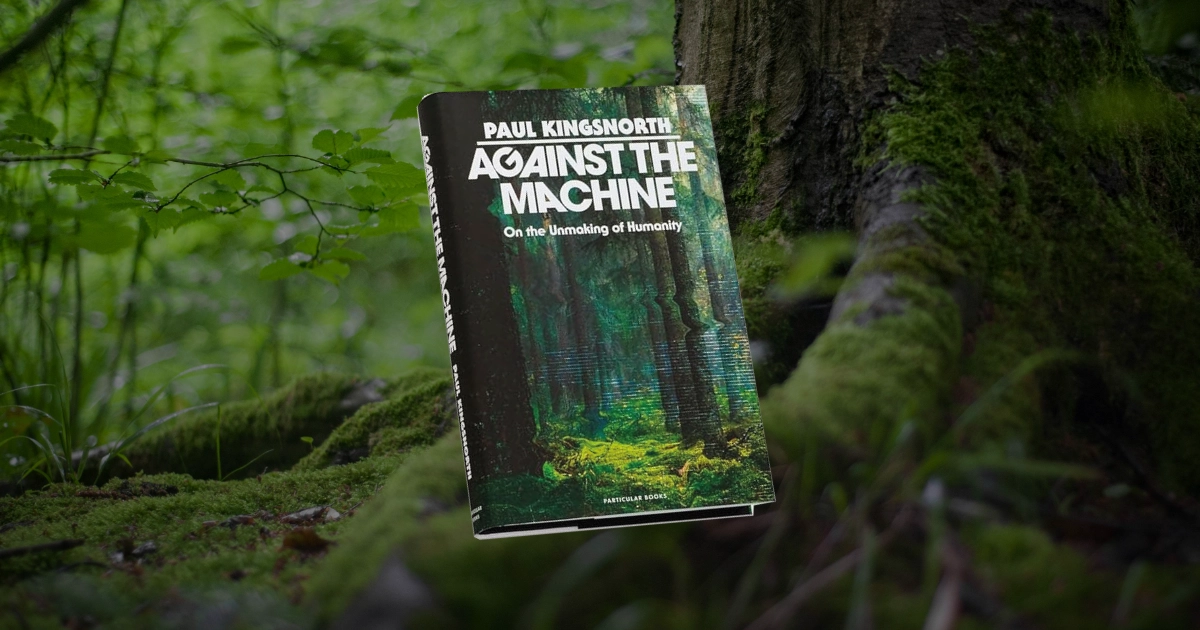
Against the Machine: On the Unmaking of Humanity
Paul Kingsnorth
Particular Books
September 2025
368 pages
ISBN: 978-0241788400
“Machine with the strength of a hundred men
Can’t feed and clothe my children
Can’t greet a sailor coming in
Or know of desperation.”
These words come from “Rock the Machine,” released in 2018 by Cavan-born Lisa O’Neill on her album Heard a Long Gone Song. O’Neill writes of the thousands of Dublin dock workers whose labour was consumed by the rapid industrialisation of Dublin’s harbour in the ’60s, ’70s and ’80s. The dockers are represented by diving cormorants, golden light on the Liffey, where the machines seem a malevolent, parasitic force – efficient, ruthless, and thoroughly inhuman. “I miss the graft, I miss the boys,” she sings, embodying the worker powerless before the tide of mechanised efficiency. “I plead for purpose in the void.”
Kingsnorth writes of this same force in his latest book, Against the Machine. He’s been writing about it since 2021 on his Substack, and really he’s been obsessed with it his whole career. The Machine, for Kingsnorth, is a unified theory of the spiritual affliction of the West. It is modernity and “progress.” It is globalism and consumer capitalism and scientific materialism, neoliberalism and post-modernism, transgenderism, scientism and New Atheism. It is a “sacrilegious treatment of a sacred world.” It’s the place we all live, and Kingsnorth has had enough of it.
A former environmental activist, Kingsnorth has written ten books, including three novels and two collections of poetry. A self-described “reactionary radical,” he has long been hard to confine to one side of the culture war or the other. About ten years ago he packed up and moved his family from the UK to rural County Galway, where he started a smallholding. He was subsequently outraged by the national (and global) response to the Covid-19 pandemic and wrote extensively on what he saw as the authoritarian nature of the lockdowns, vaccine passports, and generally high level of surveillance to which Irish citizens were subjected. In 2021, he converted to Romanian Orthodoxy, and the foundations of Against the Machine were firmly laid.
Technology is probably the most obvious manifestation of what Kingsnorth calls the Machine. Scepticism of modern technologies and their impact is becoming slowly more mainstream in cultural discourse, such as with Jonathan Haidt’s excellent and well-received The Anxious Generation, but it would be unhelpful to view Kingsnorth as part of this trend. While there is a growing recognition that perhaps American adults shouldn’t spend five hours a day on their smartphone (and perhaps children should not have ready access to violent pornography, and perhaps cheerfully training potentially world-ending AI systems might not actually be for the public good), Kingsnorth has long adopted a far more trenchant and principled position. He won’t use a smartphone, resents his lawnmower, detests driving. He has a compost toilet. He uses a scythe. He is an old-fashioned, unapologetic Romantic, and his views as a result can seem quite radical. Technology, he claims, is not neutral. Neither is science or the scientific method. Neither is the modern nation-state. This may take some digesting.
The effects of globalisation and its effect on small communities and individual cultures around the world has long interested Kingsnorth, and he has written extensively on the topic. He is scornful of it and the bland, homogeneous anti-culture it has spread across the globe. This is how the Machine spreads; not through wars of conquest but through “international development.” The most striking example given is the arrival of the “Black Ships” into Edo’s harbour in 1853, American trading vessels which docked and demanded that the Japanese do business. The Japanese, who had closed their borders to the world more than two hundred years previously, told them to get lost. The Americans responded that they would be happy to leave and return with warships in the springtime. The Japanese opted to trade.
The environmental impact of global capitalism is described in vivid detail, but again it’s important to understand how radical a stance Kingsnorth takes. It’s not that huge corporations are unwilling to lessen their environmental impact – it’s that they can’t. They are part of an intrinsically unsustainable system which can never be anything other than devastating to the natural world. Much of our waste, he explains, is shipped to less affluent countries for them to attempt to deal with, countries where production of most of our goods is already taking place, ready to be shipped right back to us. Kingsnorth wonders at the human impact on those of us who get the better end of this bargain, living in a society predicated on “boundless economic growth via boundless sensory stimulation.” We are no longer humans, but “consumers.” As to how we might deal with this? Small is beautiful, he insists, and searching for technological solutions to problems created by technology is pointless, because the problem is, in fact, spiritual.
“The West […] was Christendom. But Christendom died.” Against the Machine is not optimistic about its chances of recovery. Kingsnorth describes the “Machine culture” which has replaced Christendom as a “culture of inversion,” compartmentalising and cannibalising itself ad infinitum. To explain the kind of thinking which might have produced this culture, he draws on British neuroscientist Iain McGilchrist. McGilchrist discovered that the left and right hemispheres of the brain have very different functions, and in some sense operate independently of each other. The left hemisphere manipulates, isolates, fragments – it is concerned with detail. The right hemisphere is concerned with understanding, with the whole picture, with ambiguity, complexity and narrative. McGilchrist claims that the emphasis we in the West have placed on left-brain thinking is catastrophic in its consequences, and unprecedented in any culture in history. Kingsnorth explores this, recounting the fascinating detail that Western modernist art “often looks like the kind of representation of the world that is produced by people who have suffered brain damage to the right hemisphere.”
What might a brain-damaged culture look like? It may be a culture which produces the transgender craze of the last ten years, something Kingsnorth describes as “the latest manifestation of a long struggle for technological liberation from nature itself, symbolised by the limits of human biology.” It may manifest as a mass disowning of a nation’s past, as evidenced by the revolutionary calendar of the French Revolution beginning at Year I. It may be a culture in which two of the opposing armies in the “culture war” are animated by the same force: “progressive leftism and corporate capitalism” are, Kingsnorth claims, “variants of the same modern ideal, built around the pursuit of boundless self-creation in a post-natural world.” At every stage, Against the Machine attempts to take the broadest, most interdisciplinary view of the problem, and this scope is its great strength.
It is also its main weakness. Everything mentioned so far is addressed in a brisk and bracing 300 pages, and much is explored besides. The sheer radicalness of his assertions demands extensive, detailed support, and there simply isn’t time. In that sense the work is an uneven one, a slight lack of coherence and completeness the inevitable result of its sweeping range of ideas. Those who have followed Kingsnorth’s previous works of non-fiction may benefit from the context and expanded thinking they provide. Those unfamiliar with it may struggle.
But despite its scale, the book always prioritises the human experience over numbers. Technology and capitalism have made us comfortable, yes, more prosperous, undoubtedly – but so what? How have they enriched us spiritually? How does high-speed broadband draw us closer to God? How has Amazon made us better fathers, mothers, spouses? We are used to debating discrete ideas within an agreed framework of discussion, but Kingsnorth takes a long step back and uses the widest possible lens to challenge our assumptions about everything we think matters. There is no shadowy conspiracy here, no freemasons meeting in catacombs. The Machine is a kind of terrible metaphysical phenomenon, a spiritual malaise made manifest in every facet of modern life. It has a telos of its own. It is the expulsion from the Garden, again and again and again.
But this focus on imagery, poetry and gut instinct, this disdain for statistics and “rationality,” makes it challenging to know on which terms to assess the book. The presentation is reasonably academic, but is it too “left-brain” of an approach to critique it accordingly? For instance, when he claims that the direction of science is fundamentally negative and dehumanising, it is an almost impossible assertion to grapple with, because it is so huge that it requires its own standalone book (or books) to unpack. Yet when Kingsnorth quotes Richard Dawkins, who describes a monkey as “a machine which preserves genes up trees,” we can see that this is a most bizarre way of seeing the world. We know this to be true. We feel it.
Like a song or sonnet, this might be the best way to approach the work: hearing the music, not reading the notes. Despite certain misgivings I may have had about the scope and coherence of Against the Machine, there is something vigorous and organic about it. It is a literary analysis of the malaise of the world, capturing the stench and din, the broad curvature of its planes and edges. You could quibble with any one detail and risk missing the point. To listen to Lisa O’Neill’s song is to be a docker facing down the encroaching machine. To read this book is to realise that you were a docker all along, that we all are.
Kingsnorth wrote that he is now finished with the Machine, having said all he has to say. I hope this is not the case. Against the Machine, with its tortured central metaphor, is an imperfect, unfinished and vital contribution to the world of ideas. Ten or fifteen years from now, we might hope for a follow-up, assuming there’s anyone other than AI left to read it. Until then, Kingsnorth suggests we start where we are, and work with what we have. It is all we can do. Kingsnorth’s final suggestion “amidst the rise of robots, amidst the ascendancy of all these tiny, laughable, tyrannical dreams” is to “raindance on the astroturf.”
It’s surely worth a go.