
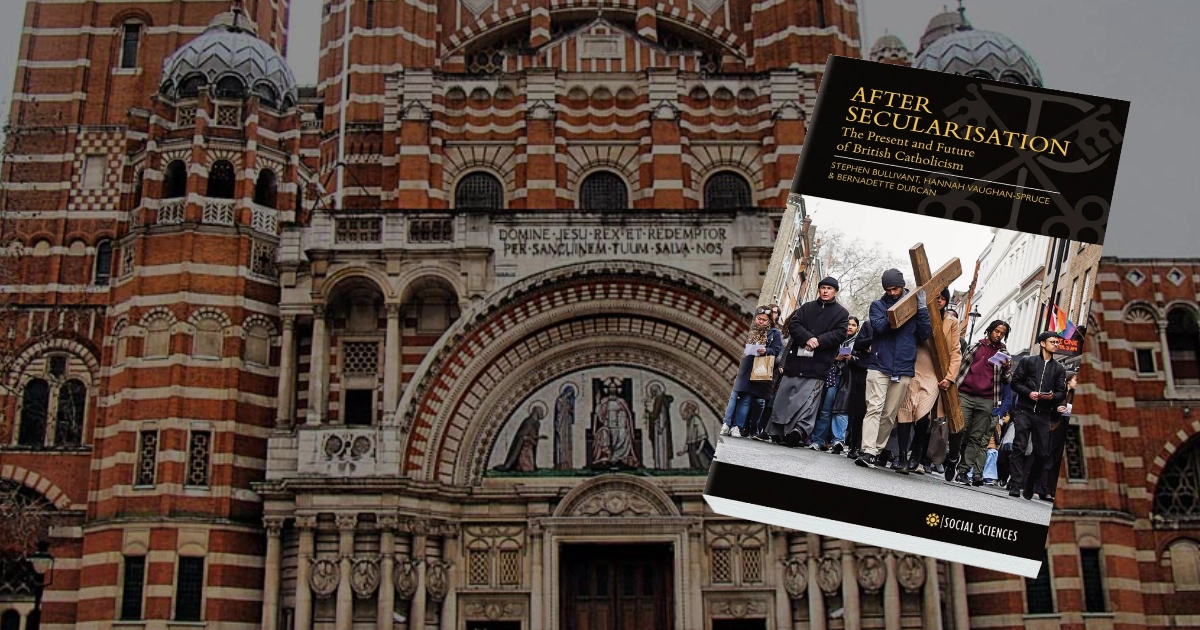
After Secularisation: The Present and Future of British Catholicism
Stephen Bullivant, Hannah Vaughan-Spruce, and Bernadette Durcan
Catholic Truth Society (CTS)
Aug., 2025
184 pages
ISBN-13: 978-1784698539
After Secularisation: The Present and Future of British Catholicism is the latest book by the brilliant sociologist of religion, Professor Stephen Bullivant (author of Mass Exodus, Nonverts, and other important works). On this occasion, Bullivant writes in partnership with Hannah Vaughan-Spruce (Executive Director of Global Mission at Divine Renovation) and Bernadette Durcan (PhD candidate with the Benedict XVI Centre at St. Mary’s University). Unsurprisingly, this is partly a story of decline. Fewer than 600,000 people attend Mass on a typical Sunday in Britain now—down more than 50 per cent compared to attendance figures at the turn of the millennium. The damage done by the Covid restrictions has not been repaired, and bishops are embarking on painful processes involving parish closures or amalgamations. Yet the authors also present good news about what appears to be a nascent religious revival, as when the 3,000-person capacity Westminster Cathedral had to turn worshippers away on Good Friday 2024. Recent Bible Society research has sparked much interest in the upsurge in church attendance among young Britons, and Bullivant et al. point to various examples of flourishing communities. The book’s title is deliberately provocative, but not unrealistically so. Secularisation, they write, is a process which will run its course, and they make two key predictions: “a) Catholic decline will definitely not continue ‘down to zero,’ but before long will bottom out; and then b) from a fairly solid base, it will start to grow again, if gradually.” They cite key findings showing that Catholics between the ages of 18–44 are more religiously committed than those aged 45 or older, being more likely to attend Mass and affirm key dogmatic teachings. In short, the community has shrunk and cultural Catholicism is fading, but the end is not nigh: “The young Catholics remaining in the pews might be smaller in number, but they are stronger in energy, commitment and zeal.”
A book that begins with an account of a visit to a massive Catholic gathering in the West Midlands is peppered with insights into how successful Church communities develop in today’s secular era. Perhaps the most important of these (and one which is directly relevant to Ireland and other post-Catholic societies) is that “the importance of ‘geographic’ territory is waning to the advantage of ‘existential’ territory.” Some London parishes are booming, as Catholics travel from across that vast city to find a spiritual home, yet other parishes are not doing well at all. The infrastructure in today’s Church dates back to an era where there were far more practising Catholics in need of churches and schools. In Ireland and elsewhere, it also tended to predate widespread car ownership. There is no point in trying to force people to attend the parish nearest to them if they would rather go elsewhere: as the authors put it, “in a post-Christian, heterogenous, pluralist society, the ‘geographic’ mindset attempts the impossible.” Both for Britain, with its 2,500 canonical parishes, and Ireland, with its 1,300 parishes, surely it would be better to concentrate resources on a much smaller number of large religious centres, where the presence of a critical mass of people would allow for more formation and activity? The Church in Britain appears to be far ahead of its Irish equivalent in preparing for the new reality.
Another important shift the authors point to is that many of the vibrant movements and initiatives in the British Church are national ones with a national reach. To build upon this progress, they call for increased financial resources to be channelled into these efforts. In an unchurched society with many empty pews, the parish is often simply not big enough to accomplish its mission. Professor Vincent Twomey highlighted the need for larger dioceses equipped with “supra-parochial structures” like conference centres in The End of Irish Catholicism (2003), but his wise words were not heeded then or since. Many of the big decisions in Ireland relate to school patronage and sacramental preparations. It is worth bearing in mind then the evidence cited here showing that attendance at “Catholic schools has little to no independent influence over adult religiosity.” It is still worth defending Catholic education as a general offering to wider society, but there is no point conflating the future of nominally Catholic schools with the future of Catholicism writ large.
Once again, Bullivant, Vaughan-Spruce, and Durcan point to other remarkable work already being done in Britain. One interlocutor describes how her London parish ended its school-based sacramental programme and instead adopted the Growing in Faith Together (GIFT) family catechesis programme, in which the whole family takes part each month, with parents-only sessions also included. Another interviewee in a different parish in the capital describes how teenagers are prepared for the Sacrament of Confirmation through a three-year discipleship process, while noting that the change has resulted in an 80 per cent retention rate post-Confirmation. The introduction of similar programmes in Ireland could result in a mass exodus of non-believing parents, but would that be an entirely bad thing in a country where the shallowest form of cultural Catholicism has often turned the Sacraments into grotesque affairs focused on the needless spending (by guilty parents) and raising (by innocent children) of money?
Some parts of After Secularisation make for less essential reading. An entire chapter on the Latin Mass and related issues feels excessive, given that the authors write that just 3,000–4,000 Britons attend Mass in the Extraordinary Form each Sunday. The authors do make the fair point that traditionalist communities contribute a disproportionate number of vocations, but it is hard to escape the feeling that the controversy over the Latin Mass occupies too much mental energy in the conservative quarters of today’s Church. College chaplaincies are also examined at length, and with good reason. But as Britain (like Ireland and other countries) is increasingly looking to promote apprenticeships, we should ask what is being done to engage with the working class, given the international evidence that rates of religious practice are often lower there. A chapter examining the class dimension of British Catholicism in greater detail would have added to this impressive book. Where stands the Church in the post-industrial regions where people are most alienated from the London-based elite?
There is much in After Secularisation for a reader to draw encouragement from, but we should not be too optimistic. The scale of secularisation is extraordinary. A full 70 per cent of Britons between the ages of 16–29 have no religion. The damage which this absence of faith will do is incalculable, and we are seeing some of the costs already in terms of social dysfunction, family disintegration, and the rise of secular ideologies as lost souls search for meaning. Here too, the authors find cause for hope, as they argue that an entirely unchurched generation has not been exposed to “weak or dead strains of Christianity” which tend to immunise them against faith. “Past a certain point of secularising, however, then feasibly this will no longer be the case. At such a time people may find it easier to encounter the good news as something genuinely new,” they write.
Of all the points made in this stimulating book, this one likely has the most relevance to an Irish Catholic audience. The emerging generation has no memory of Catholic Ireland at all, save for the lurid falsehoods presented in artistic depictions such as Small Things like These. There are already signs that many young minds have the right questioning spirit, and are seeking answers. The religious revival occurring elsewhere will surely occur here too. If the Church has the courage to be distinctive, and the wisdom to adopt structures suited to today’s needs, the period after secularisation can be looked forward to with optimism.